When to go to Auvergne?
→ The detailed month-by-month page, with real weather records
Best time: May to September
At a glance
Why go to Auvergne?
The Auvergne is the largest volcanic area in Europe, and you see it as soon as you leave Clermont-Ferrand: the Chaîne des Puys raises its 80 green cones over 45 kilometres, an alignment so singular that it has been a UNESCO World Heritage Site since 2018. Hiking on these dormant volcanoes gives a rare sensation: the perfect crater of the Puy de Pariou, the lava domes of the Puy de Dôme, flows frozen for 8,000 years. No other French landscape looks anything like it.
It is also a destination that remains authentic and affordable. Medieval villages such as Salers and Besse have kept their dark lava stone and their stone-slab roofs, the summer pasture farms still produce saint-nectaire, cantal and salers using age-old methods, and prices, for accommodation and food alike, are among the gentlest in France. You can travel well here on €70 a day.
Above all, the Auvergne is a vast four-season playground: hiking and paragliding from the Puy de Dôme in summer, swimming in volcanic lakes such as Pavin or Chambon, mountain biking in the Sancy, family skiing at Super Besse in winter. Add Vulcania for the children and the thermal waters of Le Mont-Dore, and you have a complete destination, less than 4 hours from Paris.
Map of Auvergne: what is where?
The map shows the 6 places covered in this guide, to picture the distances and plan your route.
- Puy de Dôme
- Puy Mary
- Vulcania
- Salers
- Lake Pavin
- Le Puy-en-Velay
How much does a trip to Auvergne cost?
The Auvergne is one of the cheapest regions in France to travel in. The main expense remains the hire car and fuel.
| Style | Per day | What it covers |
|---|---|---|
| Backpacker | €50-70/day | Camping or hostel, picnics, free hikes, the occasional paid visit |
| Comfort | €90-140/day | B&B or 3-star hotel, restaurants in the evening, Vulcania and the Puy de Dôme train |
| Premium | €180+/day | Boutique hotels or lodge, fine dining, tandem paragliding and a thermal spa at Le Mont-Dore |
Cards accepted everywhere, but keep a little cash for markets and summer pasture farms.
Is Auvergne safe?
The Auvergne is a very safe destination, with no notable risks beyond those of the mid-mountains. The weather changes quickly on the summits, even in summer: take a warm layer and a windproof for the Puy de Dôme, the Sancy and the Puy Mary, and check the forecast before any hike. In winter, fit the car with snow tyres, as the mountain law applies in most communes. Swimming in the volcanic lakes is done in the lifeguarded zones in season.
What to see and do in Auvergne
- Puy de Dôme
- Puy Mary
- Vulcania
- Salers village
- Lake Pavin
- Clermont-Ferrand
- Saint-Nectaire
- Le Puy-en-Velay
Puy de Dôme
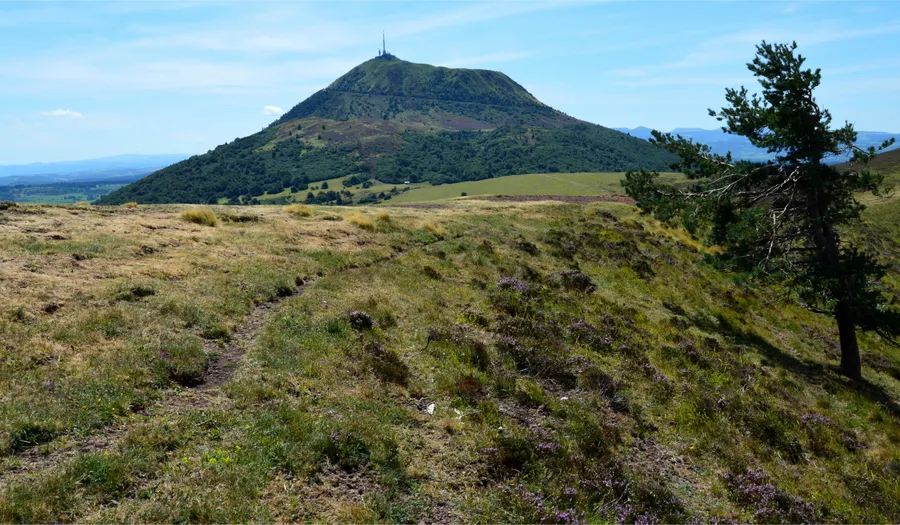
The emblematic summit of the Chaîne des Puys, the Puy de Dôme rises to 1,465 metres and offers a 360-degree panorama over dozens of volcanoes. You can ride up in 15 minutes on the Panoramique des Dômes rack railway, or walk the Chemin des Muletiers in 45 minutes of steady climbing. At the top, the remains of the Gallo-Roman temple of Mercury come as a surprise, as does the constant ballet of paragliders. At sunset, the low light over the craters is unforgettable.
Puy Mary

A Grand Site de France in the heart of the Cantal mountains, the Puy Mary is the perfect pyramid left by the largest stratovolcano in Europe. From the Pas de Peyrol, the highest road pass in the Massif Central at 1,588 metres, a staircase path leads to the summit in 30 minutes. The view plunges into the star-shaped glacial valleys of the Jordanne and the Mars. The corniche access roads rank among the most beautiful in France.
Vulcania

This theme park, unique in Europe, is entirely devoted to volcanoes and natural phenomena. Built partly underground in the middle of the Chaîne des Puys, it combines dynamic rides, immersive films and simulators, including the excellent Premier Envol balloon flight over the puys. The science content is serious without being dull, making it an ideal family day out. Allow a full day to see everything.
Salers village

Listed among the Most Beautiful Villages of France, Salers lines up its black lava houses and stone-slab roofs at 950 metres above sea level, facing the Cantal mountains. The Grande Place, framed by turreted mansions from the 15th and 16th centuries, looks like a film set. It is also the home of the Salers cattle breed and of a powerful cheese made only on the summer pastures. Try truffade and Carré de Salers, the local gentian liqueur, on the spot.
Lake Pavin

This almost perfectly circular crater lake is the youngest volcano in mainland France, formed around 7,000 years ago. Its dark blue waters reach 92 metres deep, which feeds many local legends. The shaded walk around the lake, beneath the beech trees, takes a little under an hour of easy walking. Combine it with the neighbouring village of Besse and the summit of the Puy de Montchal, which overlooks it.
Le Puy-en-Velay

The historic starting point of the Way of St James, Le Puy-en-Velay is an astonishing town set on volcanic pinnacles. The Saint-Michel d'Aiguilhe chapel crowns an 82-metre volcanic plug reached by 268 steps, the statue of Notre-Dame de France watches over the town from the Rocher Corneille, and the Romanesque cathedral is UNESCO-listed. Add AOP green lentils and lace, and you have a stop in its own right.
How many days, and which itinerary?
Allow 5 to 7 days to combine the Chaîne des Puys, the Sancy massif and the Cantal mountains without rushing.
🗺️ Day-by-day itinerary · 📓 Free printable Auvergne guide (PDF) · 🌍 All of France
Volcano essentials (4 days)
Two days around Clermont-Ferrand with the climb up the Puy de Dôme, the Puy de Pariou and Vulcania. Then two days in the Sancy: Lake Pavin, Besse, Saint-Nectaire and the cable car up the Puy de Sancy.
The great crossing (7 days)
Clermont-Ferrand and the Chaîne des Puys, the Sancy massif and its lakes, then down to the Cantal via Salers and the Puy Mary. A gourmet finale in Aurillac, or a detour to Le Puy-en-Velay for its volcanic pinnacles.
Auvergne with the family (5 days)
Vulcania and the Panoramique des Dômes to open, a swim in Lac Chambon, a visit to the Petrifying Fountains of Saint-Nectaire and cheese farms. A gentle pace, short hikes and stopover villages such as Orcival and Besse.
Getting there and getting around
A car is essential: the volcanic sites are scattered and poorly served by public transport.
Direct train Paris-Clermont-Ferrand in about 3h30 (Intercités), then car hire on arrival from €35/day.
The Panoramique des Dômes (rack railway) runs up the Puy de Dôme all year, handy with children.
Mountain roads in the Cantal: allow generous journey times, and the Pas de Peyrol pass is closed in winter.
Where to stay in Auvergne?
Characterful B&Bs in the villages (Orcival, Besse, Salers): €70-100 for a double with breakfast.
3-star hotels in Clermont-Ferrand or Le Mont-Dore: €80-130 a night.
Family campsites by the lakes (Chambon, Aydat): €20-35 per pitch, mobile homes from €60.
Restored burons (shepherds' huts) and nature lodges in the Cantal for an unusual night: €120-180.
Our places to stay, stop by stop, at three budgets →
What to eat in Auvergne?
Truffade and aligot: potatoes and fresh tomme cheese, the signature dishes to try in a summer-pasture buron.
A board of the 5 AOP cheeses: saint-nectaire, cantal, salers, fourme d'Ambert and bleu d'Auvergne.
Potée auvergnate and stuffed cabbage in village inns, hearty and rarely over €18.
AOP Puy green lentils and bilberry pastries in the Velay and the Sancy.
Entry requirements
Schengen area: an ID card or passport for EU citizens, 90 days visa-free for UK, US, Canadian and Australian passports.
Rules change: check your own government's travel advice before you go.
Frequently asked questions about Auvergne
When is the best time to visit the Auvergne?
From May to September for hiking on the volcanoes, with June and September the pick to avoid the summer crowds. Winter has its charm too, with family skiing at Super Besse and Le Mont-Dore.
What daily budget should I plan for?
Around €60 to €100 a day per person for a reasonably comfortable trip, including accommodation, meals and visits. Hikers who camp get by on €50.
How do I get around?
By car, which is all but essential. Trains serve Clermont-Ferrand, Le Mont-Dore and Le Puy-en-Velay, but the volcanic sites require a vehicle or the limited seasonal shuttles.
How many days do I need?
4 days are enough for the Chaîne des Puys and the Sancy; a week lets you add the Cantal with Salers and the Puy Mary without rushing.
Is the Auvergne suitable for children?
Yes, it is actually an ideal family destination: Vulcania, the Puy de Dôme train, the lifeguarded beaches of Lac Chambon and plenty of short hikes around the craters.
Similar destinations
 Region
🇫🇷 The Jura
 Region
🇫🇷 The French Basque Country
 Region
🇫🇷 The French Ardennes
 Region
🇫🇷 The Vosges
 Region
🇫🇷 The Cévennes
 Region
🇫🇷 The Tarn Gorges
.JPG/1280px-Lac_de_Nantua_et_Nantua_(Ain).JPG) Region
Region🇫🇷 Haut-Bugey
 Region
🇫🇷 The Mercantour
 Region
🇫🇷 The Monts du Lyonnais
.jpg/1280px-Sundgau_(7710016240).jpg) Region
Region