
Best time to travel in the French Basque Country?
→ The detailed month-by-month page, with 2015-2024 averages
Best time: May to October (June and September ideal)
Best avoided if possible: December to March (less pleasant weather or big crowds).
Temperatures and rainfall modelled for Biarritz · averages over recent years, Open-Meteo data (ERA5 reanalysis).
A mild oceanic climate: summers tempered by the ocean and showers possible all year, which keep the hills green. The best time to visit the Basque Country is May, June, July, August, September and October, with temperatures reaching 24-27°C (summer). Conversely, January, February, March, April, November and December are generally less favourable (less pleasant weather or heavy crowds, depending on the destination), although a trip is still possible with some planning. In high season, book early: prices and visitor numbers climb fast.
Go against the flow. To avoid the crowds without sacrificing too much on the weather, aim for April and November: the crowds thin out, prices drop too, and the climate stays pleasant.
Do these months appeal to you? See what's best elsewhere too: where to go in May · where to go in June · where to go in July · where to go in August · where to go in September · where to go in October.
At a glance
Why go to the French Basque Country?
Few French destinations offer such a density of experiences along 40 km of coast. Biarritz, a former imperial resort turned European surf capital, lines up Belle Époque villas and legendary breaks. Saint-Jean-de-Luz, sheltered by its enclosed bay, has the charm of a fishing port with its shipowners' houses. Bayonne, the cultural capital, keeps its Vauban ramparts, its cathedral and its chocolate.
The hinterland is the other half of the story. Twenty minutes from the coast, the Labourd villages of Espelette, Ainhoa and Sare line up white façades with ox-blood red timbering at the foot of La Rhune, the Basques' sacred mountain, climbed by a century-old rack railway. The hiking trails here cross paths with free-roaming pottoks, griffon vultures and summer shepherds' huts.
Above all, there is Basque culture itself, very much alive: pelota matches at the village fronton, the Fêtes de Bayonne in July, polyphonic singing and a cuisine that runs from pintxos to Michelin stars. Between veal axoa, ossau-iraty with Espelette pepper and gâteau basque, you soon understand why the region claims some of the best food in France.
Tourist map of the French Basque Country: what's where?
The map below pinpoints the 6 places covered in this guide: a handy way to picture the distances between each stop and plan your route in the French Basque Country.
- Biarritz
- Saint-Jean-de-Luz
- Bayonne
- La Rhune
- Espelette
- Ainhoa
How much does a trip to the French Basque Country cost in 2026? Budget calculator
Estimate your budget for the French Basque Country based on your travel style: accommodation, meals, activities and local transport included (flights excluded). Adjust the length and the number of travellers, and the totals update.
Totals for all travellers over the chosen length; the daily amount is per person. Flights extra, indicative amounts to adjust depending on the season.
Cards accepted everywhere; a little cash for markets, pelota courts and the Spanish ventas.
Safety in the French Basque Country: should you be worried?
The Basque Country is very safe. The real things to watch are natural: baïnes (rip channels) and strong ocean currents mean you should swim in lifeguarded zones, and the swell makes some beaches dangerous out of season. In the mountains, the weather turns quickly on La Rhune, so take a warm layer even in summer. During the Fêtes de Bayonne, keep an eye on your belongings in the crowds.
Things to see and do in the French Basque Country
Our first-hand favourites, and the great classics:
- Grande Plage in Biarritz
- Rocher de la Vierge
- Côte des Basques
- Saint-Jean-de-Luz bay
- La Rhune train
- Espelette village
- Old Bayonne
- Ainhoa
What to book before you go to the French Basque Country →
🧭 Discover the French Basque Country itinerary, day by dayMap, timings, budget and where to stay: free to access, to fit your dates. Create my tailor-made itinerary →Biarritz
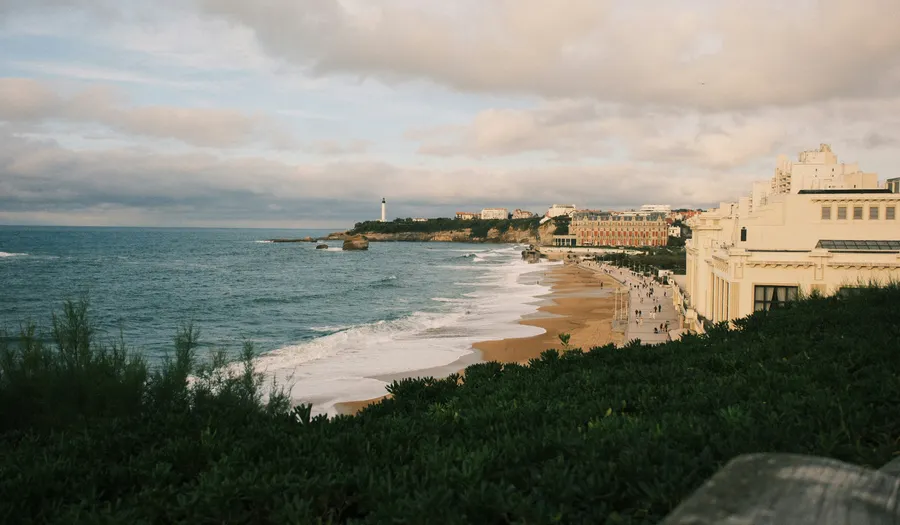
Empress Eugénie's former seaside resort has kept its palace hotels and its Rocher de la Vierge, but today it lives to the rhythm of surfing. The Grande Plage concentrates the action in front of the Art Deco casino, while the Côte des Basques draws longboarders from all over the world. The Port des Pêcheurs and its crampottes (fishermen's huts) serve grilled sardines right by the water. Wander through Les Halles in the morning to take the pulse of the town. Allow two days to see it all at an easy pace.
Read the full guide: Biarritz →
Saint-Jean-de-Luz

In its bay enclosed by three sea walls, Saint-Jean-de-Luz has the most family-friendly beach on the Basque coast. Louis XIV married here in 1660 in the Church of Saint-Jean-Baptiste, whose gilded altarpiece is one of the finest in France. Rue Gambetta lines up Basque linen, espadrilles and gâteau basque from Maison Adam, an institution since 1660 as well. The fishing port still lands tuna and hake. The walk out to the Pointe de Sainte-Barbe opens up a superb view over the bay.
Bayonne

The historic capital of the northern Basque Country, Bayonne is best discovered along the quays of the Nive, between tall half-timbered houses and food halls. Sainte-Marie Cathedral and its Gothic cloister dominate Grand Bayonne, while Petit Bayonne concentrates pintxo bars and the Basque Museum. The town has been France's chocolate capital since the 17th century; taste it at Cazenave under the arcades. Bayonne ham can be sampled at the market hall. In late July, the Fêtes de Bayonne dress the town in white and red for five days.
La Rhune

The emblematic summit of the Labourd at 905 metres, La Rhune has been climbed since 1924 aboard a wooden rack railway leaving from the Col de Saint-Ignace. In 35 minutes it climbs through heathland and herds of pottoks, the small semi-wild Basque horses. At the top, the panorama takes in the ocean, the Spanish coast and the Pyrenees range. Strong walkers can hike back down in two hours to Sare or Ascain. Booking is essential in summer, as the train is full days in advance.
Espelette

The most famous village in the Labourd owes its fame to its AOP pepper, whose red garlands dry on the white façades from late summer. The main street strings together producers, Basque linen workshops and chocolatiers, with the church and its cemetery of disc-shaped headstones as a counterpoint. The Pepper Festival, in late October, draws thousands of visitors. It is the perfect stop between the coast and the villages of Sare and Ainhoa. Try the hot chocolate with pepper at Antton.
Ainhoa and Sare

Listed among the most beautiful villages in France, Ainhoa and Sare embody Labourd architecture in its purest form: a 13th-century street-village bastide for one, scattered hamlets at the foot of La Rhune for the other. Ainhoa lines up its red-and-white houses along a single street, a former stage on the Way of St James. Sare hides the prehistoric Lezea caves and smugglers' paths into Spain. Both villages have excellent inn restaurants. In a day by car, you can combine them with Espelette.
How many days, and which itinerary in the French Basque Country?
Allow 5 days to balance the coast with the inland villages, a week to add hiking and a trip to San Sebastián.
🗺️ Day-by-day French Basque Country itinerary · 📓 Printable French Basque Country travel guide (PDF) · 🌍 Discover all of France
Coast express (3 days)
A day in Biarritz between the Grande Plage, the Rocher de la Vierge and the market hall, a day in Saint-Jean-de-Luz with a swim in the bay, a day in Bayonne between the cathedral, chocolate and the pintxos of Petit Bayonne.
Sea and mountains (5 days)
Two days in Biarritz with a surf lesson on the Côte des Basques, a day in Saint-Jean-de-Luz and the Pointe de Sainte-Barbe, a day on La Rhune train and in Sare, a day in Espelette and Ainhoa with lunch at a country inn. The right mix for a first visit.
Grand tour (7 days)
The 5-day itinerary plus Bayonne and its market hall, then a day in San Sebastián on the Spanish side, 40 minutes away, for the old town and the pintxo bars of the Parte Vieja. Optional hike on the coastal path between Bidart and Hendaye.
How to get to the French Basque Country and get around?
Direct TGV Paris-Biarritz in 4h, Biarritz-Pays Basque airport 10 min from the centre
A car is essential for the hinterland, hire from €50/day in summer (book early)
Txik Txak buses along the coast (Bayonne-Biarritz-Saint-Jean-de-Luz-Hendaye), €1-3 per journey
E-bikes are pleasant on the Vélodyssée between Bayonne and Hendaye
Where to stay in the French Basque Country?
Boutique hotels in Biarritz (Saint-Charles district or Côte des Basques): €120-200 for a double in summer
Labourd guesthouses around Espelette and Sare: €85-130 with breakfast
Rentals with bay views in Saint-Jean-de-Luz: €100-180/night, book 4 months ahead for August
Historic palace hotels (Hôtel du Palais in Biarritz): from €450
Our picks stop by stop, in three price ranges →
What to eat in the French Basque Country?
Pintxos in Petit Bayonne or at the Biarritz market hall: €2-4 each, perfect in the evening
Veal axoa with Espelette pepper at a village inn, €14-18
Grilled fish at the Port des Pêcheurs in Biarritz or at the grills of Guéthary, €20-30
Gâteau basque from Maison Adam in Saint-Jean-de-Luz and hot chocolate at Cazenave in Bayonne
Which kind of traveller is it for?
The French Basque Country is ideal for nature, good food and relaxation. Whether you travel as a couple, with family or even with friends, everyone can find their own pace. Accommodation is mostly standard hotels, boutique hotels and holiday rentals.
Entry requirements & practical info
Schengen area: an ID card or passport for EU citizens, 90 days visa-free for UK, US, Canadian and Australian passports.
Rules change: before you leave, check your country's official travel advice.
Cities & regions to discover

Frequently asked questions about the French Basque Country
When is the best time to visit the Basque Country?
June and September are ideal: pleasant ocean temperatures, villages without the August crowds and superb light. July and August for the atmosphere and festivals, May and October for hiking and gentle prices.
What daily budget should I plan for?
Allow €110 to €170 a day per person in summer with a comfortable hotel, restaurants and a car. Out of season, staying in a guesthouse inland, €80-100 is plenty.
How do I get around?
The Txik Txak bus covers the coast well from Bayonne to Hendaye for €1 to €3 a journey. For Espelette, Sare, Ainhoa and La Rhune, a car is all but essential, as bus connections are rare.
How many days do I need?
Five days give a good balance between beaches, towns and inland villages. A week lets you add hiking and a day in San Sebastián.
Is it easy to swim?
Yes, the ocean reaches 21-23°C in summer. The enclosed bay of Saint-Jean-de-Luz is the safest for families, while the beaches of Biarritz and Bidart require you to stay within the lifeguarded zones because of the currents.
Similar destinations
 Region
🇫🇷 Brittany
 Region
🇫🇷 Corsica
 City
🇮🇪 Donegal
 City
🇮🇪 The Ring of Kerry
 City
🇮🇪 Galway and Connemara
 City
🇨🇦 Charlevoix and Tadoussac
 Region
🇬🇧 Cornwall
 City
🇯🇵 Hokkaido
 Region
🇫🇷 The Opal Coast
 Region