When to go to Biarritz?
→ The detailed month-by-month page, with real weather records
Best time: May to June and September to October
At a glance
Why go to Biarritz?
Biarritz owes its existence as a resort to an imperial whim. In 1854, Eugénie de Montijo persuaded Napoleon III to build a villa facing the Grande Plage, and within twenty years the fishing village of 2,000 souls had become the most fashionable resort in Europe. The Villa Eugénie is now the Hôtel du Palais, the imperial chapel still stands two streets away, and the whole seafront keeps the layout of a seaside promenade designed to be seen. You may find it old-fashioned; you can also admit that few French towns line up such an unbroken run of Belle Époque façades thirty metres from the waves.
The other layer arrived in 1957, when the American screenwriter Peter Viertel had a board shipped over from California during the filming of The Sun Also Rises. European surfing began on the Côte des Basques, a long sandy beach at the foot of an unstable cliff, and it never left: some thirty schools set up their board racks there, the line-up is busy all year round and the town hosts its Surf Festival in July. The setting has nothing to do with the tropical imagery of surfing, the water is often 15°C and the sky grey, but the wave is there and it is consistent.
What keeps the town bearable despite its 25,000 residents and several million visitors is its size. The lighthouse, the Grande Plage, the Port des Pêcheurs, the Côte des Basques and the covered market follow one another in a two-hour walk along the coastal path, without ever getting back in the car. It is also the argument for coming out of season: in October, the light is low, the terraces stay open, the autumn swell is the best of the year and you can park without circling for three quarters of an hour.
Map of Biarritz: what is where?
The map shows the 6 places covered in this guide, to picture the distances and plan your route.
- Grande Plage
- Rocher de la Vierge
- Côte des Basques Beach
- Pointe Saint-Martin Lighthouse
- Les Halles de Biarritz
- Milady Beach
How much does a trip to Biarritz cost?
Biarritz is expensive for sleeping and parking, and costs almost nothing for everything else: the beaches, the coastal path, the Atalaye plateau and the Rocher de la Vierge are free, and the only paid entries come down to three places. The gap between July and October easily reaches 40% on accommodation.
| Style | Per day | What it covers |
|---|---|---|
| Backpacker | €60-95/day | Surf hostel or campsite, covered market and pintxos, beaches and coastal path, one group surf lesson |
| Comfort | €140-200/day | Boutique hotel in the centre, Musée de la Mer, lighthouse, a meal in a crampotte, daily parking |
| Premium | €350+/day | Palace or seafront hotel, private surf lessons, fine-dining tables, seawater spa |
Everything can be paid by card, including parking meters via an app. Still, bring a few coins for the beach showers and lockers, and be aware that Biarritz's post-parking charge, at €35, is the highest in France: pay at the meter even for a quarter of an hour.
Is Biarritz safe?
The real danger in Biarritz is not crime, it is the ocean. The coast produces baïnes, hollows that form between the beach and a sandbank and drain out to sea through a rip current capable of carrying a swimmer several hundred metres in a few minutes. The phenomenon is strongest on a falling tide and on big coefficients, it is invisible from the sand because the affected area actually looks calmer than the rest, and it kills people every year on the Aquitaine coast. The rule is not negotiable: swim only between the blue flags of the lifeguarded zones, and if you are swept out, never swim straight back against the current. Let yourself be carried without fighting, swim parallel to the shore to get out of the channel, then come back in with the waves. Lifeguards cover the Grande Plage, the Port-Vieux, the Côte des Basques, Marbella and Milady from April to October, with extended hours from 10:30 to 19:30 in July and August: outside those times, nobody will see you go. Add the cliff at the Côte des Basques, which slips regularly and whose cordoned-off areas are not to be crossed, and the rocks uncovered at low tide around the Port-Vieux, which become traps as soon as the sea comes back in.
What to see and do in Biarritz
- Grande Plage
- Rocher de la Vierge
- Côte des Basques Beach
- Pointe Saint-Martin Lighthouse
- Port des Pêcheurs
- Les Halles de Biarritz
- Musée de la Mer
- Marbella and Milady beaches
The Grande Plage and the imperial seafront

Six hundred metres of sand wedged between the 1929 municipal casino, pure Art Deco, and the former Villa Eugénie, now a palace hotel. It is the widest, most sheltered and therefore most crowded beach in town: in August, the sand disappears under parasols by 11:00 and the three lifeguard stations work non-stop. The promenade above it links the Hôtel du Palais to the Rocher de la Vierge in ten minutes and gathers the historic hotels, the striped beach huts and the 1864 imperial chapel, which still opens a few afternoons a week. At high tide with a big coefficient, the beach shrinks to a strip a few metres wide: the tide board is posted at the top of every staircase, and you need to read it.
The Côte des Basques
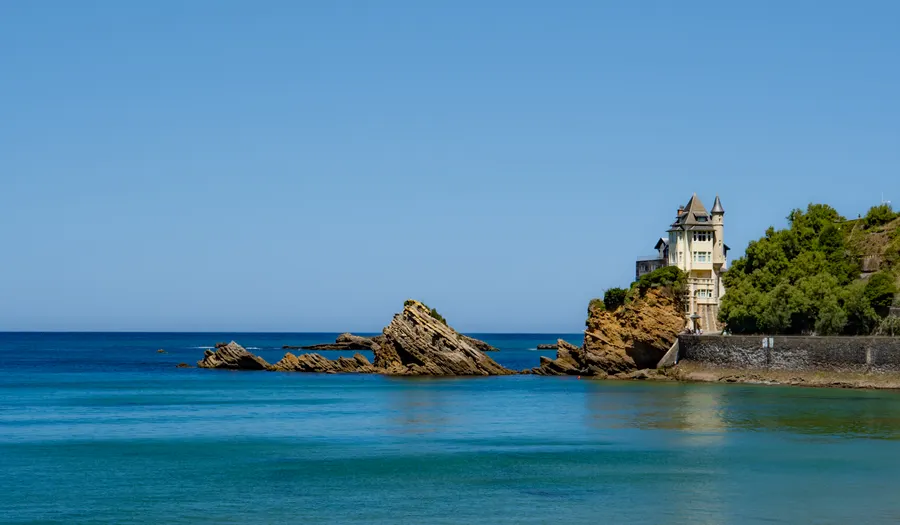
The founding beach of European surfing stretches out at the foot of a 40-metre cliff, a kilometre south of the centre. The sandy bottom is even and the wave breaks gently across a wide front, which makes it the obvious learning ground for beginners from April to October, when a dozen schools share the bottom of the steps. It does, however, disappear completely at high tide on coefficients above 90, and you need to be back up before then or risk being pinned against the cliff. The road along it has collapsed in places, the cliff slips regularly and the cordoned-off areas are not to be crossed, not even for a photo.
The Rocher de la Vierge and the Atalaye plateau
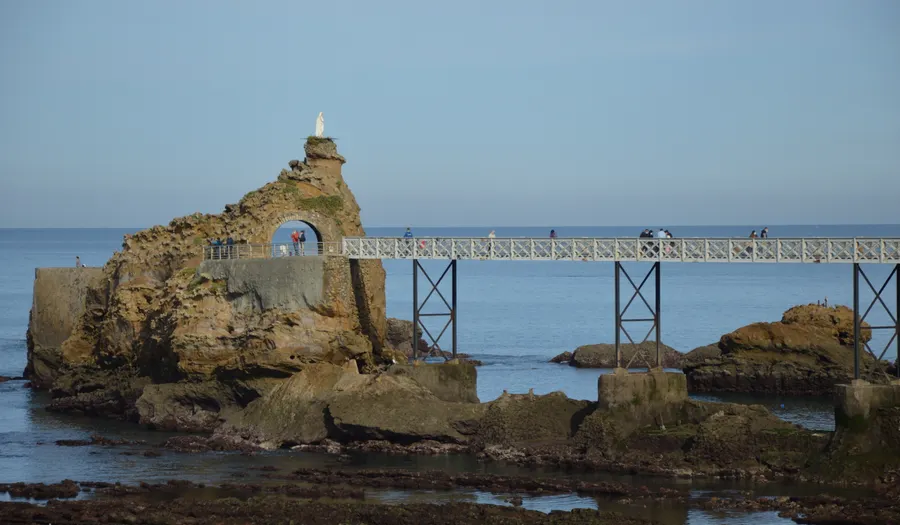
A rocky spur cut off from the coast, pierced by a tunnel in 1863 to create a harbour of refuge that never worked, and crowned since 1865 with a statue of the Virgin. The current metal footbridge dates from 1920 and replaces the one attributed to Gustave Eiffel's circle; it closes as soon as the wind picks up or the swell washes over the railing, which happens often from October to March. From the end of the rock, the view runs from the Landes in the north to the Spanish mountains in the south. The Atalaye plateau in front of it is the former lookout post of the Basque whalers and is still the best place in town for a sunset, free of charge.
The Port des Pêcheurs and the Port-Vieux
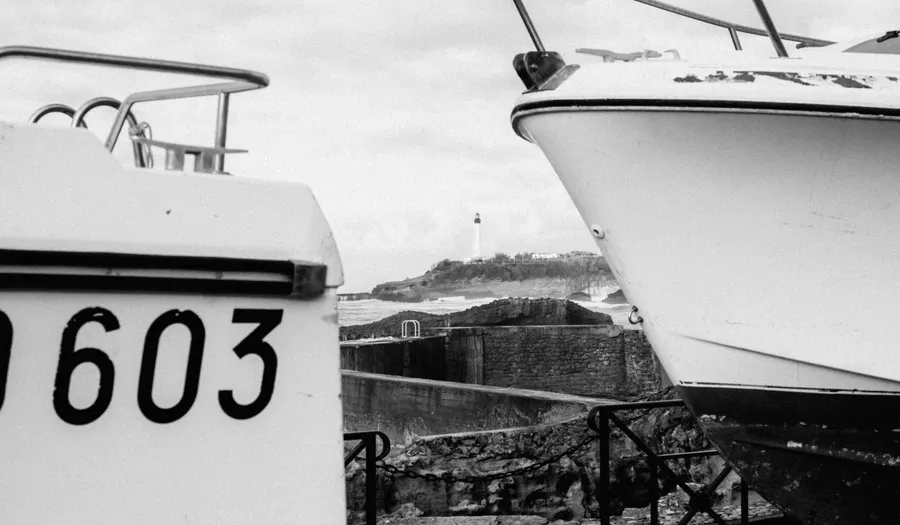
Dug into the cliff in 1870 to shelter the fishing boats, the Port des Pêcheurs has kept its crampottes, white and green huts huddled around two tiny basins. A few have become restaurants where you eat the catch of the day a metre from the water; the others are still used as storerooms. You reach it by a ramp from the esplanade, and the place stays invisible until you have gone down the steps. A hundred metres further on, the Port-Vieux beach sits in a cove closed off by two rocky points: it is the only beach in Biarritz where the water stays calm, which makes it the swimming spot for families and for the members of the Ours Blancs club, who take a dip there all year round.
The Halles district
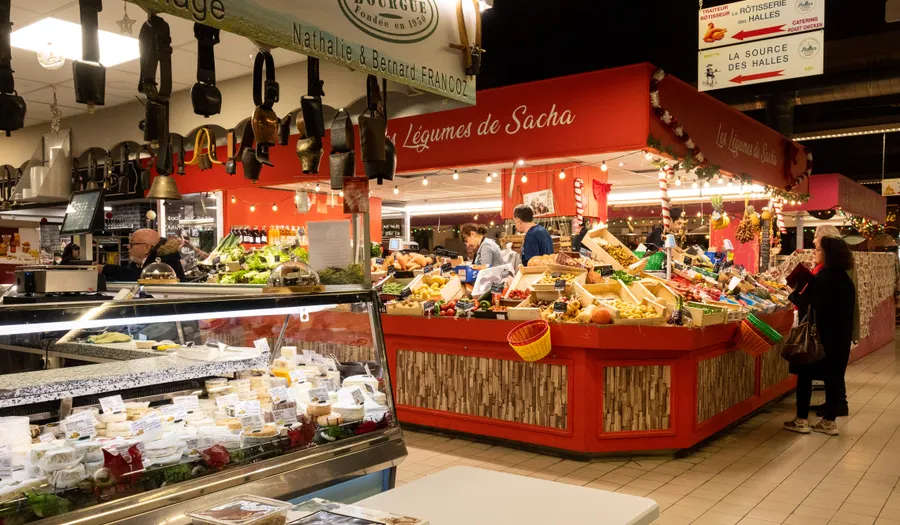
Five minutes from the Grande Plage, two iron-and-glass pavilions from 1885 house some fifty stalls: fish landed at Saint-Jean-de-Luz, Ossau-Iraty, Kintoa ham, Espelette pepper. The traders open every day from 7:30 to 14:00, with a second opening from 18:00 to 21:00 in July and August, and a producers' market on the outdoor square on Saturday mornings. The surrounding streets, led by Rue Victor Hugo and Rue Gambetta, concentrate the pintxos bars and the liveliest tables in town, a world away from the starchy atmosphere of the seafront. This is the district to stay in if you want to go out on foot in the evening.
Pointe Saint-Martin and the southern beaches
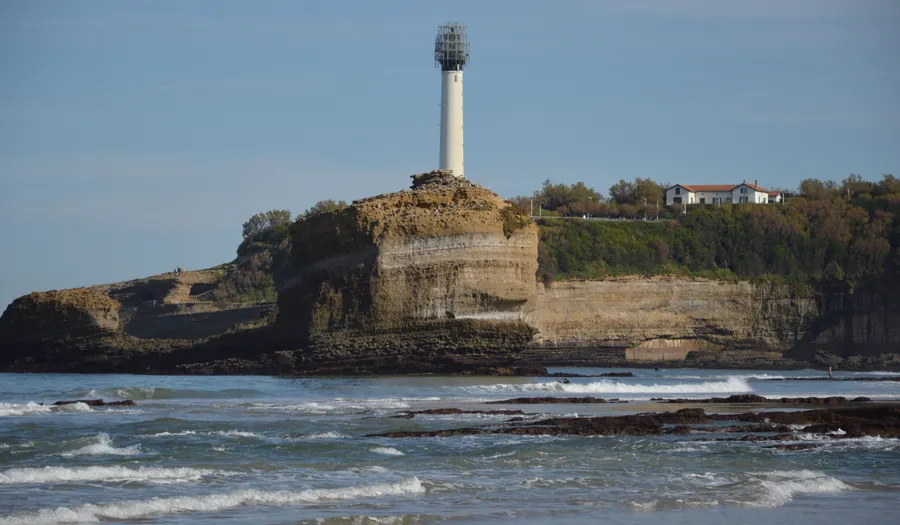
To the north, the 1834 lighthouse stands 73 metres above the ocean and marks the boundary between Biarritz and the long beaches of Anglet; its 248 steps and its lift lead to a gallery that takes in the whole bay. To the south, past the Côte des Basques, the Marbella and Milady beaches extend the coastline below a less built-up shore. Milady is the widest and best equipped, with free parking, a clearly marked lifeguarded zone and a beach access system for wheelchair users. Marbella, narrower, throws up fast waves over its sandbanks and draws mostly experienced surfers: it is not a beach for learning.
How many days, and which itinerary?
Two days are enough for the town itself, lighthouse included, on foot. Four to five days become worthwhile if you take surf lessons, because it takes three or four sessions to stand up and because conditions change every morning with the tide and the swell.
🗺️ Day-by-day itinerary · 📓 Free printable Biarritz guide (PDF) · 🌍 All of the French Basque Country
A weekend (2 days)
Day 1: the Grande Plage and the imperial promenade in the morning, the covered market at midday, the Atalaye plateau and the Rocher de la Vierge in the late afternoon, dinner in a crampotte at the Port des Pêcheurs. Day 2: the coastal path to the Côte des Basques, a swim in the lifeguarded zone, and up the lighthouse before closing time. The most common format, entirely on foot.
Four days of surf and coast (4 days)
Three surf sessions spread over the mornings, timed for the falling tide at the Côte des Basques or Milady depending on conditions. Afternoons for the Musée de la Mer, the covered market, the lighthouse and the southern beaches, with an evening at Marbella to watch the evening session. It is the minimum length to make real progress.
A week from one base (7 days)
Rent a flat in the Halles district, take a five-day surf course in the mornings, and spend the afternoons at the Cité de l'Océan, the crampottes, the markets and on long walks along the coastal path. Two rest days let you ride out a big swell or a shower without breaking the rhythm.
Getting there and getting around
Direct TGV from Paris-Montparnasse to Biarritz station in 4h05; the station is at La Négresse, 3 km from the centre, so allow 15 min by bus or 10 min by taxi.
The airport is 3 km from the Grande Plage, about ten minutes by taxi; a city bus line links the terminal to the centre for around €1 a journey, all year round.
Parking is the real issue: around €10 for three hours in the red zone on the seafront, a €35 post-parking charge if you forget, and meters active until 20:00 in July and August. The first hour is free once a day and cannot be split.
In town, everything is done on foot: the coastal path links the lighthouse to the Côte des Basques in a 45-min walk, and the free shuttles in the centre save you taking the car out again.
Where to stay in Biarritz?
Hôtel du Palais, the former imperial villa facing the Grande Plage: from €500 a night in summer, the only palace hotel on the coast.
Boutique hotels in the Saint-Charles or Halles districts: €130 to €220 for a double in July and August, around €90 to €130 in May and October.
A furnished flat or studio for a surf week: €700 to €1,400 a week depending on the season and the distance to the beach, often the best value for four.
Surf hostels and the Milady campsites: €35 to €60 per person in a dorm, with board racks and shuttles to the surf spots.
Our places to stay, stop by stop, at three budgets →
What to eat in Biarritz?
Pintxos by the piece in the bars of the Halles district, €3 to €6 each, the cheapest way to eat dinner in the town centre.
Grilled fish and ttoro, the Basque fish soup with chilli, in the crampottes of the Port des Pêcheurs: allow €25 to €40 per person.
Gâteau basque filled with custard or Itxassou black cherry, and Bayonne chocolate sold in the old chocolate houses of the centre, around €3 to €5 a slice.
Basque cider by the glass and Irouléguy wines, from the small vineyard of the Aldudes valley, served in almost every tapas bar in town.
Entry requirements
Schengen area: an ID card or passport for EU citizens, 90 days visa-free for UK, US, Canadian and Australian passports.
Rules change: check your own government's travel advice before you go.
Frequently asked questions about Biarritz
Do I need a car in Biarritz?
No, and it becomes a handicap in summer. The TGV comes direct from Paris, the whole centre can be done on foot and parking in the red zone costs around €10 for three hours. Rent a car only for days out of town, and leave it at a park-and-ride the rest of the time.
Which spot should I choose to learn to surf?
The Côte des Basques on a falling tide, without hesitation: an even sandy bottom, a long, soft wave and a dozen schools on site. Avoid Marbella, whose sandbanks throw up fast waves, and the Grande Plage in August, where the crowds in the water make learning dangerous. Allow €45 for a 1h30 group lesson.
Can I swim safely with young children?
Yes, provided you choose the right beach. The Port-Vieux, protected by two rocky points, is the only truly calm cove in town, and Milady offers a wide lifeguarded zone with free parking. Everywhere else, stay strictly between the blue flags and get out of the water when the lifeguards go off duty.
Which month avoids the crowds without sacrificing the weather?
June and September. The water is already or still around 20°C, the terraces are busy, the beaches are lifeguarded from 11:00 to 19:00 and rooms are still available at reasonable rates. October is even better for surfing, with the autumn swell, but the water cools down and the days get shorter.
How much does a day cost without breaking the bank?
Around sixty euros excluding accommodation, eating pintxos at the covered market, sticking to the beaches and the coastal path, and limiting yourself to one paid entry. The lighthouse at €5 and the Musée de la Mer at €17 are the only real tickets to budget for; the rest of the seafront is free to access.
Similar destinations
 Region
🇫🇷 Brittany
 Region
🇫🇷 Corsica
 City
City🇫🇷 Bordeaux and Around
 Region
🇮🇹 Sicily
 Country
🇭🇷 Croatia
 City
City🇮🇪 Galway and Connemara
 City
City🇿🇦 Cape Town
 City
City🇫🇷 Marseille
 City
City🇫🇷 Rochefort and the Charente Estuary
 City
City