When to go to Marseille?
→ The detailed month-by-month page, with real weather records
Best time: May to June and September to October
At a glance
Why go to Marseille?
Marseille is the only major French city where you can step out of a metro station and, forty minutes later, find yourself in a national park. The Calanques massif begins within the city limits: twenty kilometres of white cliffs, coves and trails, served by ordinary city buses. This collision between a city of 870,000 people and a protected wilderness exists nowhere else in Europe, and it accounts for a good part of the city's character.
Its year as European Capital of Culture in 2013 left the city with facilities it had never had. The MuCEM, the Villa Méditerranée, the grain silo turned concert hall and the redevelopment of the J4 esplanade gave back to the public a waterfront long cut off by warehouses. The result is uneven and whole neighbourhoods remain untouched by the effort, but the seafront between La Major and Fort Saint-Jean has become one of the best-designed stretches of city in France.
Then there is what cannot be planned. France's oldest city, founded around 600 BC, keeps a street life its neighbours have lost: you eat panisses standing up at a chip shop in L'Estaque, wander through Noailles market and its spices, and hear five languages in a hundred metres of pavement. Marseille is not visited like a compact historic centre; you cross it neighbourhood by neighbourhood, and you have to accept that some are dirty and noisy to understand the others.
Map of Marseille: what is where?
The map shows the 6 places covered in this guide, to picture the distances and plan your route.
- Vieux-Port
- Notre-Dame de la Garde
- Le Panier
- MuCEM
- Calanque de Sormiou
- Château d'If
How much does a trip to Marseille cost?
Marseille remains noticeably cheaper than Nice or Aix for sleeping and eating, and many of its best moments cost nothing: the Corniche, the calanques, Le Panier, the roof of the Cité Radieuse. It is the boat trips and a real bouillabaisse that push up the bill.
| Style | Per day | What it covers |
|---|---|---|
| Backpacker | €55-85/day | Hostel or small hotel, RTM transport, beaches and calanques on foot, food-truck pizza and panisses |
| Comfort | €110-180/day | Hotel in the centre, City Pass, shuttle boat to If and the Frioul islands, neighbourhood restaurants and one fish dinner |
| Premium | €280+/day | Hotel with a view of the port, bouillabaisse at the Vallon des Auffes, private boat trip in the calanques |
Everything can be paid by card, including RTM tickets and shuttle boats. Still keep some coins for Noailles market, the chip shops of L'Estaque and the Vieux-Port ferry, which costs €0.50 and has no card reader.
Is Marseille safe?
Marseille suffers from a reputation that far outstrips the reality experienced by visitors, but a few precautions are still justified. Phone snatching and car break-ins are common: never leave anything visible in a car, charger included, and keep your phone away from the kerb on La Canebière and around Saint-Charles. In the evening, Belsunce, Porte d'Aix, the area around the station and the lower end of La Canebière are unpleasant rather than dangerous, but it is best not to hang around alone after midnight; the gangland shootings that make the headlines are linked to drug dealing in the northern districts, far from the tourist areas. The real risk of a stay lies elsewhere: every summer, visitors set off into the calanques without water at 3pm on exposed trails, and the emergency services are regularly called out for heatstroke and broken ankles.
What to see and do in Marseille
- Notre-Dame de la Garde Basilica
- The Vieux-Port and the Quai des Belges
- Le Panier
- The MuCEM and Fort Saint-Jean
- Calanque de Sormiou
- Château d'If and the Frioul islands
- Vallon des Auffes
- Le Corbusier's Cité Radieuse
The Vieux-Port and La Canebière

The harbour dug by the Greeks in the Lacydon inlet is still the city's centre of gravity, lined by the Quai du Port to the north and the Quai de Rive Neuve to the south. Norman Foster's mirrored canopy, installed on the Quai des Belges in 2013, shelters the morning fish market and serves as the whole city's meeting point. La Canebière runs down to the port from the Église des Réformés for a kilometre: it has lost its 19th-century prestige but has been regaining shops since the tramway arrived. A little higher up lie Cours Julien and La Plaine, neighbourhoods of bars, murals and record shops, buzzing in the evening. The whole area is walkable and has the best-located hotels.
Le Panier and the Vieille Charité

On the hill north of the port, Le Panier is what remains of the city before 1943, when the district along the quays was dynamited. The lanes climb in flights of steps between narrow buildings, craft workshops and shady squares such as the Place des Moulins, the highest in the quarter. The Vieille Charité, a former almshouse with three tiers of arcades built by Pierre Puget, houses the Museum of Mediterranean Archaeology and the Museum of African, Oceanic and Native American Arts. The area has become so photogenic that it is overrun in summer afternoons, but it calms down again after 7pm. Allow two hours to explore it without museums, half a day with them.
The J4, the MuCEM and La Major
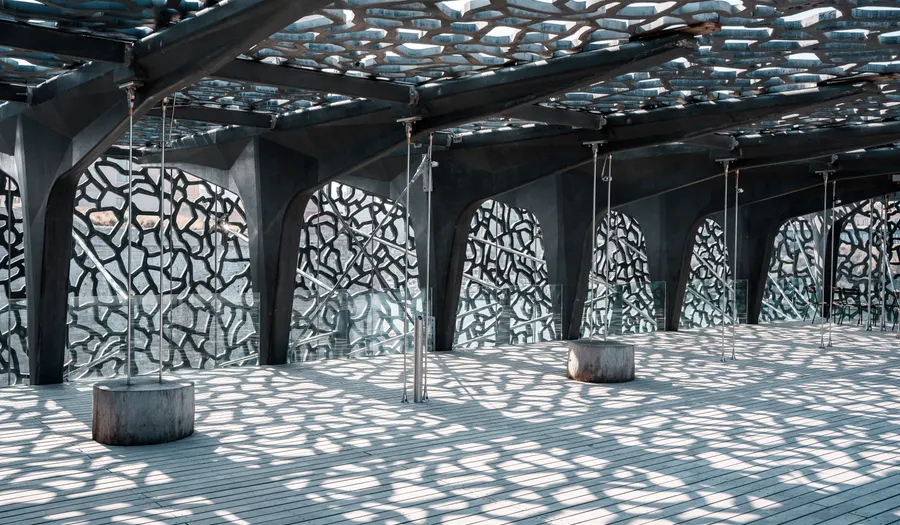
The J4 esplanade occupies the former harbour platform between the outer breakwater and the cathedral, fully reopened to the public in 2013. The MuCEM and its concrete lattice face Fort Saint-Jean, linked by two suspended footbridges that offer a free shortcut to Le Panier. La Major cathedral, a huge neo-Byzantine nave in Cassis stone and green Florentine limestone, closes the view to the north. Beneath its forecourt, the Voûtes de la Major fill the old 19th-century arcades with restaurants and shops. It is the newest part of tourist Marseille, and by far the most pleasant at the end of the day.
The Corniche and the Prado beaches
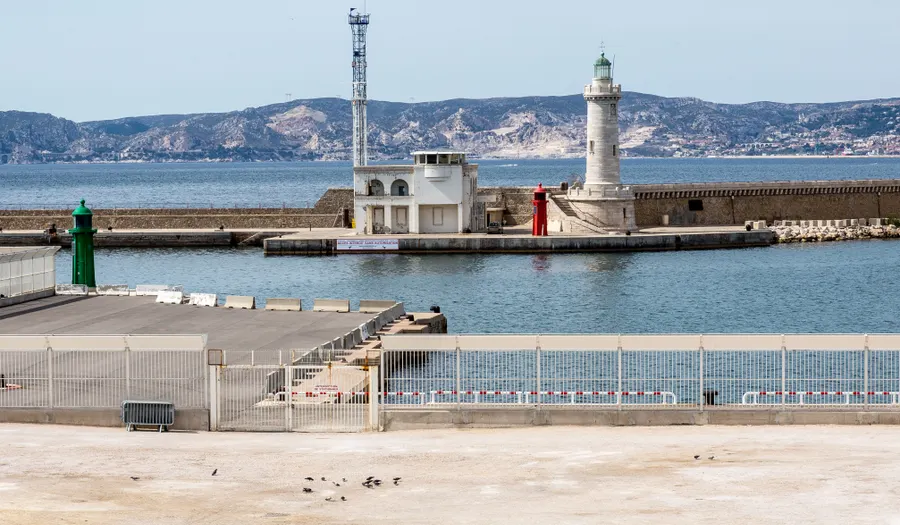
The Corniche Kennedy runs along the sea for five kilometres between the Plage des Catalans and the Prado seaside park, with, along part of the route, what the city bills as the longest bench in the world. The Vallon des Auffes opens up halfway along, beneath a viaduct, with its wooden fishing boats and cabanons. The Prado beaches, entirely artificial and built with spoil from the metro works in the 1970s, line up sand, lawns, a skatepark and beach volleyball courts. Bus 83 covers the whole route from the Vieux-Port for the price of an ordinary ticket. In summer, swimming is supervised and the water quality is posted daily at the entrance.
Calanques National Park
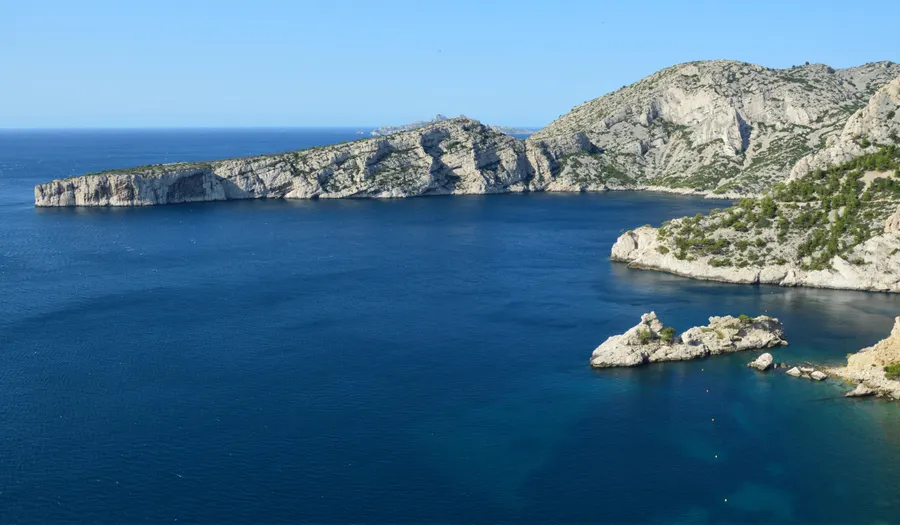
Created in 2012, it is the only peri-urban national park in Europe: it starts at the edge of the southern neighbourhoods and runs all the way to Cassis along twenty kilometres of coast. Sugiton, Morgiou, Sormiou, En-Vau and Port-Pin line up coves of turquoise water at the foot of limestone cliffs rising to 300 metres. Access is on foot, by kayak or by boat, with a free but compulsory reservation for Sugiton and Les Pierres Tombées in high season. The roads to Sormiou, Morgiou and Callelongue are closed to cars all summer, and the entire massif can be closed off when the wildfire risk is high. These are not seaside strolls: the trails are rocky, exposed and without shade.
Notre-Dame de la Garde and the hills
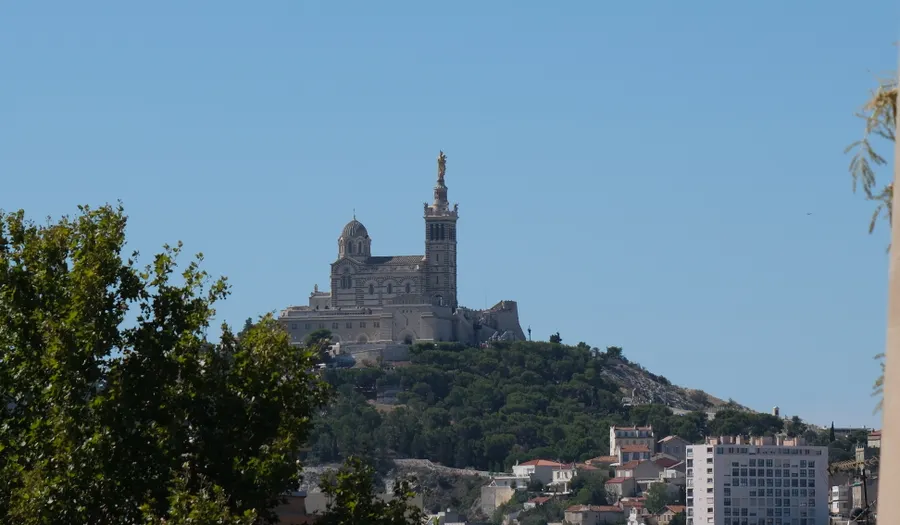
The 19th-century basilica crowns the high point of the south bank, at 162 metres, on the foundations of a 13th-century chapel and a fort built by Francis I. The gilded statue of the Virgin, 11 metres tall, is a landmark visible from all over the city and from the sea. Around it spreads Le Roucas Blanc, a district of villas and stepped lanes where getting lost on the way down to the Corniche is a pleasure. Further east, the Parc Borély and its château provide the large public garden the centre lacks. The whole lot fits into half a day if you take bus 60 up and walk down.
How many days, and which itinerary?
Three days are enough for the centre, the J4 and one calanque. Four to five days let you add the islands, the Cité Radieuse, L'Estaque and a full day of hiking in the national park without racing the clock.
🗺️ Day-by-day itinerary · 📓 Free printable Marseille guide (PDF) · 🌍 All of Provence
First weekend (2 days)
Day 1: Vieux-Port and the fish market in the morning, Le Panier and the Vieille Charité, then the J4 and the MuCEM late in the day. Day 2: an early climb to Notre-Dame de la Garde, down to the Corniche and the Vallon des Auffes, the Prado beaches in the afternoon. All on foot and by bus, no car needed.
City and calanques (4 days)
Two days in the city, a full day at Sormiou or Sugiton starting from Les Baumettes or Luminy, and a fourth day for the Château d'If, the Frioul islands and the Cité Radieuse. Schedule the hike early in your stay so you can move it if the massif closes because of wildfire risk.
Marseille and its hinterland (6 days)
Three days in Marseille, a day in Cassis and at Cap Canaille via the Route des Crêtes, a day in Aix-en-Provence by direct coach from Saint-Charles, and a last one on the Côte Bleue by regional train as far as Carry-le-Rouet. This coastal line costs a few euros and runs along the sea for forty minutes.
Getting there and getting around
RTM ticket at €1.70 on a rechargeable card, 10 journeys for €15, 24-hour pass at €5.20: two metro lines, three tram lines and a dense bus network.
The tourist office's City Pass costs €24 for 24 hours, €31 for 48 hours and €39 for 72 hours, including public transport and municipal museums, and pays for itself after two museums and one shuttle boat.
A car is a handicap in the city centre: parking is scarce and expensive, break-ins are common, and the roads to the calanques are closed all summer.
From Marignane airport, the shuttle bus reaches Saint-Charles station in 25 minutes for around ten euros, every 10 to 20 minutes.
Where to stay in Marseille?
Boutique hotel in Le Panier or near Cours Julien: €110 to 180 a night, the most practical option for doing everything on foot.
Rental apartment around Place Castellane or Notre-Dame du Mont: €80 to 140, with a kitchen and a market close by.
Youth hostel or simple hotel near Saint-Charles: €35 to 70, well connected but a noisy area with little appeal in the evening.
Seafront hotel on the Corniche or at Les Goudes: €200 and up, quiet with a view, but entirely dependent on buses to reach the centre.
Our places to stay, stop by stop, at three budgets →
What to eat in Marseille?
A proper bouillabaisse is ordered the day before and costs €60 to 75 per person: the €25 set menus on the port are a different recipe with different fish.
Panisses and chichis frégis from L'Estaque, chickpea fritters and sugared doughnuts, are eaten standing up for €3 to 5.
Noailles market, just above La Canebière, sells spices, olives and North African pastries from morning until early evening, except on Sundays.
Local pastis, pieds paquets for the curious, and orange-blossom navettes from the Four des Navettes, baking since 1781.
Entry requirements
Schengen area: an ID card or passport for EU citizens, 90 days visa-free for UK, US, Canadian and Australian passports.
Rules change: check your own government's travel advice before you go.
Frequently asked questions about Marseille
Should you hire a car in Marseille?
No, it is even counterproductive. Parking is expensive and prone to break-ins, the roads to the calanques close all summer and the RTM network serves the beaches, the hills and the trailheads. If anything, hire one for a day for Cassis or the Verdon, picking it up at Saint-Charles.
Can you get to the calanques in summer?
Yes, but with conditions. The roads to Sormiou, Morgiou and Callelongue are closed to cars from 12 June to 30 August 2026, from 7am to 7pm, Sugiton requires a free reservation in high season, and the whole massif can be closed when the wildfire risk is high. The access map is published every day after 6pm for the following day.
Where can you eat a real bouillabaisse?
At the Vallon des Auffes or on the Corniche, in the restaurants that have signed the bouillabaisse charter. Expect €60 to 75 per person, an order placed the day before and a two-stage service, the broth first and then the fish carved at the table. Below €40, it is not the same dish.
How many days should you plan?
Three days for the city and one calanque, four to five to add the islands, the Cité Radieuse and a proper hike. Marseille is spread out and journeys take time: it is better to set aside one neighbourhood per half-day than to keep going back and forth.
Which neighbourhood should you stay in?
Le Panier and the streets around the Vieux-Port to do everything on foot, Notre-Dame du Mont and Cours Julien for neighbourhood life and bars, the Corniche for peace and views. Avoid the very cheap hotels around Porte d'Aix and the lower end of La Canebière, which are noisy and poorly located in the evening.
Similar destinations
 Region
🇮🇹 Sicily
 Country
🇫🇷 France
 Region
🇫🇷 Normandy
 City
City🇫🇷 Bordeaux and Around
 Country
🇭🇷 Croatia
 Country
🇮🇪 Ireland
 City
City🇬🇧 Northern Ireland
 City
City🇮🇪 Galway and Connemara
 Region
🇪🇸 Andalusia
 City
City