When to go to Normandy?
→ The detailed month-by-month page, with real weather records
Best time: May to September
At a glance
Why go to Normandy?
Few regions pack so many major sites so close to Paris. In under two hours by road or rail, you reach the Étretat cliffs immortalised by Monet, the Giverny gardens where the painter created his Water Lilies, Rouen Cathedral and the harbour of Honfleur. Mont Saint-Michel, on the Breton border, crowns it all. Normandy is the perfect long weekend, but it deserves far more.
It is also an open-air history book. The D-Day beaches, from Omaha Beach to Arromanches, the American Cemetery at Colleville-sur-Mer and the Caen Memorial tell the story of 6 June 1944 with rare power. Nine centuries earlier, the Bayeux Tapestry was already embroidering William's conquest of England. In between, Rouen keeps the memory of Joan of Arc, and the abbeys of the Seine valley that of the builder monks.
Above all, Normandy is a feast. The Pays d'Auge lines up stud farms, half-timbered manor houses and cellars where apples and pears are pressed: cider, pommeau and calvados can be tasted along the Cider Route around Cambremer. Camembert, livarot and pont-l'évêque make up the most famous cheeseboard in France. On the coast, oysters from Veules-les-Roses and mussels from Barfleur are enjoyed facing the sea.
Map of Normandy: what is where?
The map shows the 6 places covered in this guide, to picture the distances and plan your route.
- Étretat
- Rouen
- Honfleur
- Bayeux
- Omaha Beach
- Mont Saint-Michel
How much does a trip to Normandy cost?
Normandy remains affordable outside Deauville and Honfleur in high season. Its proximity to Paris also lends itself to short breaks that lighten the overall budget.
| Style | Per day | What it covers |
|---|---|---|
| Backpacker | €55-80/day | camping or hostel, markets and crêperies, train and Nomad buses |
| Comfort | €100-150/day | charming B&Bs, restaurants serving local produce, hire car |
| Premium | €220+/day | seafront hotels in Deauville or Honfleur, fine dining, private tours |
Euro, cards accepted everywhere; a little cash is handy for the small producers on the Cider Route.
Is Normandy safe?
Normandy is a very safe region. The main thing to watch is the tide: in the Bay of Mont Saint-Michel, never venture onto the sands without a certified guide, as quicksand and fast tides are genuinely dangerous. At the foot of the Étretat cliffs, keep an eye on the rising tide and stay well away from the rock face, as rockfalls happen regularly. On the beaches, stick to lifeguarded zones in summer. Sea emergency number: 196 (CROSS).
What to see and do in Normandy
- The Étretat cliffs
- Mont Saint-Michel
- The D-Day beaches
- Honfleur and its Vieux Bassin
- Monet's gardens at Giverny
- Rouen and its cathedral
- Deauville and the Planches
- Bayeux and its tapestry
Alabaster Coast and Étretat

From Dieppe to Le Havre, the Alabaster Coast raises 130 km of white chalk cliffs streaked with flint. Étretat is its jewel, with monumental arches and the hollow Needle beloved of Arsène Lupin. The clifftop paths of the Falaise d'Amont and Falaise d'Aval give dizzying views over the Channel. The villages of Veules-les-Roses and Yport keep a retro seaside charm. Le Havre, rebuilt by Auguste Perret and UNESCO-listed, surprises with its luminous concrete architecture.
Mont Saint-Michel and its bay

The 'Wonder of the West' raises its abbey atop an islet surrounded by the biggest tides in Europe. The climb up the Grande Rue, the suspended cloister and the monks' refectory make up a unique Gothic masterpiece. Crossing the bay on foot with a certified guide is an unforgettable experience, between quicksand and shifting light. At spring tides, the sea surrounds the Mount in a matter of minutes. Staying on the island or nearby lets you enjoy the site in peace, before and after the waves of visitors.
D-Day beaches

Along 80 km of coast, from Sainte-Mère-Église to Ouistreham, the beaches of 6 June 1944 tell the story of the largest amphibious operation in history. Omaha Beach and the American Cemetery at Colleville-sur-Mer, with its 9,387 white crosses facing the sea, make for an intensely moving moment. At Arromanches, the remains of the artificial harbour still rise from the waves. The Pointe du Hoc keeps its bomb craters and bunkers. Allow a full day, two with the Caen Memorial.
Côte Fleurie and the Pays d'Auge
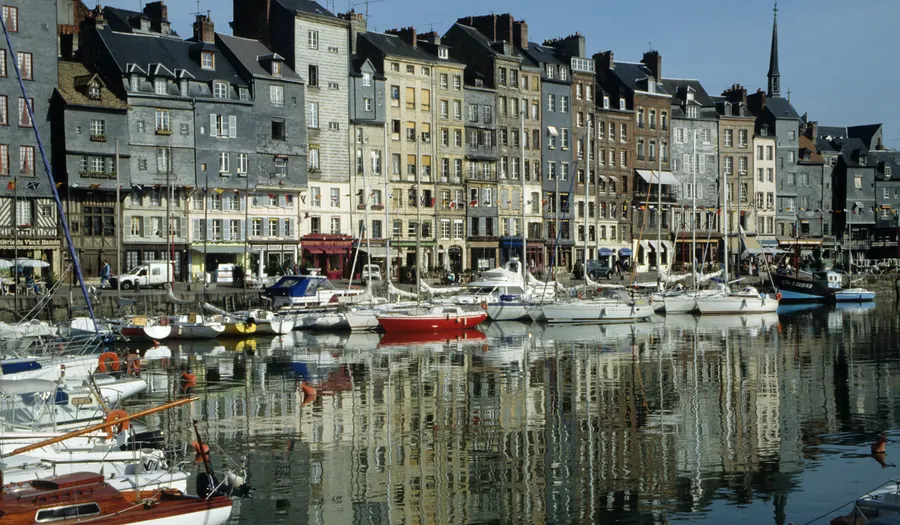
Honfleur opens the show with its Vieux Bassin lined with tall slate-clad houses, followed by family-friendly Trouville and elegant Deauville, with its Planches boardwalk and colourful parasols. Inland, the Pays d'Auge unrolls a picture-postcard patchwork of hedged fields: half-timbered manors, stud farms and villages such as Beuvron-en-Auge. The Cider Route links producers of cider, pommeau and calvados. Cabourg and its Marcel Proust promenade add a Belle Époque touch. Normandy at its most chic and gourmet, all in one.
Rouen and the Seine valley

The historic capital of the duchy, Rouen lines up a Gothic cathedral painted by Monet, the Renaissance Gros-Horloge and hundreds of half-timbered houses. The Place du Vieux-Marché recalls the execution of Joan of Arc in 1431. Downstream, the Seine meanders between chalk cliffs and majestic abbeys: romantic Jumièges, still-active Saint-Wandrille. The Seine loops can be explored by car or bike along the Abbey Route. Giverny and Monet's gardens complete the Impressionist trail.
Cotentin and the Havres coast

A wild peninsula pointing towards England, the Cotentin has an Irish feel. The Nez de Jobourg raises some of the highest cliffs in continental Europe above a turquoise sea, while Barfleur and Saint-Vaast-la-Hougue, with its listed Vauban towers, rank among the prettiest harbours on the Channel. Cherbourg is home to the Cité de la Mer and its submarine, Le Redoutable. The havres (tidal inlets) of the west coast, between dunes and salt meadows, are a paradise for birdwatchers. An undiscovered Normandy, far from the crowds of Étretat.
How many days, and which itinerary?
A long weekend is enough for a first taste (Étretat, Honfleur, Rouen); a week lets you add the D-Day beaches, Mont Saint-Michel and the Pays d'Auge.
🗺️ Day-by-day itinerary · 📓 Free printable Normandy guide (PDF) · 🌍 All of France
Impressionist weekend (3 days)
Giverny and Monet's gardens (1 day), Rouen and its cathedral (1 day), Étretat and Honfleur (1 day). The perfect itinerary from Paris to walk in the painters' footsteps.
Grand tour (7 days)
Giverny and Rouen (2 days), Étretat and the Alabaster Coast (1 day), Honfleur, Deauville and the Pays d'Auge (2 days), the D-Day beaches and Bayeux (1 day), Mont Saint-Michel (1 day). All the must-sees in a logical east-to-west loop.
History and remembrance (4 days)
The Caen Memorial (1 day), Omaha Beach, Pointe du Hoc and the American Cemetery (1 day), Arromanches and the Longues batteries (1 day), Bayeux and its tapestry (1 day). A deep dive into 1944 and 1066, ideal with friends or as a family with teenagers.
Getting there and getting around
Train: Paris-Rouen in 1h20, Paris-Caen in 2h, Paris-Bayeux in 2h20, departing from Saint-Lazare
A car is strongly recommended for the D-Day beaches, the Pays d'Auge and the coast: hire from €35-45/day
Nomad shuttles and local buses between Caen and the D-Day beaches in summer, handy without a car
By bike: the Vélomaritime and the Seine à Vélo routes cross the region, e-bike hire €25-35/day
Where to stay in Normandy?
Campsites on the Côte Fleurie and in the Cotentin: pitches €15-30/night
B&Bs in the half-timbered manors of the Pays d'Auge: €80-120 for a double, farmhouse breakfast included
2-3 star hotels in Rouen, Caen or Bayeux: €70-120, allow €150 or more in Deauville or Honfleur in summer
A night facing Mont Saint-Michel (on the bay or inside the walls): €100-180, to be booked well in advance
Our places to stay, stop by stop, at three budgets →
What to eat in Normandy?
The essential Normandy cheeseboard: raw-milk camembert, livarot and pont-l'évêque with a dry cider
Marmite dieppoise, sole normande and mussels in cream in the coastal restaurants
The Cider Route around Cambremer: tastings of cider, pommeau and calvados at the producers
Teurgoule (cinnamon rice pudding), apple tart and Isigny caramels for something sweet
Entry requirements
Schengen area: an ID card or passport for EU citizens, 90 days visa-free for UK, US, Canadian and Australian passports.
Rules change: check your own government's travel advice before you go.
Frequently asked questions about Normandy
When is the best time to visit Normandy?
From May to September for long, mild days, with peak charm in June when the gardens of Giverny burst into bloom. The shoulder season brings lovely light and peaceful sites.
What daily budget should I plan for?
Allow €55-80 a day on a backpacker budget, €100-150 for comfort and €220 or more for premium. Deauville and Honfleur in summer are the most expensive areas.
How do I get around?
Trains serve Rouen, Caen and Bayeux well from Paris, but a car remains essential for the D-Day beaches, the Pays d'Auge and the coastal villages. Summer shuttles fill the gaps around Caen.
How much time do I need?
A long weekend is enough for Étretat, Honfleur and Rouen, a week for a full loop including the D-Day beaches and Mont Saint-Michel. The region lends itself very well to repeated short stays.
Can you visit the D-Day beaches without a car?
Partly, yes: from Bayeux or Caen, seasonal shuttles and many guided tours serve Omaha Beach, Arromanches and the American Cemetery. A car is still more flexible for linking outlying sites such as the Pointe du Hoc or Utah Beach.
Similar destinations
 Region
🇭🇷 Istria
 City
City🇫🇷 Bordeaux and Around
 Country
🇮🇹 Italy
 Region
🇮🇹 Florence and Tuscany
 Region
🇮🇹 Puglia
 Region
🇪🇸 Andalusia
 City
City🇫🇷 Rochefort and the Charente Estuary
 City
City🇬🇷 Corfu
 Region
🇫🇷 Burgundy
 Region