When to go to Puglia?
→ The detailed month-by-month page, with real weather records
Best time: May to June and September to October
At a glance
Why go to Puglia?
Puglia holds on to an Italy you thought had vanished. Here, the hilltop villages of the Itria Valley line up their whitewashed houses and conical dry-stone roofs, the UNESCO-listed trulli. Ancient olive trees paint silvery seas between Ostuni and Fasano, and every small town keeps its evening passeggiata, its market and its band of nonni settled on the square.
It is also a first-rate beach destination, with two seas for the price of one. On the Adriatic side, the cliffs of Polignano a Mare and the coves of the Gargano plunge into crystal-clear water. On the Ionian side, the Salento lines up pale sandy beaches worthy of the Caribbean, such as Punta Prosciutto or Pescoluse. In May, June or September, you can enjoy them without the August crowds.
And you eat divinely well here for next to nothing. Orecchiette with cime di rapa, burrata from Andria, focaccia barese, raw fish Bari-style, Primitivo and Negroamaro wines: Pugliese cooking is simple, rustic and spectacular. Add the masserie, fortified farmhouses turned into boutique hotels, and you have a trip that ticks every box.
Map of Puglia: what is where?
The map shows the 6 places covered in this guide, to picture the distances and plan your route.
- Bari
- Alberobello
- Ostuni
- Lecce
- Matera
- Vieste
How much does a trip to Puglia cost?
Puglia remains one of Italy's most affordable regions, especially outside July-August. Car hire and upmarket masserie are the two items that push the bill up.
| Style | Per day | What it covers |
|---|---|---|
| Backpacker | €60-90/day | Simple B&B, panzerotti and trattorie, regional trains and buses, free beaches |
| Comfort | €100-160/day | Trullo or boutique B&B, hire car, restaurants every evening, one boat trip |
| Premium | €220+/day | Masseria with a pool, gourmet restaurants, private tastings, comfortable transfers |
Cards are accepted almost everywhere, but keep some cash for markets, beaches and small village cafés.
Is Puglia safe?
Puglia is a safe region to travel with peace of mind, including with family or solo. The only precautions are common sense: leave nothing on show in the car at beach car parks, watch out for pickpockets in stations and at summer festivals, and take care on narrow back roads where local driving is brisk. In high summer, protect yourself from the sun and stay hydrated, as temperatures regularly exceed 35°C.
What to see and do in Puglia
- Trulli of Alberobello
- Ostuni
- Polignano a Mare
- Matera and its sassi
- Baroque Lecce
- Vieste and the Gargano
- Otranto
- Castellana Caves
Alberobello
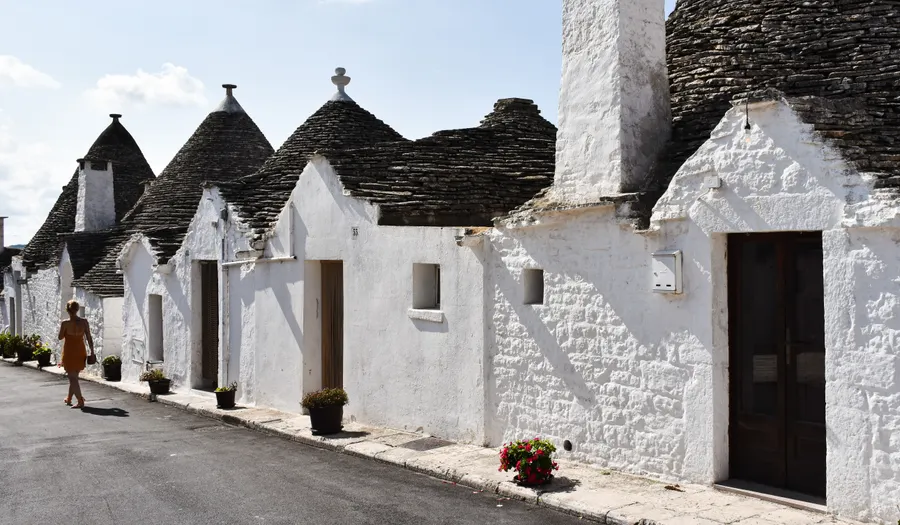
The capital of the trulli lines up more than 1,500 conical houses in the Rione Monti and Aia Piccola districts. The site has been a UNESCO World Heritage Site since 1996 and can be explored on foot in half a day. Climb to the Santa Lucia viewpoint for the full panorama over the grey roofs tipped with white pinnacles. Early in the morning or late in the day, the lanes regain their calm and their magic. Spending a night in a restored trullo is an experience in itself.
Polignano a Mare

Puglia's most photogenic village clings to a cliff riddled with sea caves. The beach of Lama Monachile, squeezed between two limestone walls, has become an icon of the Adriatic. Get lost in the historic centre, among flower-filled balconies and poems painted on doors. A boat trip reveals the caves from the sea, including the spectacular Grotta Palazzese. At sunset, the clifftop terraces are packed.
Ostuni

The Città Bianca unfurls a maze of whitewashed lanes over its hill, facing the sea and the olive groves. You climb to the 15th-century cathedral by stairways lined with craft shops and wine cellars. The ramparts offer superb views over the plain of ancient olive trees. In the evening, the town comes alive around Piazza della Libertà and its terraces. It makes an ideal base between the Itria Valley and the coastal beaches.
Matera
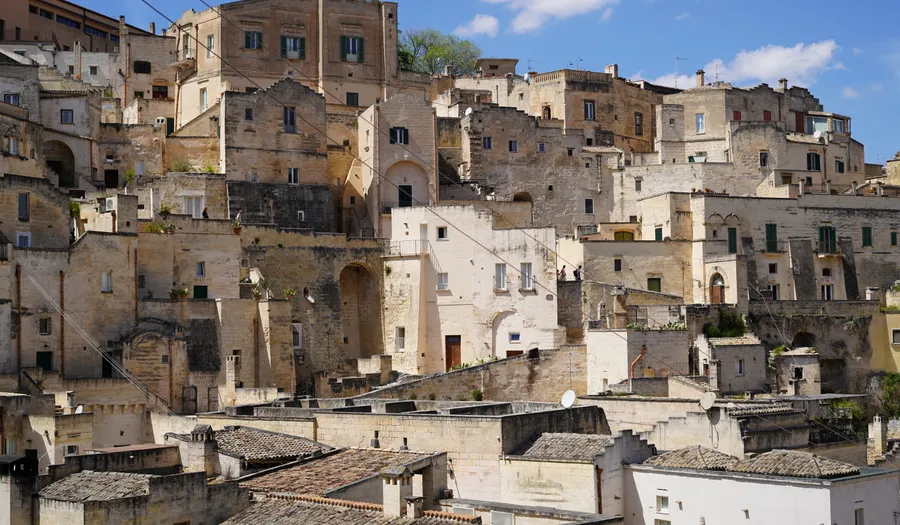
Just across the border in Basilicata, Matera is absolutely worth the detour. Its sassi, cave dwellings carved into the tuff, form a cityscape unique in the world, listed by UNESCO. You can visit Byzantine rock churches and reconstructed cave houses. The Murgia Timone viewpoint, on the other side of the ravine, gives the most striking view, especially at dusk when the town lights up. Allow a full day, ideally with a night there.
Lecce

The Florence of the South is a riot of Baroque carved from soft, honey-coloured stone. The Basilica di Santa Croce and Piazza del Duomo rank among the finest ensembles in Italy. You stroll between papier-mâché workshops, historic cafés and a Roman amphitheatre that surfaces right in the middle of Piazza Sant'Oronzo. Try the pasticciotto, the local custard pastry, and caffè leccese with almond milk. The city is also the gateway to the Salento and its beaches.
Vieste and the Gargano
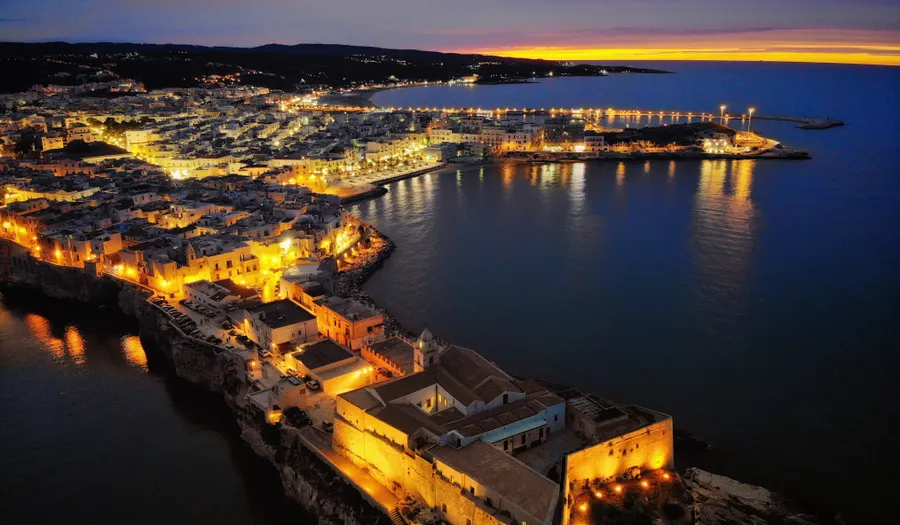
The spur of the Italian boot is a wild promontory covered by the Foresta Umbra, listed by UNESCO. Vieste, perched on its white rock, overlooks Pizzomunno beach and its 25-metre monolith. The coast road to Mattinata strings together coves, limestone arches and trabucchi, old fishing machines on stilts. A boat trip to the sea caves is a must. Allow two days for this more remote corner, a four-hour drive from the Salento.
How many days, and which itinerary?
A week covers the Itria Valley, the Adriatic coast and Matera; ten days add the Salento and the Gargano without rushing.
🗺️ Day-by-day itinerary · 📓 Free printable Puglia guide (PDF) · 🌍 All of Italy
The essentials (7 days)
Bari, then Polignano a Mare and Monopoli, two nights in the Itria Valley for Alberobello, Locorotondo and Ostuni, one night in Matera, then two days in Lecce and on the Salento beaches. The great classic, brisk but doable.
Grand tour (10-12 days)
The same core at a gentler pace, opening with the Gargano and Vieste, a night in a masseria among the olive groves, and a long finale in the Salento between Otranto, Gallipoli and Santa Maria di Leuca. The right format to see it all.
Salento and lazing about (5-6 days)
A single base in Lecce or a nearby masseria. Days split between Lecce Baroque, the beaches of Punta Prosciutto and Pescoluse, Otranto and the east coast. Ideal for couples wanting a mix of culture and sun loungers.
Getting there and getting around
A hire car is almost essential: allow €35-55/day from Bari or Brindisi airports, and book early for summer.
Two airports with flights from across Europe: Bari (north and Itria Valley) and Brindisi (Salento), so consider an open-jaw route.
The Ferrovie del Sud-Est train links Bari, Alberobello, Martina Franca and Lecce: slow but scenic and very cheap.
In towns, park in car parks on the edge of the historic centres: the ZTLs (limited traffic zones) are enforced by camera.
Where to stay in Puglia?
Restored trullo in Alberobello or the Itria countryside: €90-150 a night, the region's signature experience.
Boutique masseria with a pool between Ostuni and Savelletri: €150-350, Pugliese rural luxury.
B&Bs in the historic centres of Lecce or Monopoli: €60-110, excellent value outside summer.
Flats and small beach hotels in the Salento: €70-130, book several months ahead for July-August.
Our places to stay, stop by stop, at three budgets →
What to eat in Puglia?
Orecchiette alle cime di rapa, the region's emblematic pasta, often made by hand in the street in Bari Vecchia.
Ultra-fresh burrata and mozzarella from Andria, bought straight from the caseifici in the morning.
Focaccia barese, fried panzerotti and taralli: local street food costs €2-5 and makes a filling lunch.
Primitivo di Manduria and Negroamaro wines, with tastings in Salento cellars for around €15-25.
Entry requirements
Schengen area: an ID card or passport for EU citizens, 90 days visa-free for UK, US, Canadian and Australian passports.
Rules change: check your own government's travel advice before you go.
Frequently asked questions about Puglia
When is the best time to visit Puglia?
May, June, September and early October: warm or already pleasant sea, superb light and sights without the August crush. July-August are very hot, crowded and noticeably more expensive.
What daily budget should I plan?
Allow €60-90 on a backpacker budget, €100-160 for comfort with a car and good restaurants, and €220 and up for a stay in an upmarket masseria.
How do you get around?
A hire car is the best option for roaming between villages, beaches and masserie. The Ferrovie del Sud-Est train will do between Bari, Alberobello and Lecce, but it is slow.
How many days should I allow?
A week for the essentials (Itria Valley, coast, Matera, Lecce), ten to twelve days to add the Gargano and really enjoy the Salento beaches.
Should Matera be part of a Puglia tour?
Yes, without hesitation. The city of the sassi is in Basilicata but less than an hour's drive from Alberobello, and it is one of the most spectacular sights in Italy.
Similar destinations
 Region
🇭🇷 Istria
 Country
🇫🇷 France
 Region
🇫🇷 Normandy
 Region
🇫🇷 The Loire Valley
 City
City🇫🇷 Bordeaux and Around
 Region
🇮🇹 The Amalfi Coast
 City
City🇫🇷 Colmar
 City
City🇫🇷 Nice
 Region
🇫🇷 Aix-en-Provence
 City
City