When to go to Colmar?
→ The detailed month-by-month page, with real weather records
Best time: May to June and September (Christmas markets: late November to December)
At a glance
Why go to Colmar?
Colmar owes its density of heritage to an accident of history: unlike most towns on the plain, it was not bombed in either world war. The result is a centre less than a kilometre across where, without transition, you pass 15th-century half-timbered houses, carved Renaissance façades such as the Maison Pfister of 1537, a Gothic merchants' hall and 18th-century mansions. Everything is on foot, on the flat, and most of the old town is closed to traffic.
The Unterlinden Museum changes the whole scale of the visit. Housed in a 13th-century Dominican convent extended in 2015 by Herzog & de Meuron, it holds the Isenheim Altarpiece, painted between 1512 and 1516 by Matthias Grünewald for a hospital run by the Antonine order, which treated St Anthony's fire. The Crucifixion shows a body covered in sores, turning green, with clenched hands: the painting was made to be looked at by disfigured patients, and it has lost none of its violence. It is one of the rare works in France worth making the journey for in its own right.
The third register is the lived-in town, and it only survives outside December. The covered market of 1865, the Lauch and its market gardens, the neighbourhood winstubs and six thousand students make a town of 70,000 people that works normally eleven months of the year. Then comes the Christmas market: from 23 November to 29 December 2026, six sites, 1.6 million visitors, a centre closed to cars and streets where you move at a crawl on Saturday afternoons. It is spectacular, and it is a different trip, to be chosen with your eyes open.
Map of Colmar: what is where?
The map shows the 6 places covered in this guide, to picture the distances and plan your route.
- Unterlinden Museum
- Collegiate Church of Saint-Martin
- Koïfhus, old customs house
- Little Venice
- Covered market
- Toy Museum
How much does a trip to Colmar cost?
Colmar is noticeably cheaper than the average French tourist town for eleven months of the year, with museums under €15 and honest meals at around €25. December works by different rules: accommodation in the centre becomes scarce and expensive, and you need to book several months ahead.
| Style | Per day | What it covers |
|---|---|---|
| Backpacker | €50-80/day | Hotel near the station or a shared room, lunch at the covered market, tarte flambée in the evening, Unterlinden and Saint-Martin |
| Comfort | €120-190/day | Hotel in the old town, one winstub a day, all the museums, a boat ride, glasses of Alsace wine |
| Premium | €300+/day | Maison des Têtes or a characterful hotel, gourmet restaurant, private tasting at a wine estate, chauffeur-driven car for the vineyards |
Cards are accepted absolutely everywhere, including for a three-euro mulled wine and on TRACE buses. All the same, keep a few coins for the public toilets in the centre and for the charity stalls at the Christmas markets, some of which only take cash.
Is Colmar safe?
Colmar is a very safe town, with low crime, a centre that is well lit and lively in the evening, and nothing resembling an area to avoid within the tourist zone. Reported incidents are almost all linked to crowds and the calendar rather than to crime. In December, the crush on Place de l'Ancienne Douane and around the children's market is real, with slow-moving crowds in narrow streets: pickpockets work these time slots, so keep your bag in front of you and your phone in a zipped pocket. The centre is barred to vehicles during market hours, with anti-ramming barriers at the entrances and visual checks depending on the alert level: allow ten minutes more than you expect for every journey. Mulled wine is a subject in itself, served very sweet and drunk standing in the cold, which masks its effect; the gendarmerie runs serious checks on the roads out to the vineyards in the evening, and the train is by far the best idea. Finally, dry cold and morning ice on the uneven cobbles of the old town cause more injuries in December than everything else combined.
What to see and do in Colmar
- Unterlinden Museum and the Isenheim Altarpiece
- Little Venice
- The Tanners' Quarter
- Flat-bottomed boat ride on the Lauch
- Collegiate Church of Saint-Martin
- Dominican Church
- Bartholdi Museum
- Colmar Christmas markets
The Unterlinden Museum

A former Dominican convent founded in 1232, turned into a museum in 1853 and doubled in size in 2015 by a Herzog & de Meuron extension that links the buildings via a passage under the square. The centrepiece is the Isenheim Altarpiece by Grünewald and Nikolaus of Haguenau, displayed panel by panel in the chapel, with lighting that reveals the paint surface. The rest of the collection runs from Rhineland archaeology to the German primitives, with a strong modern floor: Monet, Picasso, Dubuffet, Soulages. Open Wednesday to Monday from 9:00 to 18:00, last entry 17:30, closed on Tuesdays. Allow at least two hours, three if you take your time in the modern wing.
Little Venice and the Tanners' Quarter
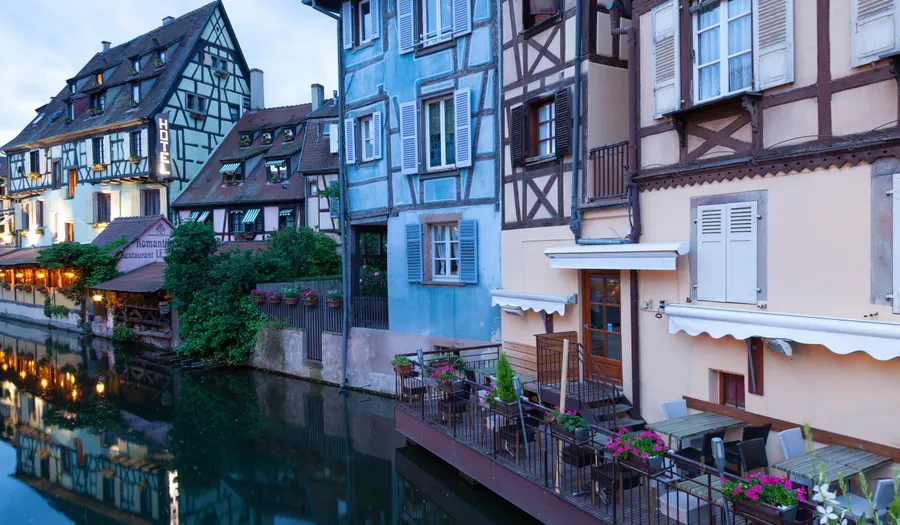
The Lauch runs through the south of the old town and forms, between the Saint-Pierre bridge and the Quai de la Poissonnerie, the row of colourful houses that everyone photographs. It is not mere decoration: the Quai de la Poissonnerie was the fishermen's quarter, and the tall, narrow houses of the Tanners' Quarter, rebuilt in the 17th and 18th centuries, have an open top floor where hides were left to dry in the air. The district was saved from planned demolition by a restoration launched in the 1970s. The best viewpoint is from the Saint-Pierre bridge, early in the morning when the light comes from the east. At the end of a summer day, the crowds make crossing it a chore.
The Koïfhus, the Maison Pfister and the merchant heart
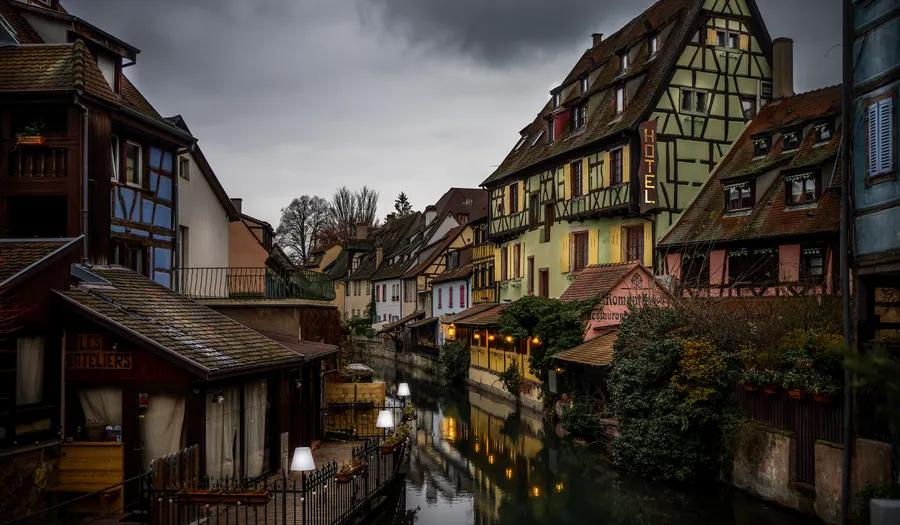
The Koïfhus, or old customs house, built in 1480, is the oldest public building in town: the ground floor was for taxing goods, and the ceremonial hall upstairs was where the Decapolis, the league of ten free cities of Alsace, met. In front, Place de l'Ancienne Douane and the Schwendi fountain form the historic merchant crossroads. A hundred metres away, the Maison Pfister of 1537, with its corner loggia, turret and frescoes, is the manifesto of the Colmar Renaissance, built for a hatter who grew rich in the silver mines. The Maison des Têtes, from 1609, lines up 106 grotesque masks on its façade and is now a hotel. The whole area can be covered in thirty minutes and fits into three streets.
The covered market
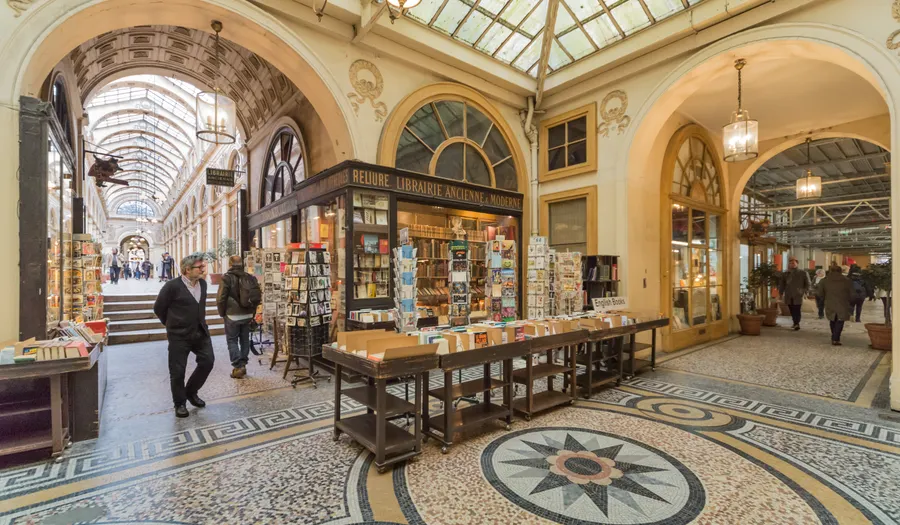
A brick and cast-iron hall opened in 1865 on the banks of the Lauch, renovated in 2010 and still home to some twenty traders: butchers, cheesemongers, greengrocers, a wine merchant and a few counters where you can eat on the spot. It is the best place in town to put together a decent lunch for little money, and the only one where you meet more Colmar locals than visitors. Open Tuesday to Thursday from 8:00 to 18:00, Friday until 19:00, Saturday until 17:00 and Sunday from 10:00 to 14:00. Closed on Mondays and public holidays. The Sunday opening is recent and many guides still don't mention it.
The churches: Saint-Martin and the Dominicans
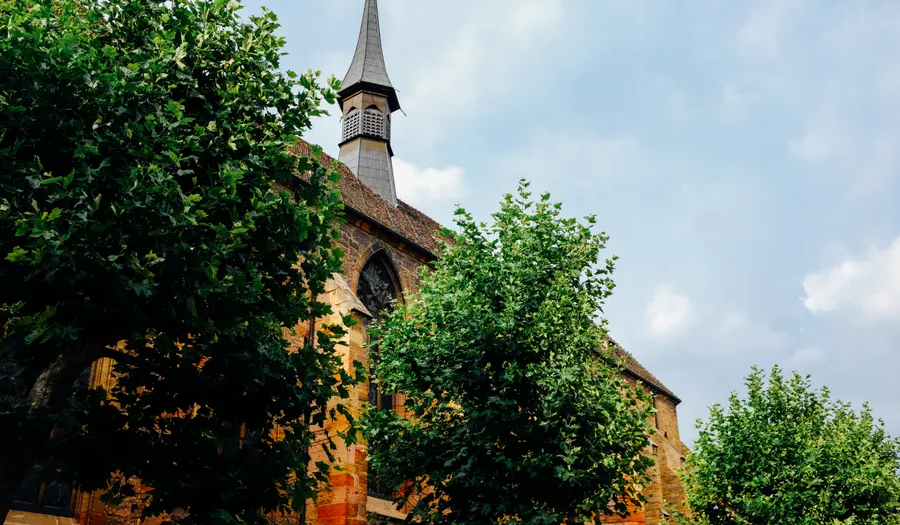
The Collegiate Church of Saint-Martin, built between 1235 and 1365 in yellow Rouffach sandstone, dominates Place de la Cathédrale with its Gothic bulk and its curious onion-domed bell tower, added after the fire of 1572. Entry is free, from 8:00 to 18:45 on weekdays. Two hundred metres away, the Dominican Church, with its 14th-century stained glass, has housed Martin Schongauer's Madonna of the Rose Bower since 1973, painted in 1473, stolen and then recovered in 1972. Entry costs €3. Note that this church only opens during certain periods of the year and closes on Wednesday afternoons only: check the calendar with the tourist office before you go.
The Christmas markets
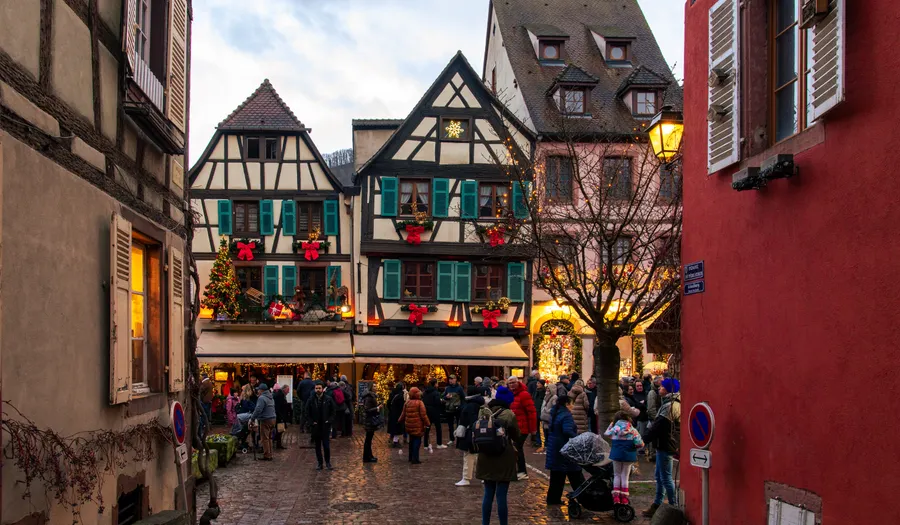
From 23 November to 29 December 2026, six separate markets fill the centre: Place des Dominicains with some sixty chalets facing the illuminated stained glass, Place de l'Ancienne Douane and its fifty chalets around the Schwendi fountain, Place Jeanne d'Arc for Alsatian produce, Little Venice for the children's market with animals and mechanical nativity scenes, the inside of the Koïfhus for fine crafts, and a food market on Rue de la Montagne Verte. Open from 11:00 to 19:00 Monday to Thursday and from 10:00 to 20:00 Friday to Sunday. The centre is closed to vehicles during market hours, and free shuttles link the Parc Expo to the centre on some weekends, with parking at €3 a day. The big wheel and the attractions on Place Rapp stay in place until 3 January.
How many days, and which itinerary?
One full day is enough to see the old town and Unterlinden without rushing; two days let you add Bartholdi, the Dominicans, the covered market and a morning with nothing planned, which is the real luxury here.
🗺️ Day-by-day itinerary · 📓 Free printable Colmar guide (PDF) · 🌍 All of Alsace
One packed day
Unterlinden as soon as it opens at 9:00, two hours for the altarpiece and the primitives, then the Collegiate Church of Saint-Martin and the Maison Pfister before lunch at the covered market. In the afternoon, the Tanners' Quarter, Little Venice and a twenty-five-minute boat ride on the Lauch, dinner in a winstub. It is all doable on foot, never more than ten minutes' walk between two stops.
Two days, the full version
Add the Bartholdi Museum on the morning of the second day, in the birthplace of the sculptor of the Statue of Liberty, then the Dominican Church for the Madonna of the Rose Bower, and the Toy Museum if you are travelling with children. Keep the afternoon for wandering with no plan, the only way to see what is ordinary about the town. Check closing days before planning: Tuesday closes Unterlinden and the Toy Museum, Monday closes Bartholdi and the covered market.
Two days during the Christmas markets
Arrive on a weekday rather than a Saturday, and visit the museums in the morning while the chalets are still quiet or closed. Do the six markets in late afternoon, at dusk around 17:00, starting with the Dominicains and ending with Little Venice, then have an early dinner. The next day, take the Parc Expo shuttle if you have a car, and keep Saturday afternoon for something else: it is the busiest slot of the whole month.
Getting there and getting around
The direct TGV takes about 2h20 from Paris Gare de l'Est, with four direct services a day; from Strasbourg, the TER regional train takes 26 to 31 minutes, with a departure roughly every half hour.
The whole old town can be crossed on foot in under fifteen minutes from end to end, and the station is ten minutes from the centre: a car is only useful for heading out to the vineyards.
TRACE buses cost €1.50 for a single ticket valid for an hour, €11 for a book of ten and €7 for a 72-hour pass, and you can pay directly by bank card on board.
In the multi-storey car parks in the centre, the first hour is free; beyond that, allow €3 a day at Lacarre, Saint-Josse or Gare, and €3.60 at Rapp or Montagne Verte. On-street parking is charged from 9:00 to 12:00 and 14:00 to 19:00, except Sundays and public holidays.
Where to stay in Colmar?
A hotel in the old town, often in a historic house: €110 to 220 a night out of season, everything on foot, but attic rooms that can be cramped.
A chain hotel near the station or the Champ de Mars: €75 to 130, no charm but with parking, ten minutes' walk from the centre.
A short-term rental flat in the Tanners' Quarter or near Little Venice: €90 to 180, the most comfortable option for couples or families staying two nights or more.
In December, everything changes: accommodation in the centre is booked months in advance and prices rise sharply, so much so that it is common to stay in Sélestat, Munster or even Mulhouse and travel in on the TER.
Our places to stay, stop by stop, at three budgets →
What to eat in Colmar?
The winstub is the local institution, with wood-panelled rooms and wine served by the jug: baeckeoffe, choucroute garnie, braised ham hock and fleischschnacka, around €18 to 30 a dish depending on whether you are on a central street or in a residential area.
Tarte flambée, thin dough with cream, bacon and onions, is ordered in rounds and costs around €10 to 14 each; it is the cheapest evening meal in town.
Alsace wines are drunk by the glass and by grape variety, riesling, pinot gris, gewurztraminer, muscat and sylvaner, generally at €4 to 8 a glass in a winstub.
The covered market remains the best value in Colmar for a quick lunch, between the charcuterie, cheese and pretzel counters, as long as you avoid Monday, when it is closed.
Entry requirements
Schengen area: an ID card or passport for EU citizens, 90 days visa-free for UK, US, Canadian and Australian passports.
Rules change: check your own government's travel advice before you go.
Frequently asked questions about Colmar
Should you come for the Christmas markets or avoid them?
Both answers hold up, but you have to choose. From 23 November to 29 December 2026, six markets transform the centre and draw around 1.6 million people: it is very beautiful at dusk and unbearable on a Saturday afternoon. If you are coming for the heritage and the museums, come in May, June or September instead, when everything is open and empty.
What is the worst day of the week to visit Colmar?
Tuesday. The Unterlinden Museum and the Toy Museum are closed that day, which strips the day of its two strongest indoor visits. Monday poses a different, lesser problem: the Bartholdi Museum and the covered market are closed, but Unterlinden stays open.
Is the Isenheim Altarpiece really worth the trip?
Yes, and it is the one thing in Colmar of which that can be said without exaggeration. Painted around 1512-1516 for a hospital that treated St Anthony's fire, it shows a tortured body with a rawness unmatched in the painting of its time, and its panel-by-panel display lets you understand how the polyptych works. Entry is €14, and allow at least an hour for the altarpiece alone.
How long should you stay in Colmar?
One full day honestly covers the old town and Unterlinden. Two days is the right format if you want to add Bartholdi, the Dominicans, a boat ride and some unplanned time. Beyond that, it is the surrounding area that takes over, not the town itself.
How do you get around without a car?
Very easily. The TGV takes 2h20 from Paris, the TER half an hour from Strasbourg, and a quarter of an hour's walk separates the station forecourt from the first half-timbered houses, with no transport ever needed after that. If you arrive by car, note that the first hour is free in the multi-storey car parks and that the centre is closed to traffic during the Christmas markets.
Similar destinations
 Region
🇫🇷 The Loire Valley
 Region
🇮🇹 Puglia
 Region
🇫🇷 Aix-en-Provence
 Region
🇭🇷 Istria
 City
City🇸🇮 Ljubljana
 Country
🇫🇷 France
 Region
🇫🇷 Normandy
 Region
🇫🇷 Provence
 City
City🇫🇷 Bordeaux and Around
 Country