When to go to Alsace?
→ The detailed month-by-month page, with real weather records
Best time: May to September (Christmas markets: December)
At a glance
Why go to Alsace?
Alsace packs into a 100 km strip what other regions spread over hundreds: two listed cities, a legendary wine route, perched fortified castles and a cuisine with its own codes. Strasbourg, a European capital, pairs the Gothic spire of its cathedral with the institutions of the Orangerie district. Colmar, more intimate, lines up its fishermen's houses along the Lauch in the Little Venice quarter.
It is also a destination that moves with the seasons. In spring and summer, the villages of the Wine Route are smothered in geraniums and winstub terraces overflow. In autumn, the grape harvest paints the vineyards gold and purple. In December, Strasbourg once again becomes the capital of Christmas, with its giant tree on Place Kléber and its 300 chalets, a tradition dating back to 1570.
Finally, Alsace is one of the easiest regions to explore without a car, or almost. TER trains link Strasbourg, Sélestat and Colmar in under an hour, cycle paths wind through the vineyards, and everything is close: you can visit Strasbourg Cathedral in the morning, lunch in Riquewihr and climb to the Haut-Koenigsbourg before sunset.
Map of Alsace: what is where?
The map shows the 6 places covered in this guide, to picture the distances and plan your route.
- Strasbourg
- Colmar
- Riquewihr
- Eguisheim
- Haut-Koenigsbourg
- Kaysersberg
How much does a trip to Alsace cost?
Alsace sits around the French average, with price peaks during the Christmas markets, when accommodation almost doubles.
| Style | Per day | What it covers |
|---|---|---|
| Backpacker | €60-85/day | Youth hostel or simple room, tartes flambées, TER trains and bike |
| Comfort | €100-160/day | Boutique hotel, winstub in the evening, shared hire car, tastings |
| Premium | €220+/day | 5-star hotel or country retreat, Michelin-starred restaurant, private driver on the Wine Route |
Cards accepted everywhere; bring a little cash for markets and some wine cellars.
Is Alsace safe?
Alsace is a very safe region. The only precautions concern pickpockets in the crowds at Strasbourg's Christmas markets and the vineyard roads after tastings: breath tests are frequent, so designate a sober driver or opt for the bike and train.
What to see and do in Alsace
- Strasbourg Cathedral
- Petite France
- Little Venice in Colmar
- Unterlinden Museum
- The Wine Route
- Riquewihr
- Eguisheim
- Château du Haut-Koenigsbourg
Strasbourg

The Alsatian capital is best explored on foot, from Place Kléber to the cathedral, whose 142-metre spire dominated the Christian world for two centuries. The Petite France quarter, once the tanners' stronghold, lines up its half-timbered houses along the Ill. Don't miss the astronomical clock at 12.30pm or the view from the cathedral platform. A Batorama boat cruise rounds off a first day nicely. In the evening, head for a winstub on Rue du Bain-aux-Plantes.
Colmar

Colmar is the most photogenic town in Alsace, and it knows it. Little Venice, the Quai de la Poissonnerie and the Maison Pfister make up a perfectly preserved historic centre. The Unterlinden Museum houses the Isenheim Altarpiece, an absolute masterpiece of Rhenish painting. Allow a good day to wander, longer during the Christmas markets. Flat-bottomed boats on the Lauch offer an unusual view of the façades.
Riquewihr
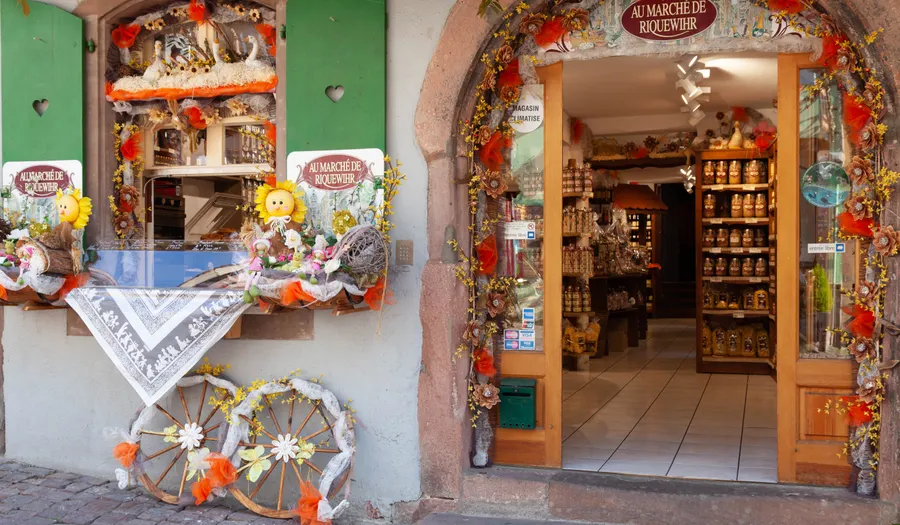
Listed among the most beautiful villages in France, Riquewihr has kept its fortifications intact, along with its cobbled main street climbing to the Dolder, a 13th-century belfry. Tasting cellars follow one after another, with Hugel and Dopff the historic houses. The village inspired the settings of Disney's Beauty and the Beast. Come before 10:00 or after 17:00 to avoid the groups. The vineyard paths above the village offer a superb view over the rooftops.
Eguisheim
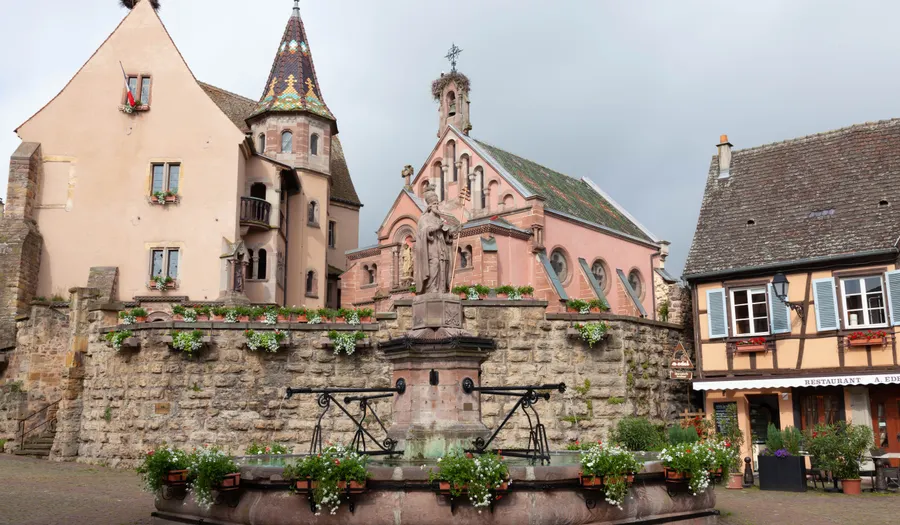
The birthplace of Pope Leo IX, Eguisheim coils in concentric circles around its castle. Its cobbled lanes, leaning houses and Renaissance fountains earned it the title of France's favourite village in 2013. The winemakers here are more approachable than in Riquewihr, with fine tastings of Eichberg and Pfersigberg grands crus. Allow two hours of wandering. The Three Castles trail, above the village, makes a lovely hiking loop.
Château du Haut-Koenigsbourg

Perched at 757 metres on its rocky spur, the Haut-Koenigsbourg has watched over the Alsace plain since the 12th century. Restored by Kaiser Wilhelm II in the early 20th century, it offers a very complete immersion in the life of a fortified castle, armouries and keep included. On a clear day, the view stretches to the Black Forest and sometimes the Alps. Allow two hours for the visit. The drive up from Kintzheim is superb, and a shuttle also leaves from Sélestat station.
The Wine Route and vineyard villages

From Marlenheim to Thann, the Wine Route threads together 70 wine villages over 170 km. As well as Riquewihr and Eguisheim, stop at Kaysersberg, birthplace of Albert Schweitzer, overlooked by its castle; at Ribeauvillé and its three fortresses; and at Hunawihr with its fortified church amid the vines. Every village has its cellars and winstubs. Cycling is an excellent way to link the villages between Colmar and Ribeauvillé. In season, wine festivals liven up the weekends.
How many days, and which itinerary?
Allow 4 to 5 days to combine Strasbourg, Colmar and the Wine Route without rushing, a week if you add the Vosges.
🗺️ Day-by-day itinerary · 📓 Free printable Alsace guide (PDF) · 🌍 All of France
The essentials (3 days)
A full day in Strasbourg between the cathedral and Petite France, then the train to Colmar. Day two between Little Venice and the Unterlinden Museum. Day three by car or bike on the Wine Route: Eguisheim, Riquewihr and Kaysersberg.
Classic Alsace (5 days)
Two days in Strasbourg with an evening in a winstub, a day in Colmar, then two days on the Wine Route with a night in a wine village. Climb to the Haut-Koenigsbourg on the last day, with a stop at the Volerie des Aigles eagle park in Kintzheim if you have children.
Grand tour (7 days)
The 5-day itinerary enriched with a day in the Vosges, between the Route des Crêtes, a farm inn and the Lac Blanc, and an excursion to the Struthof Memorial or the Écomusée d'Alsace in Ungersheim. Ideal for alternating cities, vineyards and mountains.
Getting there and getting around
TGV Paris-Strasbourg in 1h46, then TER Strasbourg-Colmar in 30 min (around €14)
A car is recommended for the Wine Route, hire from €45/day
Bikes are very practical in the vineyards: hire in Colmar, waymarked routes between the villages
Haut-Koenigsbourg shuttle from Sélestat station in season (line 500)
Where to stay in Alsace?
Winstubs with rooms and small village hotels on the Wine Route: €70-110 for a double
Boutique hotels in Colmar (Little Venice quarter): €110-180
Design addresses in Strasbourg (Graffalgar, Léonor): €100-200
B&Bs at a winemaker's with tasting: €80-130, book early for December
Our places to stay, stop by stop, at three budgets →
What to eat in Alsace?
The essential winstub: choucroute garnie or baeckeoffe, €18-26 a dish
Tarte flambée (flammekueche) to share in the evening, €9-13
Kougelhopf and bredele biscuits from the bakeries, Christmas markets for mulled wine
Michelin-starred tasting menus in Colmar (JY'S) and Strasbourg (Buerehiesel) from €90
Entry requirements
Schengen area: an ID card or passport for EU citizens, 90 days visa-free for UK, US, Canadian and Australian passports.
Rules change: check your own government's travel advice before you go.
Cities and regions to discover
 City
City🇫🇷 Strasbourg
 City
City🇫🇷 Colmar
Frequently asked questions about Alsace
When is the best time to visit Alsace?
From May to September for green vineyards and terraces, late September to October for the grape harvest and autumn colours, and December for the Christmas markets. Avoid January and February, which are greyer and quiet.
What daily budget should I plan for?
Allow €100 to €160 a day per person for a couple with a boutique hotel, restaurants and car hire. A budget trip by train with simple rooms comes down to €60-85.
How do I get around?
The train is enough for Strasbourg, Sélestat and Colmar. For the Wine Route, hire a car or a bike: the villages are close together and the cycle routes well waymarked.
How many days do I need?
4 to 5 days let you see Strasbourg, Colmar and the loveliest vineyard villages. A week adds the Vosges and more off-the-beaten-track excursions.
Are the Christmas markets worth the trip?
Yes, Strasbourg has the oldest Christmas market in France and Colmar one of the most beautiful. Book accommodation 3 to 4 months ahead and go midweek, as December weekends are packed.
Similar destinations
 Region
🇫🇷 Normandy
 Region
🇫🇷 The Loire Valley
 Country
🇮🇹 Italy
 Region
🇮🇹 Florence and Tuscany
 Region
🇮🇹 Puglia
 Region
🇫🇷 Aix-en-Provence
 City
City🇫🇷 Avignon
 Region
🇭🇷 Istria
 City
City🇸🇮 Ljubljana
 Region