When to go to Avignon?
→ The detailed month-by-month page, with real weather records
Best time: April to June and September to October
At a glance
Why go to Avignon?
For seventy years, Avignon was the capital of Christendom. Between 1309 and 1377, seven popes moved the papacy here, then two antipopes held out against Rome until 1403, long enough to raise a fifteen-thousand-square-metre fortress in under twenty years and to draw bankers, cardinals and Sienese artists. The city then remained papal territory until the Revolution, which is why it kept its ramparts whole, five kilometres of curtain walls and thirty-nine towers, while almost every other French town tore theirs down in the 19th century.
Its second identity was written in a single week in September 1947, when Jean Vilar staged three productions in the Palace's Cour d'Honneur for what was then called the Semaine d'Art Dramatique. The Festival d'Avignon grew out of it, and with it, from 1966, an Off festival that eventually outgrew it in sheer volume: more than fifteen hundred shows in a hundred and forty venues, over three weeks in July. The whole city changes function that month, accommodation prices double or triple, and the streets are papered with posters down to the last free centimetre of wall.
The rest of the year, Avignon goes back to being a city of ninety thousand people whose entire appeal fits inside an oval a kilometre and a half wide. You can walk from the Palace to Les Halles in ten minutes, from the Collection Lambert to the Rue des Teinturiers in five, and the Île de la Barthelasse begins on the far side of a free river shuttle. It is also Provence's best rail gateway, with a direct TGV from Paris in two hours forty, which makes it a logical car-free base.
Map of Avignon: what is where?
The map shows the 6 places covered in this guide, to picture the distances and plan your route.
- Palais des Papes
- Pont Saint-Bénézet
- Rocher des Doms Garden
- Place de l'Horloge
- Rue des Teinturiers
- Collection Lambert
How much does a trip to Avignon cost?
Avignon is a cheap city eleven months out of twelve and one of the most expensive in France in July. The gap between a weekend in May and the same weekend during the Festival easily exceeds a factor of three on accommodation, for exactly the same thing.
| Style | Per day | What it covers |
|---|---|---|
| Backpacker | €55-85/day | Hostel or hotel outside the walls, free Petit Palais and ramparts, Les Halles and a picnic on the Barthelasse |
| Comfort | €110-180/day | Hotel inside the walls, combined Palace and bridge ticket, Collection Lambert, two dinners on the Rue des Teinturiers |
| Premium | €300+/day | Mansion hotel within the ramparts, tastings in Châteauneuf-du-Pape, fine-dining tables, Festival tickets for the IN |
Cards are accepted everywhere, including at Les Halles, on the shuttles and at the festival box offices. Still, keep some cash for the small Off venues, some of which have only a temperamental card terminal, and for the producers at the Sunday morning markets.
Is Avignon safe?
Avignon has a complicated reputation, partly deserved but misplaced: the problems are concentrated in the western and southern districts, Monclar, Saint-Chamand and La Rocade, where a visitor has no reason to go. The walled town, where an ordinary stay takes place entirely, is safe day and night, all the more so as it stays very busy until late in summer. The real risks are the usual ones: pickpocketing in the Festival crowds, on the café terraces of the Place de l'Horloge and around Les Halles on Saturday mornings, and thefts from cars parked along the ramparts or in outlying car parks, which should never be left loaded, even for an hour. The area around Avignon Centre station and the Porte de la République is busy late at night and sometimes unpleasant, without being dangerous; if in doubt, walk back up the Rue de la République, which stays busy until midnight. Finally, a point that is as practical as it is about safety: the mistral can blow at more than 90 km/h, the Rocher des Doms garden then closes because of the risk of falling branches, and the shuttle crossing to the Barthelasse may be suspended.
What to see and do in Avignon
- Palais des Papes
- Pont Saint-Bénézet
- Rocher des Doms Garden
- Petit Palais Museum
- Rue des Teinturiers
- Les Halles d'Avignon
- Collection Lambert
- Île de la Barthelasse
The Palais des Papes
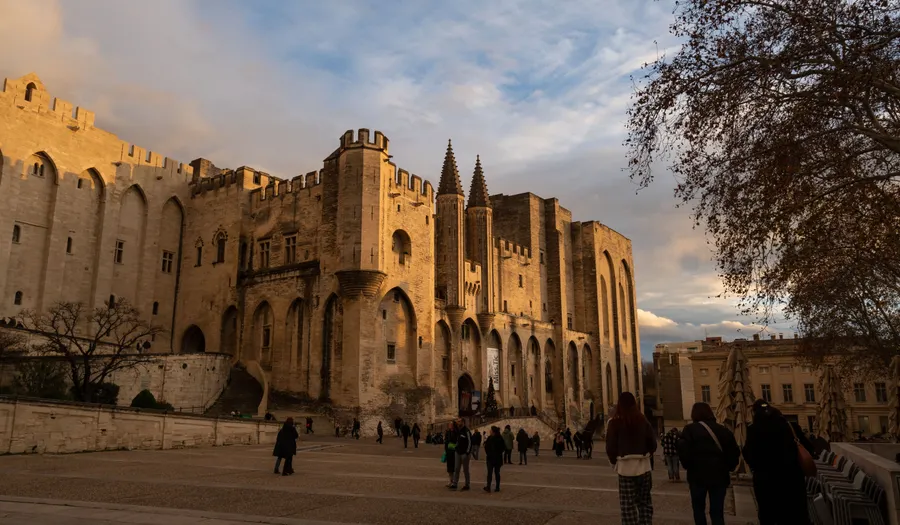
Fifteen thousand square metres of vaulted halls, the largest Gothic building in the world, built in two campaigns by Benedict XII and then Clement VI between 1335 and 1352. The interior was stripped of its furniture during the Revolution, then damaged by a century of military occupation when the Palace served as a barracks: what strikes you today is the raw scale of the spaces rather than the furnishings. Still, the frescoes by Matteo Giovannetti survive in the chapels of Saint-Jean and Saint-Martial, and above all the Chambre du Cerf, painted floor to ceiling with scenes of hunting, fishing and bathing against a backdrop of foliage. The twenty-five-room route is done with an augmented-reality tablet that reconstructs the lost decor, and takes about two hours. The Cour d'Honneur, where the Festival's opening show is staged, is closed to visitors while sets go up in July.
The Pont Saint-Bénézet and the Rocher des Doms
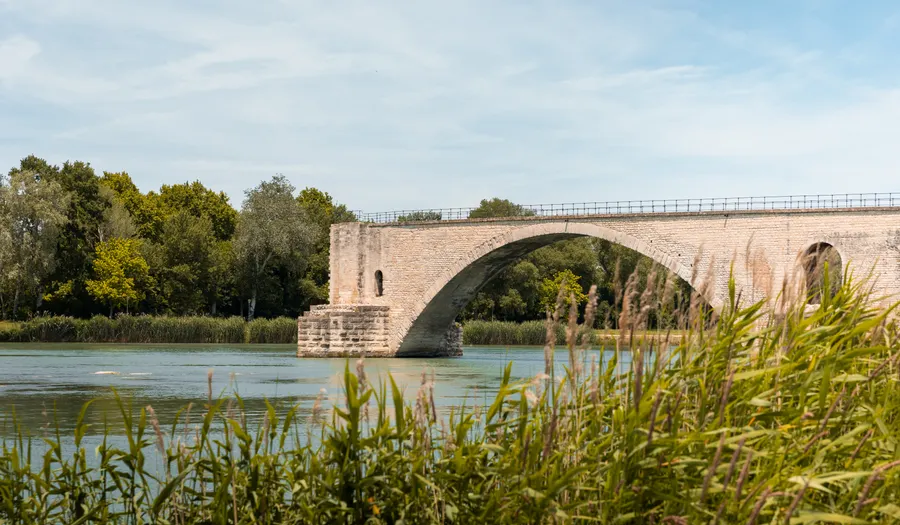
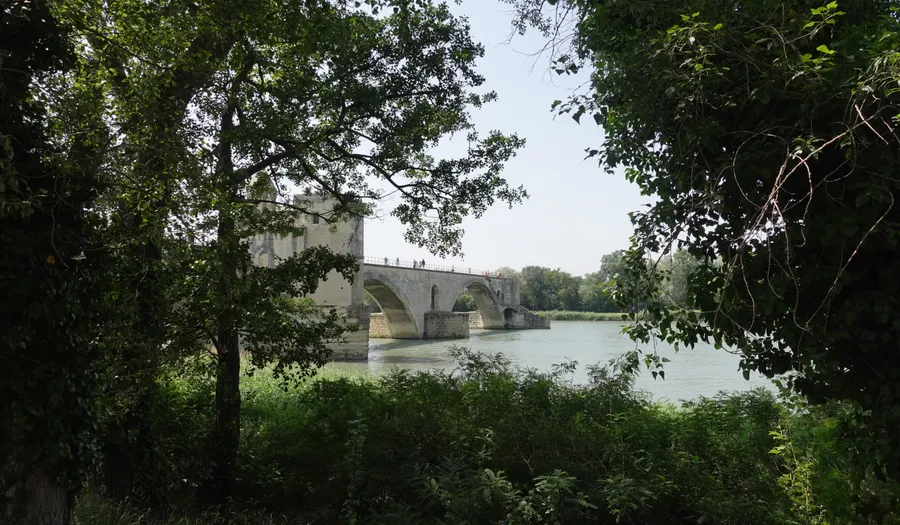
Only four of the original twenty-two arches remain, the Rhône having swept the rest away flood after flood until the bridge was finally abandoned in the 17th century. The visit takes about thirty-five minutes, Saint-Nicolas chapel included, and the real point is to grasp the scale of the structure rather than to cross it. Contrary to the song, people danced under the bridge, on the Île de la Barthelasse, not on it, where it was too narrow. Just above, the Rocher des Doms, the limestone outcrop where the city was born, has been laid out as an English-style garden with a pond, swans and a sundial. This is where you get the best view of the bridge, the Rhône, the Barthelasse and Fort Saint-André in Villeneuve, and entry is free.
The Festival d'Avignon and its Off
Three weeks in July, from the 4th to the 25th in 2026, when the city hosts two overlapping festivals. The IN, founded by Jean Vilar in 1947, puts on around forty new productions in heritage venues, led by the Palace's Cour d'Honneur, with tickets at €15 to €40 that sell out as soon as they go on sale in June. The Off, born in 1966 and now Europe's largest marketplace for live performance, lines up more than fifteen hundred shows in around a hundred venues, at €15 to €22 a ticket, with a membership card that gives 30% off everything. Theatre companies hand out flyers in the streets all day and parade at noon on the Place de l'Horloge, which is part of the show. In practical terms, everything changes in July: accommodation doubles or triples, restaurants require a booking, traffic inside the walls is restricted and visiting the Palace in the afternoon becomes impossible without a reserved time slot.
The Rue des Teinturiers
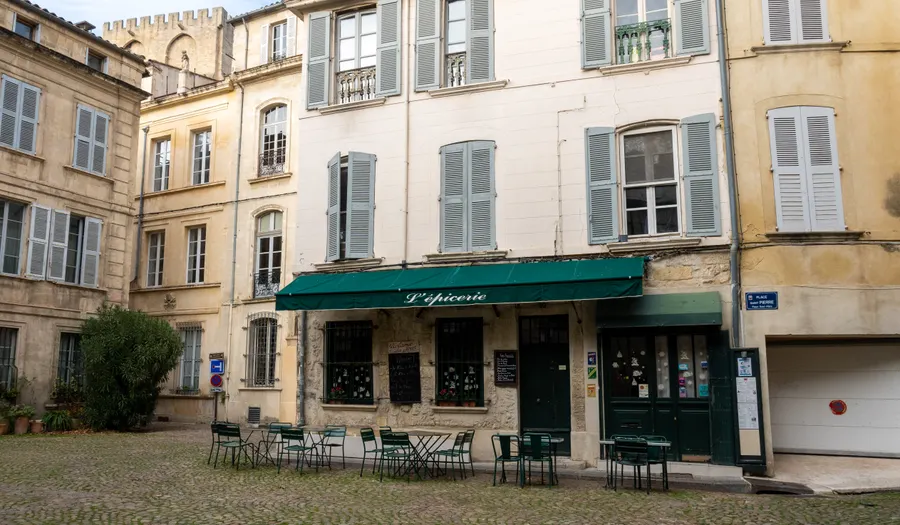
The street follows an arm of the Sorgue diverted in the Middle Ages to power the indienne factories, makers of the printed cotton fabrics that made Avignon's fortune in the 18th and 19th centuries. Four paddle wheels still turn along the canal, under the plane trees, in front of cafés, bookshops and small theatres. It is the liveliest part of town in the evening, and the epicentre of the Off in July, with stages set up in former workshops. The Chapelle des Pénitents Gris, at the end of the street, is free to visit and hides an unexpected Baroque interior. Tables here are more affordable than on the Place de l'Horloge, where you mostly pay for the view of the municipal theatre.
The ramparts and the walled town

Built between 1355 and 1370 by the popes after the Great Companies of mercenaries had passed through, the ramparts run for five kilometres, have thirty-nine towers and have survived almost intact, restored by Viollet-le-Duc in the 19th century. They enclose an oval a kilometre and a half wide that holds absolutely everything a visitor comes to see, which makes a car pointless once you are here. Inside, the city reads by districts: the papal quarter to the north with the Palace, the Petit Palais and the Rocher; the shopping quarter in the centre around the Place de l'Horloge and the Rue de la République; the lively quarter to the south-east towards Les Halles and the Teinturiers. The gates keep their medieval names: Porte de la République opposite the station, Porte de l'Oulle on the Rhône side, Porte Saint-Lazare to the east. Walking the outer circuit takes an hour and a half but offers little: the real walk is inside.
The Île de la Barthelasse

Europe's largest river island covers about seven hundred hectares of orchards, poplars and perfectly flat lanes, directly opposite the ramparts. You reach it by a free river shuttle from the quay below the Rocher des Doms, a three-minute crossing, and bikes are allowed on board. The path along the bank gives the head-on view of the Palace and the bridge, the one on every postcard, and it is especially good late in the day. The island has a municipal open-air pool that opens in summer, riverside guinguettes and a few campsites, ten minutes from the historic centre. Historically, this is where people came to dance and drink outside papal jurisdiction, which explains the line in the song.
How many days, and which itinerary?
Out of season, two days are enough for the Palace, the bridge, the Petit Palais, the Teinturiers and a crossing to the Barthelasse. During the Festival, allow four to five days at least: afternoons and evenings fill up with shows and only the mornings are left for the monuments.
🗺️ Day-by-day itinerary · 📓 Free printable Avignon guide (PDF) · 🌍 All of Provence
Avignon in 24 hours
The Palais des Papes at opening time with a reserved slot, the Pont Saint-Bénézet straight after on the combined ticket, then up to the Rocher des Doms for the view. Lunch at Les Halles, afternoon at the Petit Palais, which is free, and the end of the day on the Rue des Teinturiers. This is the stopover format between two TGVs, and it works provided you have bought your tickets in advance.
Avignon outside the Festival (3 days)
A papal day in the north of the city, a day of contemporary art and local life with the Collection Lambert, Les Halles and the Teinturiers, and a third on the Barthelasse by bike and on the Villeneuve-lès-Avignon bank. Accommodation prices are two to three times lower than in July, the monuments can be visited without queues, and the September or October light is as good as summer's.
Avignon during the Festival (5 days)
Three shows a day is a realistic pace; four is a professional's pace. Keep the mornings for the monuments, which open at 9:00, and slot the Off shows into the afternoon with twenty minutes' leeway between venues. Book accommodation in January or February, with a three-to-five-night minimum imposed by most places inside the walls.
Getting there and getting around
Avignon TGV station is 4 km from the centre: the rail shuttle nicknamed la Virgule reaches Avignon Centre station in 5 minutes for under €2, with a departure every twenty to thirty minutes.
Two free park-and-ride car parks, Île Piot and Les Italiens, are linked to the centre by a free shuttle every ten minutes from Monday to Saturday: it is the only sensible option by car, since the walled town is saturated and paid parking.
The whole walled town can be done on foot, a kilometre and a half from the Porte de la République to the Palace, and the T1 tram links the centre to the southern districts for longer journeys.
In July, traffic inside the walls is heavily restricted and part of the centre becomes pedestrianised: arrive by train or park at Piot, and add thirty minutes to every journey because of the crowds.
Where to stay in Avignon?
Inside the walls, a boutique hotel in a former mansion: €120 to €280 a night outside July, ideally placed to do everything on foot.
Outside the walls, towards Villeneuve-lès-Avignon or on the Montfavet road: €70 to €130, with free parking and twenty minutes by bus or on foot to the ramparts.
In July, rates inside the walls double or triple and most places impose a three-to-five-night minimum: book in January or February, not in May.
Festival flats are let by the week, often €700 to €1,500 for two, directly from Avignon owners via the Off's accommodation platforms.
Our places to stay, stop by stop, at three budgets →
What to eat in Avignon?
Les Halles, on Place Pie, open Tuesday to Sunday from 6:00 to 14:00: two counters serve oysters, fish and charcuterie on the spot for €12 to €20, and on Saturdays at 11:00 a local chef gives a free cooking demonstration with tasting.
Papeton d'aubergine, caillette, gardiane of Camargue bull and Banon cheese make up the local menu, at around €18 to €28 a dish in the bistros of the Teinturiers.
The area's Côtes du Rhône wines, Châteauneuf-du-Pape, Gigondas and Tavel rosé, can be tasted by the glass from €5 in the wine bars of the Rue des Teinturiers and the Place des Corps-Saints.
In July, book every dinner: between 20:00 and 21:00 the whole city eats at once, between two shows, and kitchens close early despite the crowds.
Entry requirements
Schengen area: an ID card or passport for EU citizens, 90 days visa-free for UK, US, Canadian and Australian passports.
Rules change: check your own government's travel advice before you go.
Frequently asked questions about Avignon
Should I come during the Festival or avoid it?
It all depends on what you are after, and you need to choose clearly. In July, from the 4th to the 25th in 2026, the city is in constant ferment, but accommodation doubles or triples, restaurants are full, monuments are packed and traffic is restricted. Outside the Festival, you will see the same city, calmer and two to three times cheaper, but without what makes it unique in the world.
How many days do I need for Avignon?
Out of season, two days are enough for the Palace, the bridge, the Petit Palais, the Teinturiers and the Barthelasse. During the Festival, allow four to five days: the days fill up with shows and only the mornings are left for sightseeing. A day trip from Paris is doable by TGV, but very tight.
Do I need to book the Palais des Papes and the bridge?
Yes, in July and August it is essential: the queue on the Place du Palais easily exceeds an hour. The Palace alone costs €12, the bridge alone €6, and the combined Palace, bridge and papal gardens ticket €17 until summer 2026, then €19.50 after that. The audio guide and the augmented-reality tablet are included in the price.
Is the Pont d'Avignon really worth the detour?
For a thirty-five-minute visit and €6 on its own, yes, provided you know what you are going to see: four arches out of twenty-two, a chapel and a story of floods. Taken on the combined ticket with the Palace, it costs next to nothing extra. But the finest view of the bridge is from the Rocher des Doms or from the opposite bank, and it is free.
Where can I park in Avignon?
At the free park-and-ride car parks on Île Piot or at Les Italiens, with a free shuttle to the centre every ten minutes from Monday to Saturday. Île Piot has about eleven hundred spaces and a direct view of the bridge. Do not try to park inside the walls: it is paid, saturated and heavily restricted during the Festival.
Similar destinations
 Country
🇫🇷 France
 Region
🇫🇷 Normandy
 Region
🇫🇷 Alsace
 Region
🇫🇷 The Loire Valley
 Country
🇮🇹 Italy
 Region
🇮🇹 Florence and Tuscany
 Country
🇩🇪 Germany
 Region
🇮🇹 Puglia
 City
City🇨🇦 Montreal and Quebec City
 City
City