When to go to Aix-en-Provence?
→ The detailed month-by-month page, with real weather records
Best time: April to June and September to October
At a glance
Why go to Aix-en-Provence?
Aix was born of its water. The Romans founded Aquae Sextiae in 122 BC precisely for its hot springs, and the city has never stopped living on them: the water table still emerges at 34°C beneath today's spa, the mossy fountain on Cours Mirabeau runs lukewarm all year round, and around a hundred fountains punctuate the squares of the centre. This abundance explains the profusion of plane trees, the continuous shade in the streets and the fact that Aix copes with heatwaves better than its neighbours.
The second layer is aristocratic. Capital of the County of Provence and then seat of the Parliament, Aix saw its parliamentary families build nearly two hundred mansions between the 17th and 18th centuries, in a pale golden limestone that gives the centre its rare unity. The Mazarin quarter, laid out in one go in 1646 south of Cours Mirabeau, is the proof: the same heights, the same carriage doors, the same wrought-iron balconies on a perfect grid. Nothing there is spectacular; everything is coherent.
The third is Cézanne's, and it is what draws people here. Born in Aix in 1839, he painted here for forty years, and his places of work are all preserved within a few kilometres of the centre: the Lauves studio built in 1902, the Bibémus ochre quarries he rented from 1895 to 1904, and the Jas de Bouffan, the family country house. These sites only open for part of the year, with strict visitor limits and booking compulsory in practice, which means planning your stay around them rather than the other way round.
Map of Aix-en-Provence: what is where?
The map shows the 6 places covered in this guide, to picture the distances and plan your route.
- Cours Mirabeau
- Place Richelme
- Saint-Sauveur Cathedral
- Cézanne's Studio
- Musée Granet
- Bibémus Quarries
How much does a trip to Aix-en-Provence cost?
Aix costs more than its size would suggest, because the centre is small, in high demand and frequented by a well-off clientele. The good news is that the essentials of the city, fountains, markets and the Mazarin quarter, cost nothing.
| Style | Per day | What it covers |
|---|---|---|
| Backpacker | €55-85/day | B&B or shared flat, markets and picnics, municipal museums, getting everywhere on foot |
| Comfort | €120-190/day | 3-star hotel in the centre, the Granet and Cézanne's studio, two restaurant dinners, a multi-storey car park |
| Premium | €320+/day | Mansion hotel in the Mazarin quarter, a day at the Thermes Sextius, gourmet restaurants, private guided tour of the Cézanne sites |
Everything can be paid by card, including parking via the municipal car parks' app. Still, keep €20 in cash for small producers at the markets and for the parking meters when the app doesn't work, which happens regularly underground.
Is Aix-en-Provence safe?
Aix is one of the most peaceful cities in the region, with a pedestrianised centre that stays lively until late and a large student population that keeps the streets alive all year round. The real risk is pickpocketing on big market days, Tuesday, Thursday and Saturday, when the crowds pack Place des Prêcheurs and Place de Verdun, and bags left on the ground being snatched from terrace tables on Cours Mirabeau. The second risk is theft from cars: never leave anything visible, especially in the park and ride car parks on the outskirts and at the trailheads for Sainte-Victoire and Bibémus, where smashed windows are common in summer. Student nightlife makes some areas noisy on Thursday and Friday evenings, around Place Richelme, Rue de la Verrerie and Place des Cardeurs, which is more a problem for sleep than for safety. Finally, summer has its own rule: the hills around the city, Sainte-Victoire included, are restricted or even closed depending on the day's fire risk, and the prefectoral order should be checked the evening before any hike.
What to see and do in Aix-en-Provence
- Cours Mirabeau and its fountains
- Place Richelme market
- Cézanne's Studio
- Bibémus Quarries
- Musée Granet
- The Mazarin quarter and the Fountain of the Four Dolphins
- Thermes Sextius
- Fondation Vasarely
Cours Mirabeau
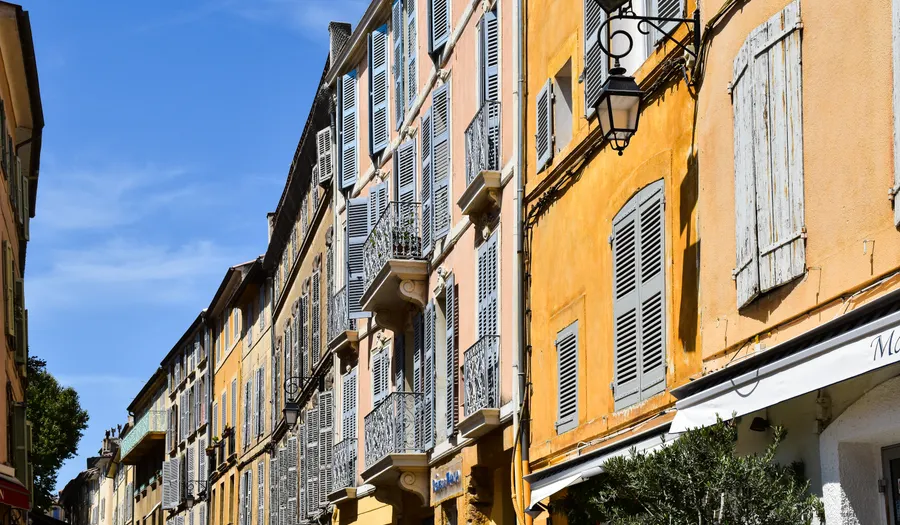
Laid out in 1649 on the site of the old ramparts, the Cours cuts the city in two and serves as a permanent landmark. Four rows of plane trees form a closed canopy that keeps it shaded even in August, and four fountains mark its four hundred metres: La Rotonde to the west, the Neuf-Canons, the mossy fountain that flows at 34°C and is covered in moss, and the Roi René to the east. The north side, in the sun, is where the cafés and shops are; the south side lines up 17th-century mansions and stays silent. This is where the city meets, from morning coffee to the 19:00 terrace crowd, and it is also where prices are highest in the centre. A market of books and regional produce sets up here on certain mornings.
The fountains and Aix's hot water
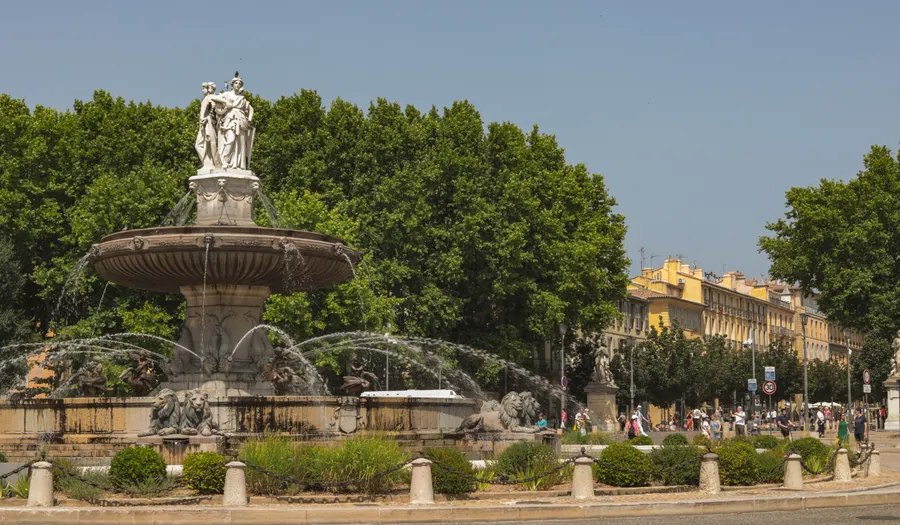
The city has around a hundred fountains, which gives Aix its nickname and shapes any walk: you go from one to the next rather than from monument to monument. The Fountain of the Four Dolphins, at the heart of the Mazarin quarter, dates from 1667 and remains the most photographed; the Neuf-Canons fountain once watered the transhumance flocks that crossed the Cours. The mossy fountain is the oddest: covered in a green mantle kept alive by the warmth of the thermal water, it steams on winter mornings. The Thermes Sextius, built above the Roman remains and a tower from the ramparts, still draw on the spring at 34°C, and patients follow three-week medically prescribed spa treatments there. So this is not a stage set but an activity that has not stopped in two thousand years.
In Cézanne's footsteps
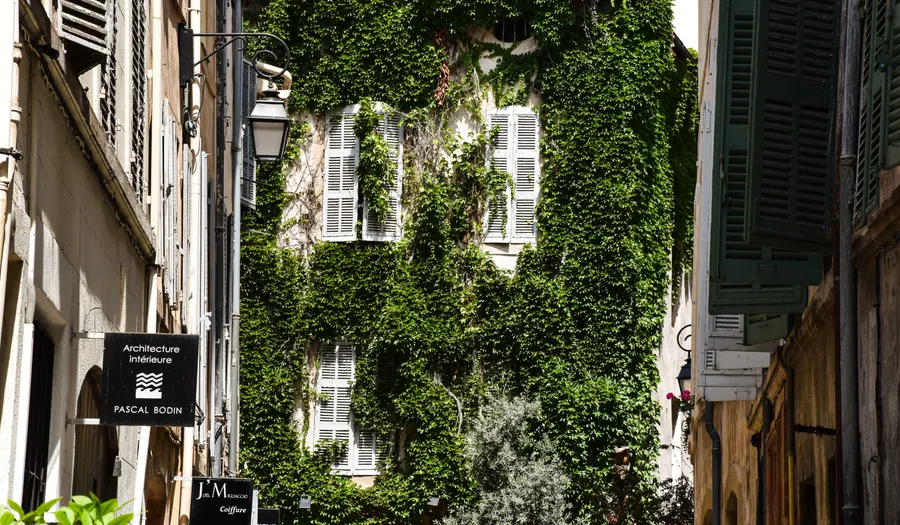
Three sites make up the Cézanne trail, and they complement each other. The Lauves studio, on the hill to the north, was built in 1902 to his plans and kept as it was at his death in 1906: tables, easels, a coat on its hook, skulls and pots from the still-life series. The Bibémus quarries, to the east, are where he rented a hut and painted some forty canvases among the cut blocks of ochre, geometric volumes that foreshadow Cubism. The Jas de Bouffan, the family country house to the west, is where he learned to paint, in the large salon whose walls he decorated. All three open in season, with limited numbers and advance booking required, Bibémus being accessible only on a guided group visit from a meeting point set by the tourist office.
The Mazarin quarter
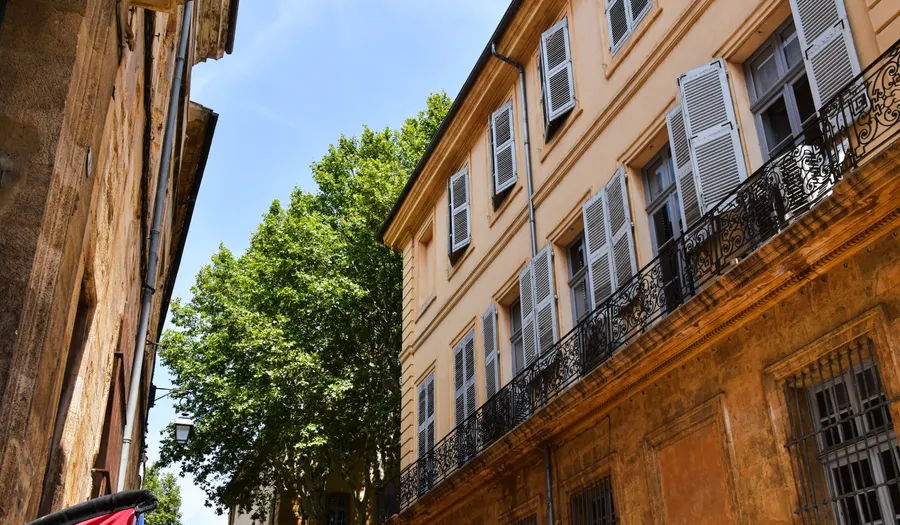
Laid out in one go in 1646 by Archbishop Michel Mazarin, the cardinal's brother, this grid-plan quarter south of Cours Mirabeau is the most uniform piece of the city. The streets are straight, the mansions aligned, and silence falls as soon as you leave the Cours. The Fountain of the Four Dolphins, at the crossing of Rue Cardinale and Rue du 4-Septembre, marks its centre. The Church of Saint-Jean-de-Malte, the city's only Gothic church and burial place of the Counts of Provence, closes the quarter to the east, right next to the Musée Granet. It is the best place to walk between 14:00 and 16:00, when the rest of the centre bakes and the terraces are full.
The markets of Aix
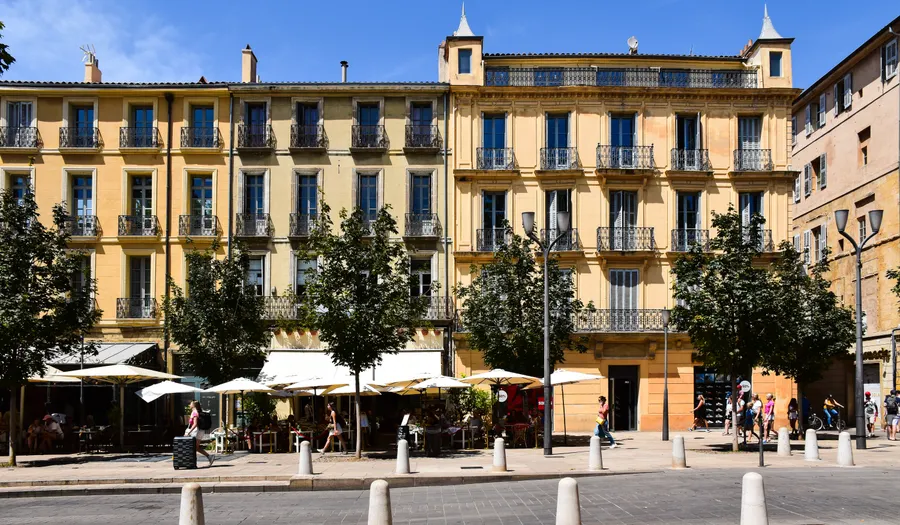
Place Richelme hosts a food market every morning of the year, without exception, under the plane trees behind the town hall: goat's cheeses from Mont Ventoux, brousse du Rove, olives, fruit, a fishmonger and two bakers. On Tuesdays, Thursdays and Saturdays, the big market takes on another dimension, spreading over Place des Prêcheurs and Place de Verdun, with producers, textiles and a large flea market on Verdun. The flower market sets up on the same days on Place de l'Hôtel-de-Ville, smaller but more photogenic. Everything wraps up around 13:00, and by 12:30 the producers are already selling off cheap. It is the best way to put together a €10 lunch in a city where the terraces charge three times as much.
The Musée Granet and the Planque collection
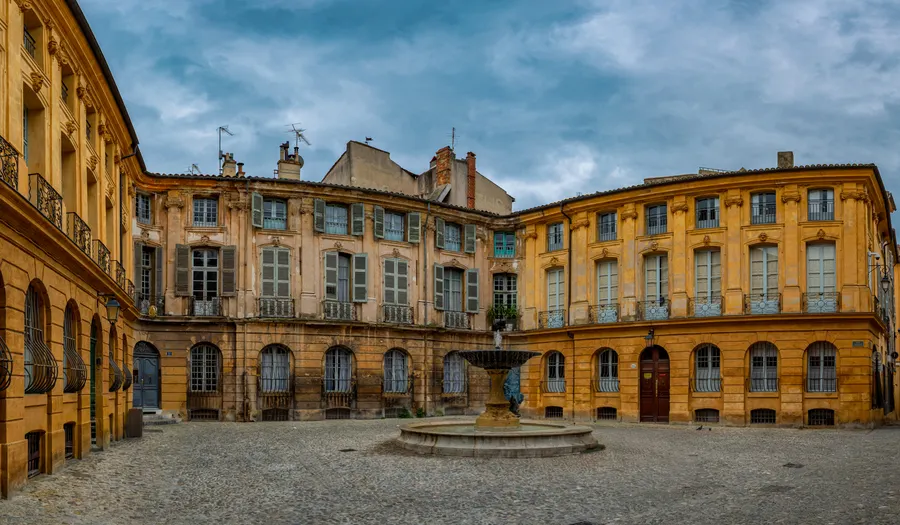
Housed in the former Palace of the Knights of Malta, on the edge of the Mazarin quarter, the Granet covers painting from the 14th to the 20th century, with an archaeology room devoted to the Celto-Ligurian sculptures of Entremont, an oppidum north of the city. The collection includes works by Cézanne, Picasso and Giacometti and a largely underrated body of French and Italian painting. Five minutes away, the Chapelle des Pénitents Blancs houses the Jean Planque collection on long-term loan, around three hundred works assembled by a Swiss painter turned dealer's adviser: Van Gogh, Monet, Renoir, Braque, Dubuffet, Picasso. The two sites are usually visited on the same ticket. The big summer exhibitions push up both the price and the crowds considerably.
How many days, and which itinerary?
Two full days cover the old centre, the markets, the Granet and the Mazarin quarter without rushing. The third day is the one that really counts, set aside for the Cézanne sites, which only open for part of the year and must be booked in advance.
🗺️ Day-by-day itinerary · 📓 Free printable Aix-en-Provence guide (PDF) · 🌍 All of Provence
Aix in one day
Place Richelme market at 9:00, Cours Mirabeau and its four fountains, then the old town as far as Saint-Sauveur Cathedral and its Romanesque cloister. Afternoon at the Musée Granet and in the Mazarin quarter, an aperitif on Place des Cardeurs. This is the format for visitors passing through between Marseille and the Luberon, and it holds up as long as you give up on the Cézanne sites, which need half a day on their own.
Aix and Cézanne (3 days)
One day in the old centre, a full Cézanne day with the Lauves studio in the morning and Bibémus in the afternoon, and a third split between the Fondation Vasarely and the Thermes Sextius. Book slots for the studio and Bibémus as soon as the season opens, as places go quickly in July and August. This is the stay that justifies a proper trip rather than a stopover.
Aix as a base (5 days)
Three days in the city following the previous plan, then two days of short outings around Mont Sainte-Victoire, to Vauvenargues and along the road that circles it. Aix is forty minutes from Marseille by coach and thirty minutes from the TGV station, which lets you stay in the same place for the whole trip. In summer, check the prefectoral order on access to the hills the evening before, as they are often closed to the public from midday.
Getting there and getting around
Aix TGV station is 15 km from the centre, in the town of Vitrolles: the shuttle reaches the Aix bus station in about twenty minutes for around €5, with a departure every quarter of an hour.
On-street parking costs €2 an hour in zone 1, €1 in zone 2 and €0.80 in zone 3, charged from 7:30 to 19:00, with 30 free minutes a day and a post-parking fee set at €33.
Zones 2 and 3 become free for the whole of August, and the Rotonde and Carnot car parks offer the first 30 minutes free; for a full day, a park and ride on the outskirts works out much cheaper.
The historic centre can be crossed on foot in fifteen minutes from north to south, and the climb to Cézanne's studio takes twenty minutes from the cathedral, or five minutes on buses 5 and 12.
Where to stay in Aix-en-Provence?
A converted mansion in the Mazarin quarter: €180 to 400 a night, inner courtyard, total calm and five minutes' walk from Cours Mirabeau.
A 3-star hotel around La Rotonde: €90 to 160, handy for the shuttle to the TGV station and the airport, but noisy on the boulevard side.
A rental flat in the old town, between Richelme and Les Prêcheurs: €80 to 200, the best option from three nights, with the market under your windows and the weekend noise that goes with it.
A bastide or B&B on the Route du Tholonet, five minutes away by car: €120 to 250 with a pool and a view of Sainte-Victoire, but a car is essential and parking in town has to be managed.
Our places to stay, stop by stop, at three budgets →
What to eat in Aix-en-Provence?
The calisson, a diamond of candied melon and almonds topped with sugar icing, sells for €4 to 6 per hundred grams at the historic confectioners in the centre and keeps for three weeks.
The bistros serve classic Provençal cooking, aïoli on Fridays, daube, pieds et paquets: allow €20 to 32 for the lunch menu, much cheaper than ordering à la carte in the evening.
The Place Richelme market provides lunch for €10 per person: brousse du Rove, tapenade, tomatoes, fougasse and a piece of fruit, to eat in the Parc Jourdan.
The terraces on Cours Mirabeau charge for the setting, with a coffee at €3.50 or €4.50, against €2 on Place des Cardeurs or Place Ramus, three minutes' walk away.
Entry requirements
Schengen area: an ID card or passport for EU citizens, 90 days visa-free for UK, US, Canadian and Australian passports.
Rules change: check your own government's travel advice before you go.
Frequently asked questions about Aix-en-Provence
How many days do you need for Aix?
Two days for the city, three if you want the Cézanne sites, which take half a day each with the journeys and shuttles. One day is enough if you are passing through between Marseille and the Luberon, but you will miss what makes the city special.
Can you visit all the Cézanne sites?
Yes, but not all year round and not without booking. In 2026, the Lauves studio opened from 4 July to 31 October, and the Bibémus quarries and the Jas de Bouffan from 15 June to 30 September. Visitor numbers are small, Bibémus can only be visited on a guided group tour booked through the tourist office, and slots go several weeks in advance in July and August.
Where should you park if you arrive by car?
Not on the street for a whole day: zone 1 is €2 an hour from 7:30 to 19:00 and the post-parking fee is €33. Aim for a park and ride on the outskirts, or the Rotonde, Carnot or Mignet car parks if you are only staying a short while, with the first 30 minutes free in some of them. In August, zones 2 and 3 are free, which changes everything.
Which days are the markets?
Place Richelme hosts a food market every morning of the year, until 13:00. On Tuesdays, Thursdays and Saturdays, the big market is added on Place des Prêcheurs and Place de Verdun, with a flea market and textiles, and the flower market sets up on Place de l'Hôtel-de-Ville. Arrive before 11:00, as the producers pack up early.
Aix or Avignon if I only have time for one city?
The two tell different stories. Aix is a city of water, fountains and Cézanne, with the feel of a well-to-do centre and a café-terrace life; Avignon is a city of popes, ramparts and theatre, more monumental and more contrasted. If you are coming in July and theatre interests you, go to Avignon; otherwise Aix is more pleasant for day-to-day living.
Similar destinations
 Region
🇫🇷 The Loire Valley
 Region
🇮🇹 Puglia
 City
City🇫🇷 Colmar
 Region
🇭🇷 Istria
 City
City🇸🇮 Ljubljana
 Country
🇫🇷 France
 Region
🇫🇷 Normandy
 Region
🇫🇷 Alsace
 City
City🇫🇷 Bordeaux and Around
 Country