When to go to Nice?
→ The detailed month-by-month page, with real weather records
Best time: May to June and September to October
At a glance
Why go to Nice?
Nice was Savoyard and then Italian until 1860, and it still shows everywhere. The ochre and blood-red façades of Old Nice are those of Turin, Sainte-Réparate Cathedral is Piedmontese Baroque, and Nissart, the local language still displayed on street signs, owes more to Ligurian than to Provençal. Union with France was settled by a plebiscite negotiated between Napoleon III and Cavour, and the city has kept an identity of its own, not quite Provençal and not really Italian, right down to what is on the plate.
The city reads as three parallel bands, which makes finding your way immediate. First the seafront, seven kilometres of Promenade des Anglais between the airport and Castle Hill. Then the flat city, from Old Nice in the east to the Musiciens quarter in the west, where absolutely everything is under thirty minutes on foot. Finally the hills, Cimiez, Fabron and Mont Boron, home to the museums, the Belle Époque villas and the viewpoints.
Since 2019, three tram lines have changed the logic of a stay. Line 2 crosses the city underground and reaches both airport terminals, line 1 heads north to the Thiers station, and line 3 serves the stadium and the business district. As a result, a hire car is of no use whatsoever for visiting Nice, and the coastal TER train does the rest as far as Menton. It is also what makes Nice the cheapest base on the coast for the same level of comfort.
Map of Nice: what is where?
The map shows the 6 places covered in this guide, to picture the distances and plan your route.
- Place Masséna
- Cours Saleya
- Castle Hill
- Promenade des Anglais
- Matisse Museum, Cimiez
- Port Lympia
How much does a trip to Nice cost?
Nice remains the cheapest city on the Côte d'Azur for the same level of comfort, as long as you don't sleep on the Promenade or have lunch on Cours Saleya. The price gap between June and August is close to 60% for accommodation, while the weather is almost the same.
| Style | Per day | What it covers |
|---|---|---|
| Backpacker | €60-90/day | Hostel or studio near the station, socca and markets, 24h tram pass, public beaches and Castle Hill |
| Comfort | €130-200/day | 3-star hotel in the Carré d'Or, two museums, a dinner at the port, a day on the coast by TER |
| Premium | €400+/day | Palace hotel on the Promenade, sunlounger on a private beach, Michelin-starred restaurants, private transfers and boat trips |
Everything can be paid by card, including socca, the tram and the markets. Keep a few coins for small producers, and always check the menu board before sitting down on a terrace on Cours Saleya: the bills there are noticeably steeper than two streets away.
Is Nice safe?
Nice is safe by the standards of a large urban area, but it also has the problems of one, which the postcard image makes easy to forget. The real, everyday risk is pickpocketing: on the Promenade des Anglais at busy times, on packed trams between Masséna and the port, and above all on the beaches, where bags left on the pebbles during a swim regularly disappear in high summer. Old Nice stays busy and well lit until late, but the lanes around Rue Droite empty out after 1:00 and scuffles outside bars are common at weekends. The area around Thiers station and the top of Avenue Jean Médecin at night call for the same caution as any big-city station, no more, and the municipal police are very present there. Finally, the city still lives with the memory of the 14 July 2016 attack on the Promenade: during major events, Carnival in February included, filtered perimeters and bag checks are systematic, adding twenty to thirty minutes of waiting that you need to plan for.
What to see and do in Nice
- Old Nice at sunset
- Cours Saleya and its market
- Castle Hill
- Promenade des Anglais
- Ponchettes beach and its pebbles
- Matisse Museum and Cimiez park
- Marc Chagall National Museum
- Port Lympia
Old Nice
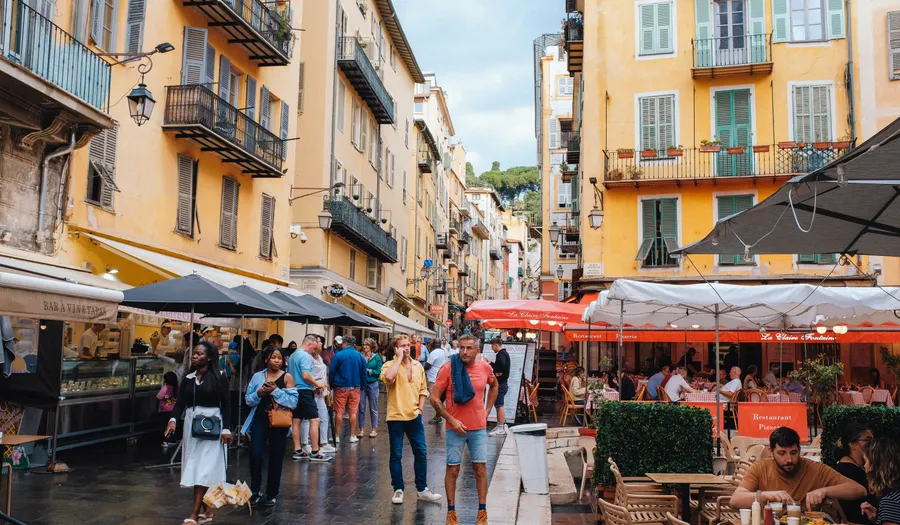
A triangle of narrow lanes between Cours Saleya, Place Garibaldi and the foot of Castle Hill, still a lived-in neighbourhood despite the crowds. The buildings rise five or six storeys over streets three metres wide, which keeps them in shade all day and explains why the air feels fresher here than elsewhere in August. The heart is Place Rossetti, with Sainte-Réparate Cathedral and its glazed-tile domes on one side and the Fenocchio ice-cream parlour on the other. Rue Droite, Rue Pairolière and Rue du Marché are where you find the grocers, wine shops and little bistros; the wider parallel streets are where the tourist menus to avoid are concentrated. The neighbourhood changes face three times a day: deliveries in the morning, coach groups at midday, terraces and musicians from 19:00.
Cours Saleya and the Libération market
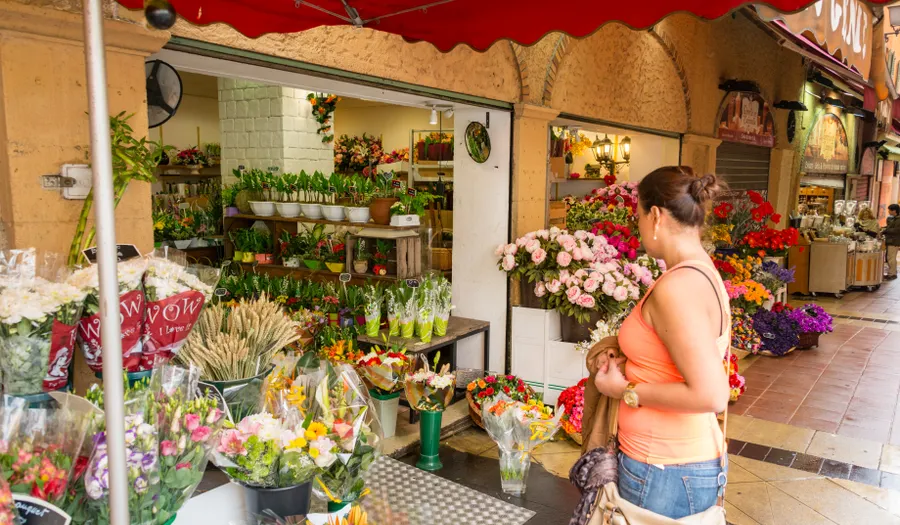
Cours Saleya is the postcard market, with cut flowers, producers from the Nice hinterland and crates of Niçoise olives, Tuesday to Sunday mornings. On Monday it all vanishes in favour of a flea market that runs the full length of the Cours, and from 13:30 the restaurants take over the space from the stalls. The Libération market, in the north of the city on Avenue Malausséna, is the other market, where people from Nice really do their shopping: bigger, cheaper, with a fish hall and producers' stalls open Tuesday to Sunday until 13:00. Tram 1 gets you there in eight minutes from Place Masséna. Both can easily be visited the same morning, and the contrast says a lot about the city.
Castle Hill

The castle itself was razed by Louis XIV's troops in 1706; all that remains are foundations, an artificial waterfall fed since the 19th century and a nineteen-hectare park planted with Aleppo pines and agaves. It is the best viewpoint over the Baie des Anges, with the rooftops of Old Nice on one side and Port Lympia on the other. You can climb up via the 213 steps of the Montée Lesage, take the free lift at the end of Quai des États-Unis, or follow the gentle slope from the port. The Castle cemetery at the top deserves a detour for its marble mausoleums and its Russian and Italian graves. The park closes at nightfall, from 18:00 in winter to 20:00 in high summer.
Cimiez, Matisse and the arena

Cimiez hill bears the remains of Cemenelum, Roman capital of the Maritime Alps, with its arena, baths and archaeology museum, all set in a public olive grove. The Matisse Museum occupies a red-ochre 17th-century Genoese villa and holds the works the painter kept until his death, including gouache cut-outs and studies for the chapel in Vence. Matisse lived in Nice from 1917 to 1954 and is buried in Cimiez cemetery, a hundred metres away. The neighbouring Franciscan monastery has three altarpieces by Louis Bréa and a terraced garden overlooking the city, both free to enter. Bus 5 from Place Masséna gets there in fifteen minutes; on foot, allow forty minutes and two hundred metres of climb.
The Promenade des Anglais and the pebble beaches
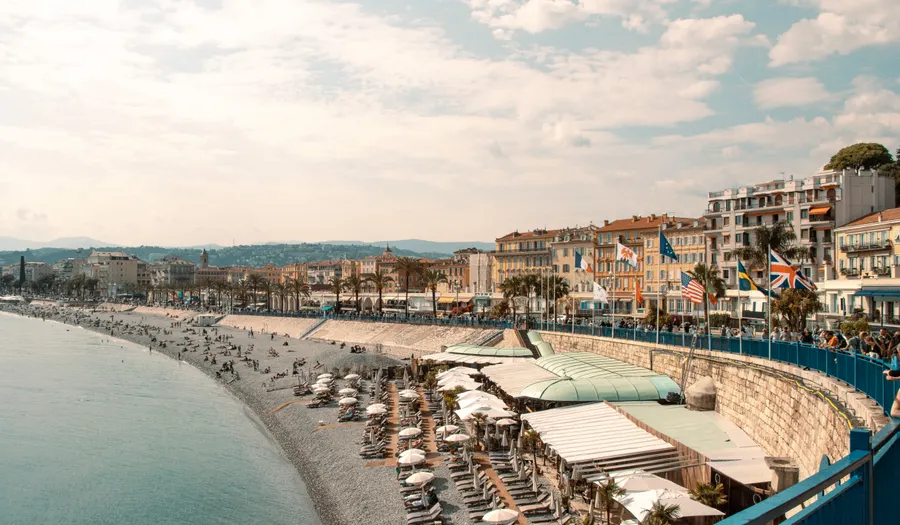
Funded in 1820 by Nice's English colony to give labourers work during a winter of famine, the Promenade has stretched to seven kilometres and is now as much a backbone of local life as a backdrop. Cycle lane, blue chairs, joggers at dawn, families on Sundays: the stretch really worth seeing runs from the Jardin Albert Ier to the Negresco, beyond which the buildings become ordinary. Every beach is pebbles, without exception, and the first swim always surprises those who haven't brought water shoes. Some fifteen free public beaches alternate with private beaches where a sunlounger costs €25 to 40 a day in high season. The water gets deep very quickly and stays clear even right in the centre, which more than makes up for the uncomfortable ground.
Port Lympia and Mont Boron

Dug out from 1749 in a marshy area, the port lines up its red and yellow façades around the Lympia basin, with ferries to Corsica on one side and yachts on the other. For the past decade or so, Quai Lunel and Rue Bonaparte have been home to the best restaurants of the moment, far more interesting than the tourist menus of Old Nice. Place Garibaldi, close by, is the city's finest arcaded square and the evening meeting point. From the port, a path climbs up Mont Boron and its forts, an hour's round trip through pine forest, with a head-on view of the Villefranche harbour. It is also the terminus of tram lines 1 and 2, and so the direct starting point for the airport.
How many days, and which itinerary?
Three full days are enough for the city itself: one for Old Nice and Castle Hill, one for Cimiez and the museums, one for the Promenade, the beaches and the port. Five days let you add two TER trips along the coast without ever touching a car.
🗺️ Day-by-day itinerary · 📓 Free printable Nice guide (PDF) · 🌍 All of the French Riviera
Nice in 48 hours
First morning at Cours Saleya and then in Old Nice before the crowds, up Castle Hill in late afternoon, dinner at the port. Second day in Cimiez, Chagall then Matisse on the same climb, and back via the Promenade for a swim at Les Ponchettes at the end of the day. The most popular format for a weekend break, done entirely on foot and by tram.
Nice and its coast (4 days)
Two days in the city following the plan above, then two days by TER from Nice-Ville station: Villefranche-sur-Mer and Beaulieu one way, Menton and its gardens the other. Each journey costs €2 to 6 and takes under forty minutes, which avoids the car and the Basse Corniche traffic jams entirely.
Nice as a base (one week)
Four days of city and coastal outings, plus a day in the hinterland on the Train des Merveilles to Tende, and a day in Monaco or Antibes. Spending seven nights in one place works out much cheaper than changing hotels every night along the coast, and the rail network does all the work.
Getting there and getting around
Tram line 2 links Terminal 2 at the airport to Port Lympia in twenty-six minutes for €1.80, the price of a normal city journey: it is the most useful line in the city and makes taxis unnecessary.
On the Lignes d'Azur network, a single ticket costs €1.80 with free transfers for an hour, a book of 10 journeys €12.60 and a 24-hour pass €5, trams and buses included.
The coastal TER serves Villefranche, Beaulieu, Èze-sur-Mer, Monaco and Menton every twenty to thirty minutes for €2 to 6: the simplest way to get out of Nice without a car.
Don't hire a car for the city: on-street parking costs around €2.50 an hour, underground car parks €25 to 30 a day, and Old Nice and Cours Saleya are pedestrianised.
Where to stay in Nice?
Old Nice: the liveliest, flats and small hotels at €90 to 200 a night, but noisy nights until 2:00 in summer, especially around Place Rossetti.
The Carré d'Or and the Musiciens quarter, between the Promenade and Avenue Jean Médecin: 3- and 4-star hotels at €120 to 300, five minutes from the beach and quiet.
The Thiers station and Libération area: the best value in the city, €60 to 120 a night, with tram 1 to reach the centre in ten minutes and a real neighbourhood market.
The seafront: from €250 to more than €1,000 a night in the palace hotels on the Promenade, booked three to four months ahead for July and August.
Our places to stay, stop by stop, at three budgets →
What to eat in Nice?
Socca, a chickpea pancake baked in a wood-fired oven, is eaten piping hot and standing up for €3 to 4 a portion, at René Socca or Chez Pipo near the port.
Pan bagnat is not a tuna sandwich but a salade niçoise in an oiled round roll, with no mayonnaise and no cooked vegetables, around €6 to 8.
Petits farcis, pissaladière, courgette flower fritters and daube in red wine make up the menu of Niçois bistros: allow €25 to 40 a meal at a restaurant with the Cuisine Nissarde label.
At Fenocchio, on Place Rossetti, ice cream costs around €3 a scoop, with flavours ranging from tomato to basil to black olive.
Entry requirements
Schengen area: an ID card or passport for EU citizens, 90 days visa-free for UK, US, Canadian and Australian passports.
Rules change: check your own government's travel advice before you go.
Frequently asked questions about Nice
Do you need a car to visit Nice?
No, it actually becomes a handicap. Three tram lines cover the city and the airport, the TER serves the whole coast as far as Menton, and parking in the centre costs €25 to 30 a day in an underground car park. Only hire a car for a day in the hinterland.
Are Nice's beaches really pebbly?
Yes, all of them, along the full seven kilometres of coastline, and it is the number one surprise for first-time visitors. The pebbles are round and as big as a fist, getting into the water is wobbly and the ground gets very hot in the afternoon. Water shoes at €10 and a beach mat rather than a towel solve the problem.
When is the best time to visit?
May, June, September and October: the sea is already or still at 22°C in June and September, prices are a third lower than in August and the museums are not overrun. July and August remain bearable thanks to the breeze, but accommodation prices double. February brings the Carnival and the nearby Lemon Festival, with mild weather and low prices.
How many days should you plan?
Three full days for the city alone, five to add two day trips by train. Beyond that, Nice becomes a base for the whole coast, which is much more economical than changing hotels every night.
Which area should you stay in on a first visit?
The Carré d'Or and the Musiciens quarter offer the best compromise: within walking distance of the Promenade, Old Nice and Place Masséna, with quiet nights. Old Nice is livelier but noisy in summer, and the Thiers station area is the most affordable, with the tram on the doorstep.
Similar destinations
 Region
🇮🇹 The Amalfi Coast
 Region
🇮🇹 Puglia
 City
City🇬🇷 Corfu
 Region
🇭🇷 Istria
 City
City🇲🇹 Valletta
 Region
🇫🇷 Charente-Maritime and the Île de Ré
 Region
🇫🇷 Saint-Malo and the Emerald Coast
 Country
🇫🇷 France
 Region
🇫🇷 Normandy
 Region