When to go to Andalusia?
→ The detailed month-by-month page, with real weather records
Best time: March to June and September to October
At a glance
Why go to Andalusia?
Andalusia packs into a single region the greatest contrasts Europe has to offer. In a week on the road, you go from the Nasrid palaces of Granada to the dunes of the Tabernas Desert, from the endless olive groves of Jaén to the volcanic cliffs of Cabo de Gata. Every stop brings a change of scenery, of light and almost of country. That density is what makes an Andalusian road trip so addictive: nothing looks the same, and everything is less than two hours' drive away.
Eight centuries of al-Andalus have left a heritage seen nowhere else on the continent. The Alhambra, the Mezquita of Córdoba and the Alcázar of Seville form a unique triptych, extended by dozens of white villages whose lanes smell of jasmine and fresh whitewash. In Jerez or the Sacromonte district, flamenco is not a show for tourists but a living practice, sung in bodegas and caves.
It is also an easy and affordable destination. The motorways are excellent and often toll-free, car hire remains cheap, and you eat divinely for 15 euros' worth of tapas. Outside July and August, the climate is ideal: you can ski in the Sierra Nevada in the morning and swim at Nerja in the afternoon. Few regions offer so much freedom on such a reasonable budget.
Map of Andalusia: what is where?
The map shows the 6 places covered in this guide, to picture the distances and plan your route.
- Seville
- Córdoba
- Granada
- Ronda
- Cabo de Gata
- Cádiz
How much does a trip to Andalusia cost?
Andalusia remains one of the most affordable destinations in Western Europe, especially outside July-August. The main expense is accommodation in the big cities in high season.
| Style | Per day | What it covers |
|---|---|---|
| Backpacker | €45-70/day | hostel or guesthouse, tapas and menú del día, ALSA buses, essential sights |
| Comfort | €90-150/day | boutique hotel with a patio, restaurants, hire car, all the monuments |
| Premium | €220+/day | parador or palace hotel, gourmet restaurants, private guide at the Alhambra |
Euros everywhere, cards accepted even in the smallest bars, but keep a little cash for the villages.
Is Andalusia safe?
Andalusia is a very safe region where the main risk remains pickpocketing in the tourist areas of Seville, Granada or Málaga: keep an eye on bags and phones on café terraces. Never leave anything visible in the car, especially in car parks at natural sites. In summer, the heat is the real danger: avoid sightseeing between 14:00 and 18:00, drink plenty and be wary of hiking in the middle of the day. The mountain roads to Ronda or the Alpujarras are winding but in excellent condition.
What to see and do in Andalusia
- Alhambra of Granada
- Mosque-Cathedral of Córdoba
- Ronda and the Puente Nuevo
- White villages of the Sierra
- Cabo de Gata
- Caminito del Rey
- Flamenco night in Jerez
- Tarifa beaches
Granada and the Alhambra
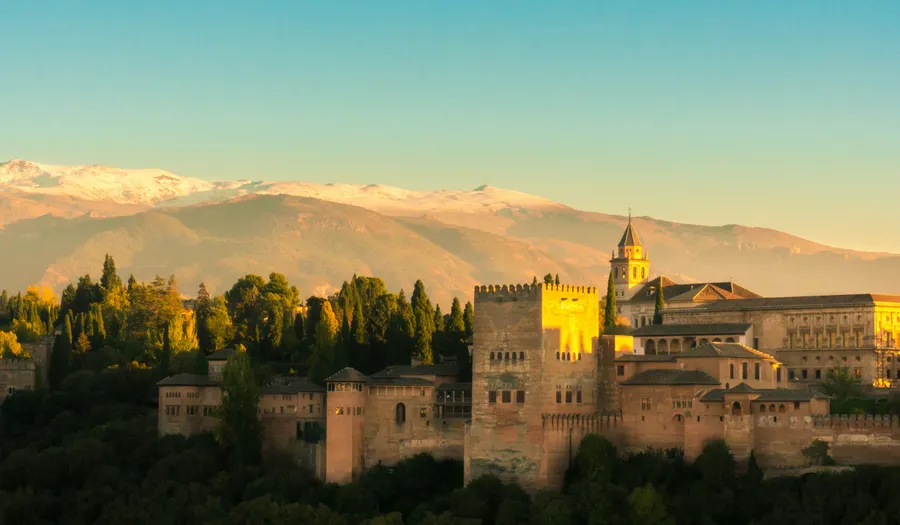
Set at the foot of the Sierra Nevada, Granada is Andalusia's most bewitching city. The Alhambra dominates everything: Nasrid palaces carved like lace, the gardens of the Generalife, the Alcazaba fortress. Below, the Albaicín district unrolls its white lanes up to the Mirador de San Nicolás, facing the palace set ablaze by the sunset. In the evening, bars still serve a free tapa with every drink, a local tradition that is very much alive. Allow two nights minimum so you don't rush anything.
Córdoba

Córdoba was the largest city in the West in the 10th century, and its Mezquita still bears the memory. This forest of 850 columns and two-tone arches, with a cathedral planted in its centre, is an absolute aesthetic shock. Around it, the Judería lines up flower-filled patios, leather stalls and shady little squares. In May, the Patios Festival opens the most spectacular private courtyards in Spain. The Roman bridge at sunset gives the finest view of the old town.
Ronda

Ronda is quite literally cut in two by the El Tajo gorge, a 100-metre canyon spanned by the Puente Nuevo, one of the most famous images in Spain. The town also has the country's oldest bullring and palaces perched on the edge of the void. Hemingway and Orson Welles made it their refuge. Take the path down to the bottom of the gorge for the most impressive view of the bridge. It is the ideal pivot stop between Seville and the coast.
The white villages

Between Ronda and Arcos de la Frontera, the route of the pueblos blancos strings together whitewashed villages clinging to the hills. Zahara de la Sierra overlooks a turquoise lake from its Moorish castle, Grazalema nestles in a natural park criss-crossed by trails, and Setenil de las Bodegas builds its houses beneath huge overhanging rocks. Each village deserves an hour of wandering and a coffee on a terrace. This is rural Andalusia, slow and photogenic, to be savoured without a fixed plan.
Cabo de Gata

At the far eastern end of Andalusia, the Cabo de Gata natural park is the wildest coastline on Spain's Mediterranean. Its volcanic beaches, such as Playa de los Genoveses or Mónsul, remain free of any buildings. The old fishing villages, San José or La Isleta del Moro, have kept their soul, far from the tower blocks of the Costa del Sol. Its seabed also makes it a renowned snorkelling spot. Allow two days and bring water: shade is rare in this coastal desert.
Caminito del Rey

Long considered the most dangerous path in the world, the Caminito del Rey was fully secured and reopened in 2015. Its walkways, pinned 100 metres above the Gaitanes gorge, offer three hours of spectacular walking between sheer rock walls, ending with a suspension bridge. The route runs one way only, from north to south, helmet provided. Griffon vultures often glide at walkers' eye level. It is the unmissable nature excursion between Málaga and Ronda.
How many days, and which itinerary?
Allow 10 to 14 days for a full loop of Seville, Córdoba, Granada, Ronda and the coast, and a week for a condensed tour of the three great cities.
🗺️ Day-by-day itinerary · 📓 Free printable Andalusia guide (PDF) · 🌍 All of Spain
The golden triangle (7 days)
Seville, Córdoba then Granada, by train or car. The essentials of Andalusian heritage, with two nights per city and a detour through the white villages on the way back.
The grand Andalusian loop (12 days)
Seville, Córdoba, Granada, then down to the coast via the Alpujarras, Nerja, Málaga, the Caminito del Rey, Ronda and the white villages before closing the loop via Jerez and Cádiz. The complete road trip.
Nature and wild coast (9 days)
Málaga, the Caminito del Rey, Granada and the Sierra Nevada, then east to the Tabernas Desert and Cabo de Gata. For those who prefer hikes and deserted coves to city sightseeing.
Getting there and getting around
A hire car is essential for the white villages and Cabo de Gata: from €25/day off-season in Málaga or Seville
Fast AVE trains between Seville, Córdoba and Málaga (Seville-Córdoba in 45 min, from €15 if you book early)
Reliable, cheap ALSA buses between all the cities, including Granada and Ronda (€5-15 per journey)
In the historic centres, everything is done on foot; leave the car in an outlying car park (€12-20/day)
Where to stay in Andalusia?
Hostels and guesthouses in the historic centres: €20-35 for a bed or a single room
Boutique hotels in former palaces or patio houses: €70-120 for a double
Exceptional paradores, such as Granada's within the walls of the Alhambra: €180-350
Casas rurales in the white villages: €50-90 a night, often with a pool and a view
Our places to stay, stop by stop, at three budgets →
What to eat in Andalusia?
Tapas: the Andalusian ritual par excellence, €2.50-4 a portion, free with your drink in Granada
Must-tries: salmorejo from Córdoba, gazpacho, Iberian ham, pescaíto frito on the coast
Menú del día at lunchtime: starter, main, dessert and a drink for €12-16 in neighbourhood bars
Sherry from Jerez (fino, manzanilla) to taste in a bodega, tour with tasting from €20
Entry requirements
Schengen area: an ID card or passport for EU citizens, 90 days visa-free for UK, US, Canadian and Australian passports.
Rules change: check your own government's travel advice before you go.
Frequently asked questions about Andalusia
When is the best time for an Andalusia road trip?
From April to mid-June and from mid-September to October: guaranteed sunshine, temperatures of 22 to 28°C and less crowded sights. Avoid July-August, when Seville and Córdoba regularly top 40°C. Winter stays mild and pleasant for the cities, with very low prices.
What daily budget should I plan?
Allow €45 to €70 a day on a backpacker budget, €90 to €150 to travel comfortably with a hire car and boutique hotels. Tapas and menús del día let you eat very well for €15 to €20 a day.
Do you need a car to visit Andalusia?
For the big cities, no: AVE trains and ALSA buses do the job very well. But for the white villages, the Caminito del Rey and Cabo de Gata, a car is essential. Hire costs from €25/day and most motorways are toll-free.
How many days should I allow?
A week is enough for the Seville-Córdoba-Granada triangle. Allow 10 to 14 days for the grand loop including Ronda, the white villages and the coast. With fewer than 5 days, focus on two cities at most.
Should you book the Alhambra and the Caminito del Rey in advance?
Yes, absolutely. Alhambra tickets sell out several weeks ahead, sometimes two months in high season, and the Caminito del Rey is fully booked weeks in advance. Book these two visits even before your hotels.
Similar destinations
 Country
🇫🇷 France
 City
City🇬🇷 Corfu
 Region
🇫🇷 Normandy
 Country
🇮🇹 Italy
 Region
🇮🇹 The Amalfi Coast
 Region
🇮🇹 Sicily
 City
City🇳🇴 Bergen
 Region
🇭🇷 Istria
 Region
🇫🇷 The Côte Vermeille and Collioure
 Region