When to go to Geneva?
→ The detailed month-by-month page, with real weather records
Best time: May to September
At a glance
Why go to Geneva?
Geneva is a tiny city that behaves like a capital. Two hundred thousand people in the municipality, a canton whose border is French along almost its entire length, and yet it is home to the European headquarters of the United Nations, the International Committee of the Red Cross, the World Health Organization, the World Trade Organization and nearly two hundred diplomatic missions. That density of institutions explains everything else: the cosmopolitanism, the rents, the watchmakers' windows, and the fact that you hear as much English as French on the tram.
The setting comes down to three elements you can see from just about everywhere. The harbour, where the Rhône leaves Lake Geneva between two quays lined with benches and diving boards. The hill of the Old Town, a compact block of patrician houses packed around the cathedral, heart of the Calvinist Reformation since 1536. And the horizon closed off to the south by the Salève, a 1,300-metre French mountain that gives the illusion of being up high when you are in fact at 375 metres on a lakeshore.
Which leaves the question that really decides the trip: money. An evening main course at 40 francs, a beer at 9 francs and a decent hotel room at 250 francs are the norm, not the exception. The good news is that there are very effective local countermeasures, from the transport card given free to anyone sleeping in the city to free municipal museums, not to mention the border that tens of thousands of people cross every day to live more cheaply.
Map of Geneva: what is where?
The map shows the 6 places covered in this guide, to picture the distances and plan your route.
- Jet d'Eau
- St Pierre Cathedral
- Bains des Pâquis
- Palais des Nations
- Carouge
- Salève Cable Car
How much does a trip to Geneva cost?
Geneva consistently ranks among the five most expensive cities in the world, and there is no discreet version of the problem: it is a third to a half more expensive than Paris on almost every item. There is still room for manoeuvre, through the free transport card, the free museums and the border.
| Style | Per day | What it covers |
|---|---|---|
| Tight | CHF 110-160/day | Youth hostel or a night on the French side, supermarket shopping, free transport, baths at CHF 2 and free municipal museums |
| Comfort | CHF 280-400/day | 3-star hotel, one restaurant meal a day, two paid museums, a trip up the Salève and a visit to the Palais des Nations |
| Generous | CHF 650+/day | Harbourside hotel, fine-dining tables, a private cruise on the lake, taxis and watch shopping |
Cards are accepted absolutely everywhere, even for a 4-franc coffee, and the local app Twint is the Swiss default way to pay. Euros are often accepted in tourist shops but at the shop's own rate, with change given in francs: pay in francs or by card. Tipping is not expected, service is included, and at most people round up to the nearest ten.
Is Geneva safe?
Geneva is a very safe city, including alone and at night, and the gap between its reputation and the reality tends to work in your favour. Violent crime is marginal; what does exist is pickpocketing around Cornavin station, on packed trams and on the harbour terraces in summer, where a phone left on the table vanishes fast. The Pâquis district, between the station and the lake, combines the hotels, the best cheap restaurants, a red-light district and a far-from-discreet street market: you can get around without any difficulty, but the late-night scene surprises those who thought Switzerland was sanitised. Two real risks are underestimated: the lake, whose water stays below 15°C until June and where the currents where the Rhône meets the Arve at La Jonction sweep away swimmers every year, and fines, because ticket checks on public transport, parking and even rubbish sorting are charged in three figures, no discussion. Finally, demonstrations linked to international news are frequent around the Place des Nations and are well policed, but they block traffic without warning.
What to see and do in Geneva
- Jet d'Eau
- Old Town and St Pierre Cathedral
- Bains des Pâquis
- Palais des Nations
- International Red Cross and Red Crescent Museum
- CERN Science Gateway
- Carouge
- Salève Cable Car
The harbour and the Jet d'Eau

This is the city's centre of gravity, where the Rhône leaves Lake Geneva between two banks linked by the Pont du Mont-Blanc. On the right bank, the Pâquis quays line up benches, diving boards and the jetty of the Bains; on the left bank, the Jardin Anglais and its flower clock open onto the Eaux-Vives quays, where the jetty leading to the foot of the Jet d'Eau begins. The Mouettes genevoises, four yellow shuttle boats included in the transport ticket, cross the harbour in five minutes and give the best viewpoint for nothing. In summer, Genevans swim everywhere, even off the rock embankments, and evenings stretch on until it gets dark around 22:00. In winter, the bise wind empties the quays and the atmosphere changes completely, with low, raking light on Mont Blanc on clear days.
The Old Town

A compact hill of cobbled streets, fountains and patrician houses that takes a quarter of an hour to walk from end to end. At its centre stands St Pierre Cathedral, stripped of its ornaments by the Reformation in 1535, whose towers can be climbed for CHF 5 and whose basement holds a remarkable archaeological site for CHF 8. The Place du Bourg-de-Four, a former Roman forum, serves as a living room of café terraces; the Grand-Rue lines up antique dealers and galleries; the Maison Tavel, the oldest house in the city, is free to visit all year round. The Reformation Wall, a hundred metres of stone figures in the Parc des Bastions, recalls that Geneva was the capital of a European religious revolution. The district is quiet in the evening, which makes it the best place to understand the city without the crowds on the quays.
The Pâquis
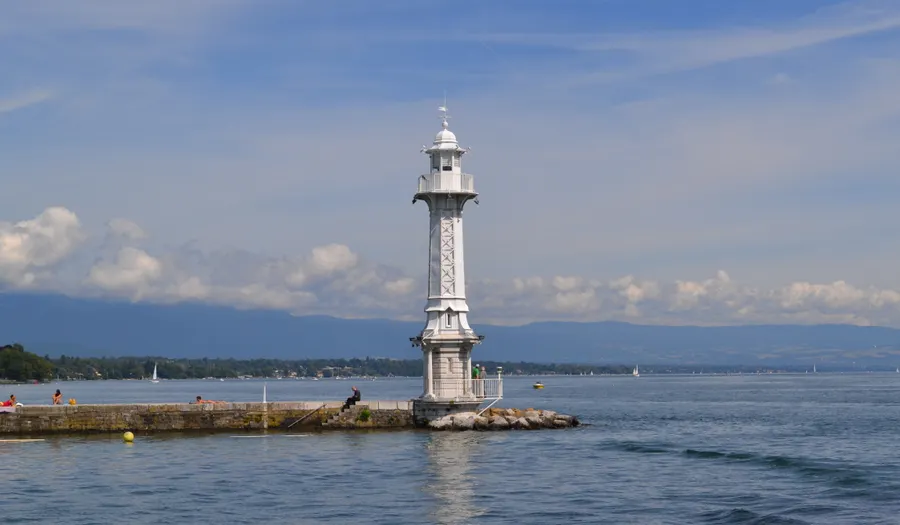
Squeezed between Cornavin station and the lake, this is Geneva's densest, most mixed and least polished district. It concentrates hotels of every category, the city's cheapest Eritrean, Portuguese, Lebanese and Thai restaurants, an unabashed red-light district and a permanent street market. Its jetty, the Bains des Pâquis, is the local institution par excellence: two francs to get in, swimming in summer, sauna and hammam in winter, and a buvette open to everyone. Locals meet there at dawn to swim and in the evening for an aperitif, regardless of income, which is rare enough in this city to be worth pointing out. The contrast with the palace hotels lining the same quay a hundred metres further on sums up Geneva better than any brochure.
The international district

On the Pregny hill, two kilometres north of the harbour, lies Geneva's second city, the one of the organisations. The Palais des Nations, completed in 1936 for the League of Nations, can be visited in an hour by reservation and with ID, taking in the Assembly Hall and Miquel Barceló's ceiling. Opposite, the Place des Nations and its twelve-metre Broken Chair, a monument against anti-personnel mines, serve as a permanent stage for demonstrations. The International Red Cross and Red Crescent Museum, right next door, is the most powerful visit in the district, notably with the handwritten card index of the seven million prisoners of war of 1914-1918. Bus 8 and tram 15 serve the whole area from Cornavin in about fifteen minutes.
Carouge

An independent municipality right on Geneva's southern edge, Carouge was designed in the 18th century by architects from Turin for the Kingdom of Sardinia, with the explicit aim of competing with Calvinist Geneva by offering religious tolerance and an easy life. What remains is a grid of low two-storey houses, planted inner courtyards and gardens that looks like nothing else in the region. The district lives off its craft workshops, record shops, designers and above all its terraces, very busy on Saturdays. The market on the Place du Marché, on Wednesday and Saturday mornings, is when the place makes the most sense. Tram 12 or 18 drops you there in ten minutes from the centre, and the atmosphere is distinctly more relaxed than on the quays.
The Salève and day trips
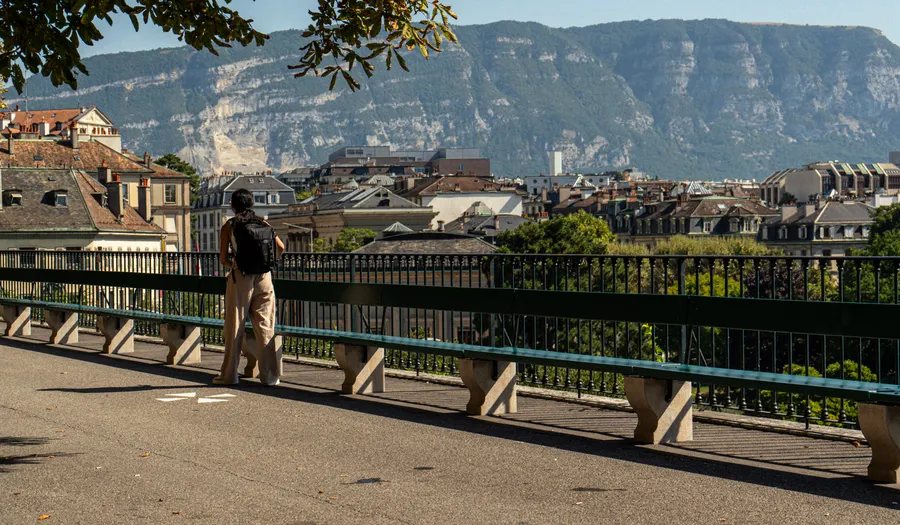
The mountain that blocks the horizon to the south is French, six kilometres from the centre, and the cable car cabin, renovated in 2023, climbs from 500 to 1,100 metres in five minutes. From the top, the view takes in Lake Geneva, the entire conurbation and Mont Blanc on a clear day, with ridge trails and paragliding launch sites thrown in. On the lake side, CGN boats head for Yvoire, a medieval Savoyard village an hour and a half away, and for Nyon and Lausanne. To the west, CERN's Science Gateway, opened in 2023 and free, is twenty minutes away on tram 18. All three outings can be done in a day and turn a city weekend into a far more varied stay.
How many days, and which itinerary?
Two full days are enough for the harbour, the Old Town and the international district; three to four days let you add the Salève, CERN, Carouge and a proper day by the lake without rushing.
🗺️ Day-by-day itinerary · 📓 Free printable Geneva guide (PDF) · 🌍 All of Switzerland
The weekend (2 days)
One day for the harbour, the Bains des Pâquis first thing, the Old Town and the cathedral; one day for the international district, with the Palais des Nations in the morning and the Red Cross museum in the afternoon. The most common format, entirely doable on foot and by tram.
City and surroundings (4 days)
The two-day base, plus a morning at CERN's Science Gateway, an evening in Carouge and a trip up the Salève at sunset. The fourth day is spent on the water, on a Mouette genevoise or on a boat to Nyon and Yvoire.
Geneva and Lake Geneva (6 days)
Three days in Geneva, then up the lake to Lausanne, Vevey and Montreux by train or CGN boat, with a round trip on the French side via Yvoire and Évian. The logical combination if you want your train ticket to be used for more than a return journey.
Getting there and getting around
Anyone staying in registered accommodation in Geneva receives the Geneva Transport Card free of charge, valid from arrival to departure on buses, trams, Mouettes and regional trains in zone 10. It arrives by email three days before arrival and cannot be bought separately.
The centre can be crossed on foot in twenty minutes from one bank to the other, and the Mouettes genevoises, four small yellow shuttle boats, cross the harbour in five minutes on the same ticket.
The Léman Express links Cornavin to Annemasse in about twenty minutes and to Saint-Julien-en-Genevois on the French side, which makes staying across the border perfectly practical.
Genève Roule lends bikes free of charge for four hours from several points in the city from April to October, in exchange for an ID document and a deposit.
Where to stay in Geneva?
A 3- or 4-star hotel in the Pâquis or Eaux-Vives: CHF 180 to 320 a night, with the free transport card and the centre within walking distance.
A boutique hotel in the Old Town or a palace hotel on the harbour: CHF 350 to 800, for the setting and the view of the Jet d'Eau.
A youth hostel or dorm bed in the Pâquis: CHF 45 to 95, which remains the only way to sleep in the city for under 100 francs.
On the French side, in Annemasse, Ferney-Voltaire or Saint-Julien: €60 to €120 a night, two to three times cheaper, but without the Geneva Transport Card, which you only get by staying in the canton.
Our places to stay, stop by stop, at three budgets →
What to eat in Geneva?
Lake perch fillets with chips and tartare sauce are the local dish par excellence, at CHF 32 to 45 by the water. Ask where the fish comes from: much of the perch served in Geneva arrives from Eastern Europe.
Longeole, a slow-cooked pork sausage flavoured with cumin, and the silver spiny cardoon of Plainpalais are the two truly Genevan specialities, mostly found from November to January.
The buvette at the Bains des Pâquis serves breakfast from 7:00, a dish of the day at around CHF 20 and fondue in winter, making it the cheapest waterside address in the centre.
The lunchtime dish of the day often costs CHF 20 to 26 for the same menu that costs CHF 40 in the evening: eating a big lunch and a light dinner halves your food bill.
Entry requirements
Schengen area: an ID card or passport for EU citizens, 90 days visa-free for UK, US, Canadian and Australian passports.
Rules change: check your own government's travel advice before you go.
Frequently asked questions about Geneva
Is Geneva as expensive as they say?
Yes, and often more so. Allow CHF 9 for a beer, CHF 6 for a coffee, CHF 40 for a main course at dinner and CHF 250 for a decent room. Countermeasures exist: transport provided free by your hotel, CHF 2 entry to the Bains des Pâquis, municipal museums always free for their permanent collections, and free entry across the board on the first Sunday of the month.
Do I need Swiss francs or euros?
Francs. Switzerland is in the Schengen Area but not in the European Union or the eurozone. A bank card covers everything, and the main thing is to avoid paying in euros in shops, which apply their own rate and give change in francs.
Does the Jet d'Eau run all year round?
It has run all year round since 2003, but it is switched off far more often than you might think: wind that is too strong, prolonged frost that would turn the quays into an ice rink, and a maintenance shutdown of several weeks scheduled in the low season. Check its status online before crossing the Pont du Mont-Blanc for nothing.
Can I stay in France and visit Geneva?
Yes, and tens of thousands of cross-border commuters make that journey every day. Annemasse is twenty minutes from Cornavin on the Léman Express, Ferney-Voltaire a quarter of an hour by bus, for nights two to three times cheaper. The only real sacrifice is the Geneva Transport Card, reserved for those staying in the canton.
How many days should I plan?
Two full days honestly cover the city, which makes it an excellent weekend. Beyond that, the interest comes from the surroundings: the Salève, CERN, Carouge, the vineyards of the canton of Vaud and the trip up the lake to Lausanne and Montreux.
Similar destinations
 Country
🇸🇪 Sweden
 City
City🇳🇴 Oslo
 City
City🇨🇭 Lucerne
 Country
🇭🇷 Croatia
 City
City🇮🇪 Galway and Connemara
 City
City🇫🇷 Mougins
 City
City🇳🇴 Bergen
 City
City🇬🇷 Corfu
 City
City🇫🇮 Helsinki
 City
City