When to go to Chiloé?
→ The detailed month-by-month page, with real weather records
Best time: December to March (southern summer)
At a glance
Why go to Chiloé?
Chiloé spent centuries apart from the rest of Chile, cut off from the mainland by a channel and for a long time the last royalist stronghold in South America. What remains is a culture of its own: a mythology peopled by the Trauco, the Pincoya and the ghost ship Caleuche, a vocabulary all its own, more than 200 varieties of native potato, many of which exist nowhere else, and mingas in which the whole village moves an entire house with oxen.
The architecture alone is reason enough to come. Sixteen wooden churches, built from the 18th to the 20th century by carpenters trained in shipbuilding, have been World Heritage Sites since 2000: vaults shaped like upturned hulls, hexagonal bell towers, joints held with wooden pegs and not a single nail. In the villages, façades are clad in larch shingles cut like fish scales, and in Castro the palafitos plant their stilts straight into the waters of the fjord.
The third argument is nature, and it has to be earned. The west coast of Chiloé National Park strings together dunes, Valdivian forest and beaches pounded by the Pacific, the Puñihuil islets host the only colonies in the world where Humboldt and Magellanic penguins nest together, and the inland sea is explored by ferry between some forty islands. All under frequent rain, which is part of the scenery and best built into your plans rather than endured.
Map of Chiloé: what is where?
The map shows the 6 places covered in this guide, to picture the distances and plan your route.
- Castro
- Ancud
- Dalcahue
- Achao
- Cucao
- Chonchi
How much does a trip to Chiloé cost?
Chiloé is considerably more affordable than the Atacama or Patagonia, with cheap hospedajes and inexpensive market food. The two items that push up the bill are the hire car and Castro's palafito hotels.
| Style | Per day | What it covers |
|---|---|---|
| Backpacker | €45-70/day | Hospedaje or dorm, buses and ferries, Dalcahue market kitchens, national park on foot |
| Comfort | €90-140/day | Cabaña or boutique hotel, hire car, curanto and Castro restaurants |
| Premium | €220+/day | Design palafito hotel, west coast lodge, boat trips and a naturalist guide |
There are cash machines in Ancud, Castro, Chonchi, Achao and Quellón, but not in the hamlets. Keep cash for the ferries, the markets and the curantos served in people's homes, which do not take cards.
Is Chiloé safe?
Chiloé is one of the calmest regions in Chile and you can travel here without worry, including solo or with children. The real risks are weather and roads: more than 2,000 mm of rain falls each year, secondary roads are ripio gravel that turns very slippery when wet, and westerly gusts sometimes suspend the ferry crossings to Quinchao or Lemuy. The Pacific coast is frankly dangerous for swimming, with rip currents and water around 12°C, and the Muelle de las Almas trail turns into sticky mud after a shower. On the practical side, leave slack in your schedule if a flight awaits you in Puerto Montt, and bring a genuinely waterproof jacket rather than a windbreaker: here the rain comes in sideways.
What to see and do in Chiloé
- Castro's palafitos
- San Francisco Church in Castro
- Puñihuil penguins
- Chiloé National Park
- Muelle de las Almas
- Dalcahue market
- Achao and Quinchao Island
- Curanto en hoyo
Castro

Capital of the archipelago and the third-oldest city in Chile, founded in 1567 and set at the head of a fjord. Its palafitos, wooden houses on stilts, line up their colourful façades in the Gamboa, Pedro Montt and Nercón districts, and several have been converted into hotels or cafés. The yellow and lilac San Francisco church dominates the main square with its fully listed wooden frame. The municipal market sells spun wool, hats and fibre baskets. It is the obvious logistical base for exploring the rest of the island.
Ancud and the Puñihuil islets

The northern gateway to the archipelago, Ancud keeps its Spanish Fort San Antonio facing the Chacao Channel. 27 km to the west, three rocky islets form a natural monument where Humboldt and Magellanic penguins nest side by side, a case unique in the world. Boat trips leave from the beach, last around forty minutes and run from September to March depending on the birds' presence. Sea otters, cormorants and sometimes dolphins complete the picture. The north coast road between Ancud and Puñihuil is one of the most beautiful on the island.
Chiloé National Park

On the Pacific side, the park protects 430 km² of Valdivian forest, peat bogs and dunes, with Cucao as its gateway. The El Tepual trail crosses dense forest on slippery wooden boardwalks, and the dunes trail opens onto a beach several kilometres long where nobody swims. Wildlife includes the pudú, the smallest deer in the world, and the rare, endemic Darwin's fox. It rains here more than anywhere else on the island, up to 3,000 mm a year. Cucao has a few cabañas and horse hire outfits, nothing more.
Quinchao Island
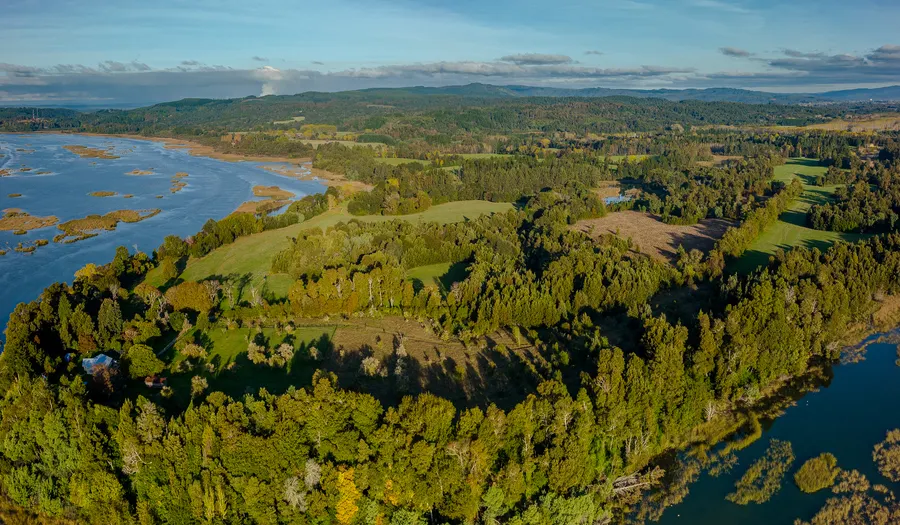
Ten minutes by ferry from Dalcahue, Quinchao packs the best of the archipelago into a single island. Achao, its main town, is home to the church of Santa María de Loreto, the oldest in Chiloé and probably in Chile, assembled around 1740 from larch and wooden pegs, without nails. Curaco de Vélez, a little before, lines up its shingled houses around a square and lives from oyster farming. The road crosses green hills dotted with sheep, facing the inland sea. It is also the best place in the archipelago for a family curanto.
Dalcahue and the east coast

Dalcahue holds its craft market on Sunday mornings, when weavers from the neighbouring islands sell wool, hats and blankets. Its listed church faces the jetty from which the ferries leave for Quinchao. Further north, Tenaún and its blue church with three bell towers, then Quemchi and Aucar Island, linked by a 500-metre footbridge, make up a quiet and very little-visited coastal route. The market kitchens serve curanto and empanadas de mariscos for a handful of euros. Allow a full day for the loop.
Chonchi and the south
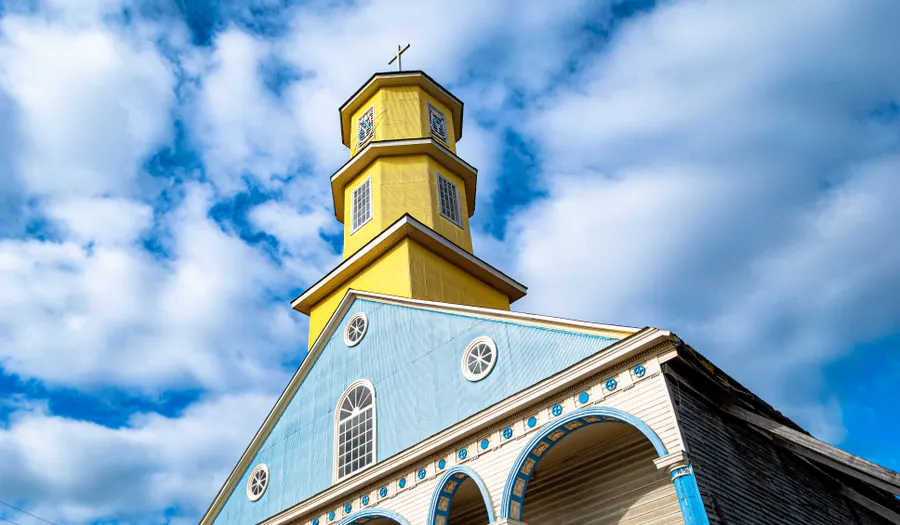
Nicknamed the three-storey town because it tumbles down a steep slope to the port, Chonchi keeps its church with a neoclassical façade and its merchants' houses from the larch boom. It is the departure point for the ferry to Lemuy Island, which alone has three listed churches and almost no visitors. The south of the archipelago, towards Quellón, marks the end of Route 5, which begins at the Peruvian border 3,400 km further north. The Muelle de las Almas, on the nearby west coast, is an hour's drive from Chonchi. Accommodation is scarcer here, so book ahead in January.
How many days, and which itinerary?
Four days are enough for Castro, Quinchao and the west coast; a week lets you add Ancud, the east coast and a day swallowed by rain.
🗺️ Day-by-day itinerary · 📓 Free printable Chiloé guide (PDF) · 🌍 All of Chile
The essentials (4 days)
Ferry crossing from Pargua, a night in Ancud for the Puñihuil penguins, then three nights in Castro. Days devoted to Dalcahue and Quinchao, the national park via Cucao and the Muelle de las Almas. A car is essential for this format.
The whole archipelago (7 days)
The previous core plus Tenaún and Quemchi on the east coast, Lemuy Island and its three listed churches, Chonchi and the drive down to Quellón. Plan a day with no fixed programme: the weather will decide for you.
Chiloé and the southern lakes (10-12 days)
Four days in the archipelago, then back via Puerto Montt to Puerto Varas, the Osorno volcano and the Cochamó valley. Logistically coherent, since everything starts and ends at the same airport.
Getting there and getting around
The Pargua-Chacao ferry crosses the channel in thirty minutes, with no booking needed, departures every fifteen to thirty minutes and a fare of about €20 per car.
Pick up your hire car in Puerto Montt, €45-70/day: check that the contract allows you to take it onto the island, as some companies charge extra for it.
Buses link Puerto Montt to Ancud in 2 hours and to Castro in 3 hours 30, ferry included, for around fifteen euros. From Castro, buses then serve Dalcahue, Chonchi and Cucao several times a day.
Between islands, small ferries leave Dalcahue for Quinchao and Chonchi for Lemuy roughly every fifteen minutes, for just a few euros.
Where to stay in Chiloé?
Castro's palafito hotels, on stilts above the fjord: €110-200 a night, the archipelago's signature address, to be booked early for January.
Family-run hospedajes in Ancud, Chonchi or Achao: €40-70, breakfast and wood stove included, often the best contact with locals.
Wooden cabañas with kitchens, very common around Cucao and Dalcahue: €60-110, practical for families and in bad weather.
Isolated lodges on the west coast and towards Quellón: €150-300, often on half board for lack of restaurants nearby.
Our places to stay, stop by stop, at three budgets →
What to eat in Chiloé?
Curanto en hoyo, cooked underground between scorching stones and nalca leaves: shellfish, smoked meats, milcao and chapalele, €15-22 per person.
Milcao and chapalele, two potato breads, one made from raw grated potato, the other from mash: the daily bread of the archipelago.
More than 200 varieties of native potato, on display at the market stalls of Castro and Dalcahue, with purple and blue flesh.
Mussels, salmon and seaweed from the inland sea, then licor de oro, a local anise and whey liqueur served ice-cold at the end of the meal.
Entry requirements
Visa-free for 90 days for EU, UK, US, Canadian and Australian passports.
Rules change: check your own government's travel advice before you go.
Frequently asked questions about Chiloé
How do you get to Chiloé?
A 2-hour flight from Santiago to Puerto Montt, then 60 km by road to Pargua and thirty minutes by ferry to Chacao. Allow 3 hours 30 from Puerto Montt to Castro by bus, ferry included, or a little less by car.
When is the best time to go?
From December to March: 16-20°C, long days lasting until 21:30 and boat trips to the penguins guaranteed. It rains all year round, just less often in the southern summer, and winter is damp, dark and windy.
How many days should you plan?
Four days minimum for Castro, Quinchao, the national park and the Muelle de las Almas. A week lets you add Ancud, the east coast and Lemuy Island without being held hostage by the weather.
Which UNESCO churches should you prioritise?
Sixteen wooden churches have been listed since 2000. If time is short, pick Achao, the oldest and most impressive inside, San Francisco in Castro for its colours, and Tenaún with its three blue bell towers on the east coast.
Can you see the penguins all year round?
No. Boat trips to the Puñihuil islets run from around September to March, the nesting season of the Humboldt and Magellanic penguins. Out of season, the colonies have left and crossings are often cancelled because of the swell.
Similar destinations
 Region
🇫🇷 Guadeloupe
 Region
🇫🇷 Martinique
 Region
🇫🇷 The Vendée
 Region
🇫🇷 Brittany
 Country
🇧🇷 Brazil
 City
City🇨🇦 Charlevoix and Tadoussac
 Country
🇦🇷 Argentina
 Country
🇵🇪 Peru
 Country
🇨🇴 Colombia
 Region