When to go to Hanoi?
→ The detailed month-by-month page, with real weather records
Best time: October to April
At a glance
Why go to Hanoi?
Hanoi cultivates an old-world charm that wins you over within hours. The Vietnamese capital blends colonial avenues lined with flame trees, centuries-old temples and teeming lanes where scooters stream past in a continuous swarm. You feel the weight of a thousand years of history, between shady pagodas and ochre façades weathered by the monsoon.
The city is lived at pavement level, on those little plastic stools where people sip a cà phê trung or a cold beer at any hour. Markets overflow with tropical fruit, women vendors still carry the shoulder pole, and the scent of pho broth drifts through the early morning. It is a constant sensory immersion, raw and endearing.
Hanoi is also the gateway to northern Vietnam and its spectacular landscapes. A few hours by road or rail bring you to the terraced rice fields of Sapa, the sugarloaf peaks of Ninh Binh or Halong Bay. The capital alone distils the deep soul of the country.
Map of Hanoi: what is where?
The map shows the 6 places covered in this guide, to picture the distances and plan your route.
- Hoan Kiem Lake
- Old Quarter of the 36 Guilds
- Temple of Literature
- Ho Chi Minh Mausoleum
- Train Street
- West Lake
How much does a trip to Hanoi cost?
Hanoi ranks among the most affordable capitals in South-East Asia. Accommodation and food cost a fraction of Western prices.
| Style | Per day | What it covers |
|---|---|---|
| Backpacker | €20-35/day | Dorm, street food and public transport or Grab motorbike |
| Comfort | €50-90/day | Boutique hotel, varied restaurants and a few excursions |
| Premium | €150+/day | Colonial luxury hotel, private driver and fine-dining tables |
Withdraw dong from cash machines, but keep cash on you as many stalls do not take cards.
Is Hanoi safe?
Hanoi is a safe city where violent assaults are rare, but stay alert to petty theft in crowded tourist areas. The main danger remains the chaotic traffic: cross at a steady, determined pace and the scooters will flow around you. Be wary of unofficial taxis and use Grab to avoid overcharging. Always haggle in markets and keep an eye on your belongings in crowds.
What to see and do in Hanoi
- the Old Quarter
- Hoan Kiem Lake
- the Temple of Literature
- the street food
- Train Street
Hoan Kiem Lake
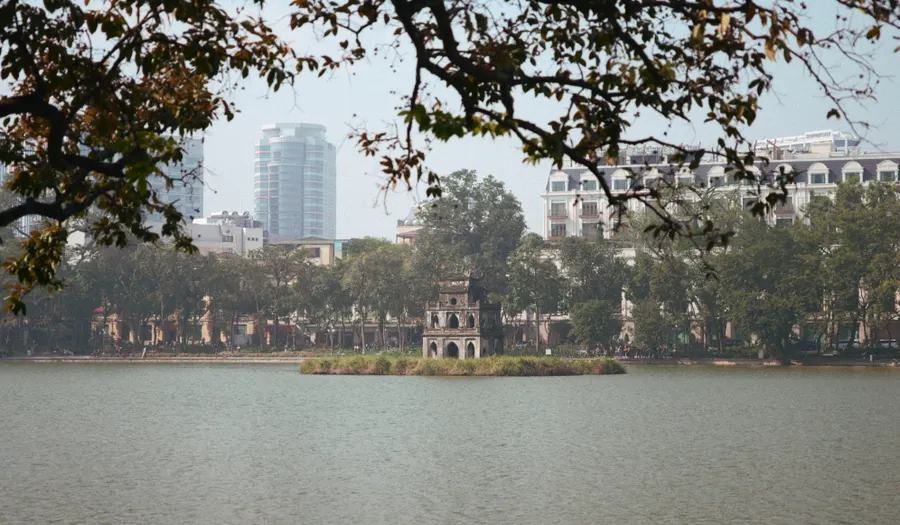
This legendary lake is the beating heart of Hanoi, ringed with weeping willows and shady benches. In the early morning, locals practise tai chi as the sun lights up the red Huc Bridge. At its centre stands the Turtle Tower, emblem of the city. At weekends, the surrounding streets go pedestrian and become one huge festive square.
Old Quarter of the 36 Guilds

This maze of lanes preserves a medieval layout in which each street bore the name of a trade. You wander between silk shops, tinsmiths, herbalists and street food stalls. The tall, narrow tube houses tell the story of the city's merchant past. It is the best place to get lost on purpose and taste Hanoi's joyful chaos.
Temple of Literature

Founded in 1070, this sanctuary dedicated to Confucius houses Vietnam's first university. Its successive courtyards, pools and steles resting on stone turtles offer an interlude of calm. Young graduates come to pose here in traditional dress on graduation days. The pared-back architecture beautifully illustrates the country's scholarly heritage.
Ho Chi Minh Mausoleum

This austere grey granite monument holds the embalmed body of the father of Vietnamese independence. The monumental square around it hosts highly formal military ceremonies. Nearby you can visit Uncle Ho's stilt house and the One Pillar Pagoda. The whole complex is a major site of remembrance, heavy with solemnity.
Train Street

This narrow lane is crossed, a few centimetres from the façades, by a train that passes several times a day. The cafés set up along the tracks offer a gripping spectacle when the train bursts through. Access is sometimes restricted for safety reasons, so check the times beforehand. It has become one of the most viral images of Hanoi.
West Lake

The city's largest body of water, West Lake draws Hanoians in search of cool air at the end of the day. Its shores are lined with trendy cafés, restaurants and the venerable Tran Quoc Pagoda, set on an islet. This is the place to try the famous banh tom, a crispy shrimp fritter. The atmosphere is calmer and more residential than in the Old Quarter.
How many days, and which itinerary?
Allow 2 to 3 days to explore Hanoi, more if you use it as a base for trips into northern Vietnam.
🗺️ Day-by-day itinerary · 📓 Free printable Hanoi guide (PDF) · 🌍 All of Vietnam
Hanoi express (2 days)
Spend the first day on the Old Quarter and Hoan Kiem Lake, then the night market. The next day, take in the Temple of Literature, the mausoleum and a coffee break at West Lake.
Hanoi and around (5 days)
Spend three days in the city to wander freely, then slip away for two days to Ninh Binh for its rice fields and caves. A boat trip at Tam Coc rounds off the stay perfectly.
The far north (8 days)
Base yourself in Hanoi, then head off to explore Sapa and its terraces before reaching Halong Bay. This circuit combines urban culture, ethnic-minority mountains and a natural wonder.
Getting there and getting around
Walking remains the best way to explore the compact Old Quarter
The Grab app (motorbike or car) is reliable and cheap, and spares you the haggling
The train links Hanoi with Sapa, Hue and Ho Chi Minh City for long distances
Renting a scooter is possible, but the heavy traffic makes it a poor idea for beginners
Where to stay in Hanoi?
Old Quarter hostels: €8 to €15 a night in a dorm
Charming boutique hotels: €30 to €60 for a double room
Upmarket colonial hotels: €100 to €200 a night
Homestays on the outskirts: €15 to €25 for a local immersion
Our places to stay, stop by stop, at three budgets →
What to eat in Hanoi?
Pho, the emblematic noodle soup, is eaten from breakfast onwards
Bun cha, grilled pork with rice vermicelli, is said to have been popularised in Hanoi
Cà phê trung, a velvety egg coffee, is an unmissable speciality
Old Quarter street food stalls serve nem, banh mi and cold beer
Entry requirements
UK and several EU nationalities get 45 days visa-free. US, Canadian and Australian passports need an e-visa, applied for online before departure and valid for up to 90 days.
Rules change: check your own government's travel advice before you go.
Frequently asked questions about Hanoi
When is the best time to visit Hanoi?
Autumn, from October to December, brings dry, mild weather, ideal for exploring the city without the sticky heat of summer.
How many days should you spend in Hanoi?
Two to three days are enough for the essentials, but four or five let you branch out to Ninh Binh or Halong Bay.
What daily budget for Hanoi?
Allow around €20 to €35 a day as a backpacker, and €50 to €90 for a comfortable stay.
How do you get around Hanoi?
Walking suits the compact Old Quarter, and the Grab app remains the most practical and cheapest option for longer journeys.
Which area should you stay in in Hanoi?
The Old Quarter of the 36 Guilds is the most central and lively, while the shores of West Lake offer a calmer atmosphere.
Similar destinations
 Country
🇹🇭 Thailand
 City
City🇹🇭 Bangkok
 Country
🇮🇳 India
 Country
🇹🇷 Turkey
 Country
🇬🇪 Georgia
 City
City🇮🇩 Java
 Region
🇮🇳 Rajasthan
 Region
🇨🇳 Yunnan
 City
City🇳🇵 Kathmandu
 City
City