When to go to Vietnam?
→ The detailed month-by-month page, with real weather records
Best time: December to April
At a glance
Why go to Vietnam?
Vietnam unfurls like a long ribbon between sea and mountains, and that is precisely where its richness lies. Travelling from north to south, you move from the karst pinnacles of Halong Bay to the terraced rice fields of Sapa, then on to the canals of the Mekong Delta. One trip, several countries.
The country races ahead without having lost its soul. Scooters surge by the thousand through Hanoi and Saigon, yet slowness returns in a rowing boat on the Mekong or over a steaming bowl of pho at dawn. This contrast between energy and gentleness gives Vietnam a tempo all its own.
Finally, it is a generous destination for your budget. You eat a celebrated cuisine for a few euros, sleep comfortably without breaking the bank, and the welcome, often tinged with French inherited from history, stays warm. Enough to travel for a long time without emptying your wallet.
Map of Vietnam: what is where?
The map shows the 6 places covered in this guide, to picture the distances and plan your route.
- Halong Bay
- Hanoi
- Sapa
- Hoi An
- Mekong Delta
- Ho Chi Minh City
How much does a trip to Vietnam cost?
Vietnam ranks among the most affordable destinations in South-East Asia. You can travel comfortably for little, and both food and accommodation weigh very lightly on the budget.
| Style | Per day | What it covers |
|---|---|---|
| Backpacker | €20-30 | dorms, street food, night buses |
| Comfort | €40-60 | guesthouses, restaurants, a few flights |
| Treat | €90 and up | boutique hotels, a cruise, private guides |
Dong can be withdrawn from cash machines (per-withdrawal fees are common) and cards are accepted in hotels and big cities, but keep cash for markets and the countryside. Tipping is not systematic but is appreciated.
Is Vietnam safe?
Vietnam is a safe country to travel in, where crime is mostly limited to pickpocketing and small scams in tourist areas. Keep an eye on your belongings in crowds and agree on the fare before a ride. Health-wise, drink bottled water, protect yourself from mosquitoes and bring your vaccinations up to date before you leave. The heavy traffic is the real danger: cross calmly and carefully, without sudden movements.
What to see and do in Vietnam
- Halong Bay
- Hanoi and Saigon
- the rice fields of Sapa
- the Mekong Delta
- Hoi An
Halong Bay

Its thousands of limestone pinnacles rising from an emerald sea make up one of the most famous landscapes in Asia. It is best discovered on a one- or two-night cruise aboard a junk, between caves, kayaking and swimming. To escape the crowds, neighbouring Lan Ha Bay offers comparable scenery in peace. Sunrise over the misty waters alone justifies the night on board.
Hanoi, capital of the north

Hanoi cultivates an old-world charm in its Old Quarter, whose lanes are organised by trade. Hoan Kiem Lake, the stalls, the street vendors and the egg coffee cafés set the pace of a stroll. The city is the starting point for Halong, Sapa and Ninh Binh. In the evening, you perch on a tiny stool for a cold beer and a grilled skewer.
The rice fields of Sapa

In the mountains of the north-west, Sapa unrolls terraced rice fields carved into the valley sides. This is the land of ethnic minorities, the Hmong and the Dao, whom you meet on treks between villages. The landscapes are at their greenest before the harvest, from May to September. Homestays are a natural choice here to prolong the exchange.
Hoi An and its lanterns

A former trading port listed by Unesco, Hoi An charms with its pedestrian old town of yellow houses and its Japanese covered bridge. At nightfall, thousands of coloured silk lanterns are reflected in the river. The town is also the capital of tailoring, where you can have a garment made in a single day. Nearby beaches and the countryside by bike round off the stop.
The Mekong Delta
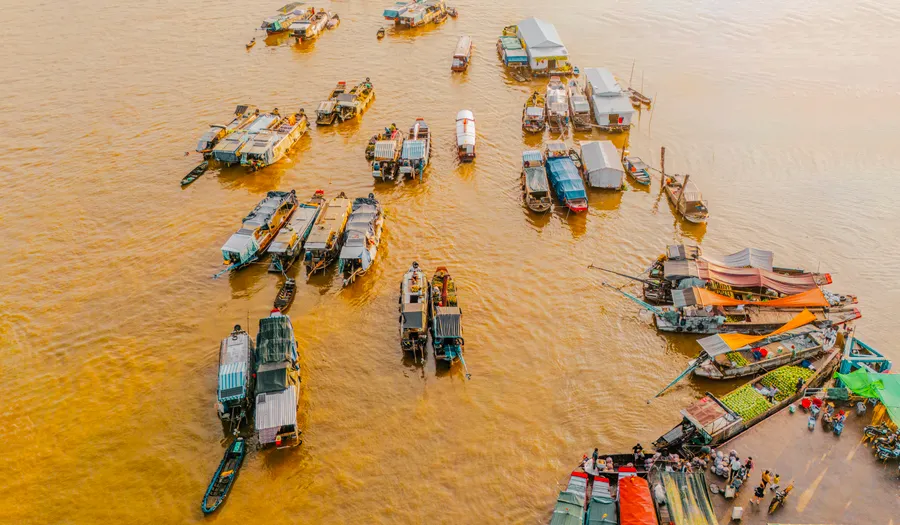
South of Saigon, the river splits into a web of canals, rice fields and orchards. You explore it by boat to discover the floating markets, such as Cai Rang, where trading is done from boat to boat from dawn. Coconut candy workshops and fruit gardens punctuate the outing. A homestay night plunges you into a life set to the rhythm of the water.
Saigon and the south

Ho Chi Minh City, still known as Saigon, is the frenetic economic engine of the south. Between the brick cathedral, the Central Post Office and the skyscrapers, it blends colonial heritage with breakneck modernity. Its museums, including the War Remnants Museum, shed light on the country's recent history. Nearby, the Cu Chi Tunnels bear witness to the ingenuity of the conflict.
How many days, and which itinerary?
Allow two to three weeks to travel the country from north to south without rushing; ten days means choosing one half.
🗺️ Day-by-day itinerary · 📓 Free printable Vietnam guide (PDF)
12 days
Days 1-3: Hanoi and its Old Quarter. Days 4-5: a cruise in Halong Bay or Lan Ha. Days 6-7: Ninh Binh, the Halong Bay on land, by bike. Days 8-10: fly to Da Nang and Hoi An, lanterns and beach. Days 11-12: Saigon and a getaway into the Mekong Delta. An efficient north-centre-south digest.
3 weeks
Week 1: Hanoi, Halong and the Sapa trek. Week 2: down to the centre, Ninh Binh, Hue and Hoi An. Week 3: Saigon, the Cu Chi Tunnels and a two-night immersion in the Mekong Delta. The pace allows for homestays and less-trodden stops.
Getting there and getting around
As the country is so long, domestic flights (Vietnam Airlines, Vietjet, Bamboo) save precious time between Hanoi, Da Nang and Saigon.
The Reunification Express follows the coast and offers fine daytime stretches, such as the spectacular Hue-Da Nang section.
Night buses and minivans serve the country in fine detail, while cruises link the islands of Halong Bay.
In town, the Grab app (car or motorbike) spares you the haggling; riding a scooter is possible but traffic remains heavy.
Where to stay in Vietnam?
Value for money is excellent: dorms at €5-8, clean double rooms in guesthouses around €12-25.
Charming and boutique hotels remain affordable, often under €50, and junk cruises include the night on board.
Favour homestays in Sapa and the Mekong Delta for the human contact and authenticity.
In Hanoi, the Old Quarter is central; in Hoi An, the old town or hotels near the beaches, depending on the atmosphere you want.
Our places to stay, stop by stop, at three budgets →
What to eat in Vietnam?
Fresh and fragrant Vietnamese cuisine is enjoyed everywhere: pho, the emblematic noodle soup, is eaten from breakfast onwards.
Try banh mi, the sandwich descended from the colonial baguette, bo bun, nem and fresh spring rolls.
Each region has its signature: bun cha in Hanoi, cao lau in Hoi An, sweeter cooking in the south.
Egg coffee and iced coffee with condensed milk are part of the ritual, best savoured on a little pavement stool.
Entry requirements
UK and several EU nationalities get 45 days visa-free. US, Canadian and Australian passports need an e-visa, applied for online before departure and valid for up to 90 days.
Rules change: check your own government's travel advice before you go.
Cities and regions to discover
 City
City🇻🇳 Hanoi
 City
City🇻🇳 Halong Bay
Frequently asked questions about Vietnam
When is the best time to go?
From November to April, the dry season is broadly the most favourable, but the climate varies greatly from north to south. The north can be cool and misty in winter, the centre rainy in autumn, and the south stays hot all year. Tailor your itinerary to the season.
What daily budget should you plan for?
Allow €25 to €55 per person per day for a comfortable trip, excluding the international flight. It is one of the destinations where money goes furthest, between street meals for a few euros and very affordable accommodation.
Is Vietnam safe to travel in?
Yes, it is a safe country where the main risks are pickpocketing and heavy road traffic. A little vigilance with your belongings and crossing the street carefully are enough. Tourism is well developed and the welcome is warm.
How do you get around such a long country?
Low-cost domestic flights efficiently link Hanoi, Da Nang and Saigon in a few hours. The Reunification Express and night buses cover the rest, with superb coastal stretches, while Grab makes urban journeys easy.
Similar destinations
 City
City🇮🇩 Java
 Country
🇨🇴 Colombia
 Country
🇬🇪 Georgia
 Region
🇨🇳 Yunnan
 Country
🇹🇭 Thailand
 City
City🇹🇭 Chiang Mai
 Country
🇰🇭 Cambodia
 Country
🇮🇩 Indonesia
 Country
🇯🇵 Japan
 Country