When to go to Namibia?
→ The detailed month-by-month page, with real weather records
Best time: May to October
At a glance
Why go to Namibia?
Namibia is one of the most spectacular and least populated countries on the planet, a place where vastness becomes an experience in itself. You cross ancient deserts, dizzying canyons and coastlines haunted by shipwrecks. The light sculpts the landscapes with unreal sharpness, from the red of the dunes to the white of the salt pans. Few places let you feel silence and space so intensely.
The country is an ideal playground for road trips and self-drive tours. The roads are good, safety is assured and the tourist infrastructure is well run. You drive for hours without meeting a soul, before stumbling on an isolated lodge with surprising comfort. This freedom of movement, rare in Africa, is what gives the trip its flavour.
The wildlife is spectacular and easy to watch, especially in Etosha National Park around its waterholes. Desert elephants, black rhinos, oryx and giraffes put on a show against a backdrop of salt pans. Add encounters with the Himba and San peoples, and you have an adventure destination as photogenic as it is authentic.
Map of Namibia: what is where?
The map shows the 6 places covered in this guide, to picture the distances and plan your route.
- Sossusvlei
- Etosha Park
- Swakopmund
- Fish River Canyon
- Damaraland
- Skeleton Coast
How much does a trip to Namibia cost?
Namibia is more expensive than the African average, owing to the distances and the isolated lodges. Camping cuts the bill considerably.
| Style | Per day | What it covers |
|---|---|---|
| Backpacker | €50-80/day | Camping, a shared hire car and self-catering. |
| Comfort | €120-180/day | Guesthouses, bush lodges and an equipped 4x4. |
| Premium | €300+/day | Luxury camps, domestic flights and private safaris. |
The Namibian dollar is pegged to the South African rand, which is accepted everywhere; withdraw cash in town before heading into remote areas.
Is Namibia safe?
Namibia is one of the safest and most stable countries in southern Africa, with low crime outside the big towns. The main risk is driving: long distances, slippery gravel tracks and animals on the road call for caution, especially at night, when driving is best avoided. Malaria is found only in the north, in the Caprivi region and around Etosha in the rainy season; prevention is then advised. Carry water, spare fuel and a spare tyre for isolated desert areas.
What to see and do in Namibia
- the dunes of Sossusvlei and Deadvlei
- Etosha National Park (safari)
- Fish River Canyon
- the Skeleton Coast
- the Namib Desert
Sossusvlei and the dunes
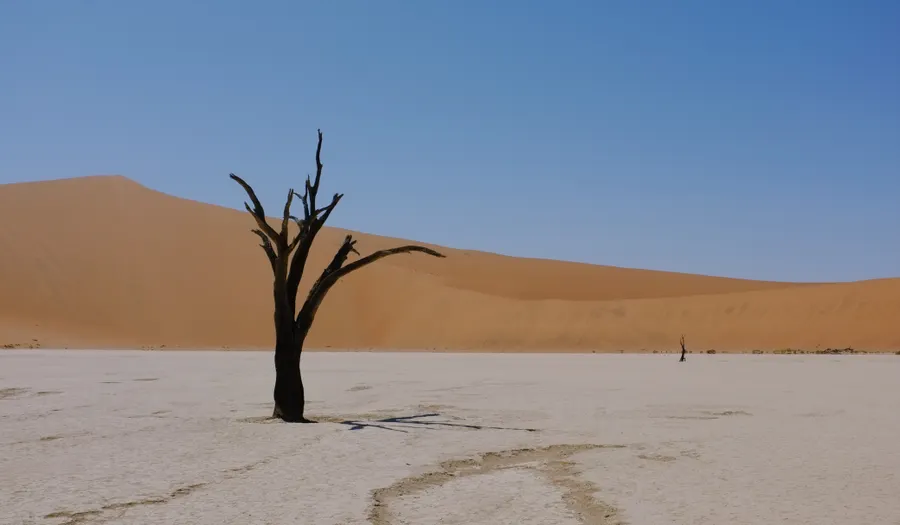
In the heart of the Namib, one of the oldest deserts in the world, rise red dunes that are among the highest on the planet. At dawn, climb Big Daddy or Dune 45 to capture the contrast between ochre sand and sky. Nearby, the dried-up pan of Deadvlei lines up its dead, petrified acacias on white clay. This surreal scene is Namibia's most iconic image.
Etosha National Park

Set around a vast salt depression visible from space, Etosha is one of the great wildlife sanctuaries of southern Africa. The animals gather around the waterholes, which makes sightings easy and predictable. Elephants, lions, rhinos and countless antelope mingle here in a chalky light. In the dry season, you often only need to wait at a waterhole to watch the wildlife parade past.
Swakopmund

Wedged between the desert and the Atlantic, this town with its German colonial charm surprises with its half-timbered houses and cafés. It is a breath of fresh air after days on dirt roads, between pastries and a spray-swept seafront. It is also the capital of adventure sports: sandboarding on the dunes, quad biking and skydiving. Excursions to the Cape Cross seal colony leave from here.
Fish River Canyon

The second-largest canyon in the world after the Grand Canyon of the Colorado, the Fish River carves through the rock for more than a hundred and fifty kilometres. From the viewpoints, your gaze plunges into a maze of meanders and sheer walls. A legendary hiking trail runs through it over several days in the cool season. The sunset sets the rocks ablaze and alone justifies the detour to the deep south.
Damaraland

This semi-desert region in the north-west combines lunar landscapes with an exceptional heritage. At Twyfelfontein, thousands of UNESCO-listed rock engravings tell of the life of San hunters. You can also track desert elephants, adapted to the drought, and black rhinos. Geological formations such as the Organ Pipes add to the strangeness of the place.
Skeleton Coast

This misty northern coastline owes its sinister name to the shipwrecks and whale bones stranded on its beaches. Where the dunes plunge into the Atlantic, fog and cold currents create a ghostly atmosphere. Seal colonies, ship carcasses and sand as far as the eye can see make up an end-of-the-world scene. You explore it by 4x4, with the feeling of reaching an ultimate frontier.
How many days, and which itinerary?
Allow twelve to fifteen days to complete the classic self-drive loop between Windhoek, the Namib, the coast and Etosha.
🗺️ Day-by-day itinerary · 📓 Free printable Namibia guide (PDF)
Southern loop and dunes (8 days)
From Windhoek, head for Sossusvlei and Deadvlei, then Swakopmund on the coast. Return via the central plateau before dropping off the vehicle. A first taste focused on the headline landscapes.
Classic grand tour (14 days)
The full loop links the Namib, Swakopmund, Damaraland and Etosha before returning to Windhoek. You alternate dunes, wildlife and rock-art sites along the tracks. The benchmark itinerary for a first trip.
The wild South (11 days)
This route heads down to Fish River Canyon and the Kalahari Desert before reaching Sossusvlei. Less visited, it appeals to lovers of wide open spaces and solitude. Distances are long but the scenery unforgettable.
Getting there and getting around
A self-drive tour by 4x4 is the way to go; the gravel roads are good but distances are enormous, so allow plenty of time.
Domestic flights quickly link isolated lodges, a popular option for saving time.
No bus network covers the whole country; an organised tour is the alternative to renting a vehicle.
Fill up at every station without fail and carry water, as filling stations are few and far between.
Where to stay in Namibia?
Equipped campsites in the national parks: €15-30 per pitch, bring your own gear.
Guesthouses and B&Bs in Windhoek and Swakopmund: €40-80 for a double room.
Bush lodges with a waterhole and guided safaris: €90-180 a night.
Isolated luxury camps in the desert: €250 and well beyond, often with full board.
Our places to stay, stop by stop, at three budgets →
What to eat in Namibia?
Biltong, spiced dried meat, the essential snack for long drives on the tracks.
Game meats, oryx, springbok or kudu, served grilled in the lodges.
Potjiekos, a stew slow-cooked in a cast-iron pot over the embers.
The German heritage, with craft beers, pastries and cold meats in Swakopmund.
Entry requirements
Since 1 April 2025, EU, UK, US, Canadian and Australian passports all need a visa. For UK, US, Canadian, Australian and most western EU passports it is issued on arrival at Windhoek airport and the main borders, or applied for online in advance, for NAD 1,600; other EU nationals should check with a Namibian embassy. The passport must be valid six months beyond arrival, with three blank pages.
Rules change: check your own government's travel advice before you go.
Cities and regions to discover
 Region
🇳🇦 Etosha National Park
 City
City🇳🇦 Sossusvlei
Frequently asked questions about Namibia
When is the best time to visit?
The dry season, from May to October, is ideal: clear skies, wildlife gathered at the waterholes and passable tracks. From June to August, nights in the desert are cold.
What daily budget should I plan for?
Allow around €70 a day camping and €120-180 for lodge comfort. Distances and fuel weigh heavily in a self-drive budget.
Is there a risk of malaria?
Malaria is present only in the north of the country, notably in the Caprivi and around Etosha in the rainy season. The rest of the country, including the Namib Desert, is considered risk-free.
How do I get around Namibia?
A self-drive tour by 4x4 is by far the best option for exploring the country at your own pace. Plan for long stages, fill up at every station and avoid driving at night at all costs.
Similar destinations
 Region
🇪🇬 The Egyptian Red Sea
 Region
🇪🇸 The Canary Islands
 City
City🇲🇦 Merzouga and Erg Chebbi
 Country
🇿🇦 South Africa
 City
City🇿🇦 Cape Town
 Country
🇹🇿 Tanzania
 Country
🇲🇬 Madagascar
 Country
🇯🇴 Jordan
 Country
🇨🇳 China
 Country