When to go to Jordan?
→ The detailed month-by-month page, with real weather records
Best time: March to May and September to November
At a glance
Why go to Jordan?
Jordan packs into a small space wonders that seem to come from another age. Petra, the Nabataean city carved into rose-pink rock, would justify the trip on its own, but it is only the gateway to a country of extraordinary richness. Lunar deserts, Byzantine mosaics and Roman remains follow one another over a few hundred kilometres. Here, history isn't just visited, it's crossed on foot and by camel.
Beyond the stones, Jordan wins hearts with its legendary Bedouin hospitality, the spontaneous generosity that comes with every cup of tea shared. In the Wadi Rum desert, you sleep under the stars at camp, lulled by the nomads' stories. The country, an island of stability in a troubled region, can be explored with complete peace of mind. Jordanians are proud to show off their land, and it shows in every encounter.
Jordan is also an invitation to slow down and feel. Floating on the Dead Sea, the lowest point on the planet, is a sensation like no other on Earth. The desert offers blazing sunsets, and swimming in the Red Sea at Aqaba reveals well-preserved coral reefs. Between adventure and contemplation, the Hashemite kingdom makes for a journey of rare intensity.
Map of Jordan: what is where?
The map shows the 6 places covered in this guide, to picture the distances and plan your route.
- Petra
- Wadi Rum
- Dead Sea
- Amman
- Jerash
- Aqaba
How much does a trip to Jordan cost?
Jordan is pricier than its Asian neighbours, mainly because of site entry fees, but the Jordan Pass lightens the bill.
| Style | Per day | What it covers |
|---|---|---|
| Backpacker | €45-60/day | hostel, street food, JETT bus and Jordan Pass |
| Comfort | €90-140/day | three-star hotel, hire car, camp in Wadi Rum |
| Premium | €250+/day | resorts, private guides, designer desert bubbles and spa |
The Jordanian dinar is a strong currency; the Jordan Pass, bought online, covers the visa and entry to Petra and many other sites.
Is Jordan safe?
Jordan is a safe and stable country, regularly praised for its welcome despite a turbulent neighbourhood. Tourist infrastructure is excellent and tap water is drinkable in most hotels, although bottled water remains preferable. Protect yourself from the sun and dehydration in the desert, and bring good shoes for Petra. No specific vaccinations are required, but travel insurance with repatriation cover is still recommended.
What to see and do in Jordan
- the city of Petra
- the Wadi Rum desert
- a swim in the Dead Sea
- Amman's Citadel
- the Dana reserve
Petra
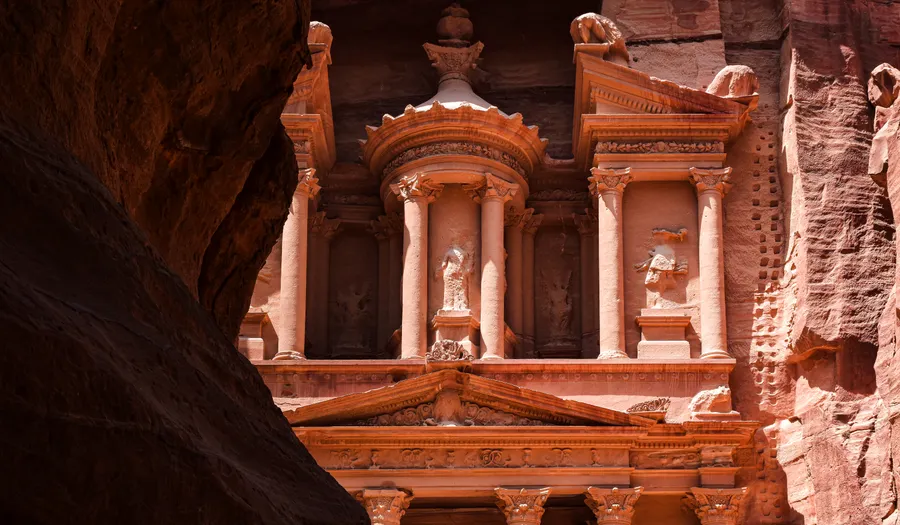
The Nabataeans' rose-red city reveals itself after a walk through the Siq, a narrow gorge that opens onto the Treasury carved straight into the cliff. The vast site counts hundreds of tombs, a Roman theatre and the Monastery, perched at the top of eight hundred steps. A full day is barely enough to grasp its scale. The candlelit night visit, on certain evenings, is a striking experience.
Wadi Rum

This desert of red sand and sculpted mountains has served as the backdrop for many science-fiction films. You explore it by 4x4 with Bedouin guides, among natural arches, dunes and ancient petroglyphs. A night in a tent at camp, far from any light pollution, reveals an exceptional starry sky. Hiking, climbing and hot-air ballooning round out the desert experience.
The Dead Sea

The lowest point on Earth, more than four hundred metres below sea level, the Dead Sea offers surreal buoyancy. You coat yourself in its mineral-rich black mud, famed for the skin, before letting the ultra-salty water carry you. Sunsets over the hills of the West Bank are magnificent. Take care not to splash your eyes, as the water is extremely salty.
Amman

The capital blends ancient remains and modern buzz across its hills. The Citadel overlooks the city with its Temple of Hercules and Umayyad Palace, while the Roman theatre still hosts performances. Downtown and its souks teem with cafés, falafel stalls and art galleries. The cafés of Rainbow Street, in Jabal Amman, reveal a creative and cosmopolitan younger generation.
Jerash

This remarkably preserved Greco-Roman city stands north of Amman. You stroll along the colonnaded street, the oval forum, two theatres and temples dedicated to Zeus and Artemis. The scale and condition of the ruins make it one of the finest Roman sites outside Italy. Re-enactments of chariot races are sometimes staged for visitors.
Aqaba and the Red Sea

The country's only outlet to the sea, Aqaba is a laid-back resort on the Red Sea. Its coral reefs, reachable straight from the beach, will delight divers and snorkellers. The town also serves as a base for reaching nearby Wadi Rum. Its mild winter climate makes it a pleasant final stop on a trip.
How many days, and which itinerary?
A week to ten days is enough to cover the essentials, as distances are short and the sites close together.
🗺️ Day-by-day itinerary · 📓 Free printable Jordan guide (PDF)
The kingdom's essentials (7 days)
From Amman and Jerash in the north to Petra and Wadi Rum in the south, by way of the Dead Sea. The condensed circuit of must-sees, perfect for a first visit.
Grand Jordanian tour (10 days)
Add an extra night in Wadi Rum, the King's Highway with its castles and mosaics, and a beach break in Aqaba. A comfortable pace to make the most of every stop.
Adventure and desert (5 days)
A getaway focused on Petra and Wadi Rum, with a night camping under the stars and hikes. Ideal for a short stay centred on the spectacular landscapes of the south.
Getting there and getting around
Hiring a car is the most practical option: roads are good and signposting decent for reaching the sites.
JETT buses link Amman comfortably with Petra, Aqaba and the airport at reasonable prices.
Taxis are affordable in town: in Amman, insist on the meter or use the Careem app.
For Wadi Rum, leave the car in the visitor village and explore the desert by 4x4 with a Bedouin guide.
Where to stay in Jordan?
Hostels and small hotels in Amman or Wadi Musa: €15-30 a night.
Bedouin camps in Wadi Rum, from simple tents to panoramic bubbles: €40-120.
Comfortable three- or four-star hotels in Petra and Aqaba: €60-120.
Upmarket spa resorts on the shores of the Dead Sea: €150-300 and more.
Our places to stay, stop by stop, at three budgets →
What to eat in Jordan?
Mansaf, lamb simmered in fermented yoghurt and served on rice, is the national dish, shared on special occasions.
Falafel and hummus, with warm pitta bread, are the go-to breakfast or snack.
An array of mezze (moutabal, tabbouleh, vine leaves) opens every generous meal.
Knafeh, a warm dessert of stretchy cheese and sugar syrup, is a must in Amman or Nablus.
Entry requirements
Visa on arrival for EU, UK, US, Canadian and Australian passports, or included at no extra cost with the Jordan Pass bought online before you fly.
Rules change: check your own government's travel advice before you go.
Cities and regions to discover

Frequently asked questions about Jordan
When is the best time to go?
Spring (March to May) and autumn (September to November) offer ideal temperatures for visiting Petra and the desert. Summer is scorching in the south, and winter can be cool and rainy in the north.
What daily budget should I plan for?
Allow around €55 a day as a backpacker, excluding big-ticket items such as nights in a luxury camp. Jordan is more expensive than Southeast Asia, especially for site entry fees.
Is Jordan safe despite the region?
Yes, Jordan is an island of stability and one of the safest destinations in the Middle East for travellers. Tourist areas are well managed and the welcome is especially warm.
How do I get around the country?
Hiring a car gives the most freedom on good-quality roads, while JETT buses efficiently link the main stops. In Wadi Rum, exploring is done by 4x4 with a local guide.
Similar destinations
 Country
🇨🇳 China
 Country
🇯🇵 Japan
 Country
🇺🇸 The American West
 Country
🇦🇷 Argentina
 Country
🇨🇱 Chile
 Country
🇴🇲 Oman
 Country
🇲🇳 Mongolia
 City
City🇨🇳 Guilin and Yangshuo
 Region
🇮🇹 Sicily
 Country