When to go to Annecy?
→ The detailed month-by-month page, with real weather records
Best time: May to June and September (swimming: July to August)
At a glance
Why go to Annecy?
Annecy owes its shape to a simple physical constraint: the town is squeezed between the slopes of the Semnoz and the northern tip of the lake, on a strip of land barely more than a kilometre wide. The Counts of Geneva settled here in the 13th century, the Thiou drove the mills and then the cotton mills, and the medieval street plan was never widened. That is why you can cross the old town on foot in twenty minutes, and also why a few dozen people are enough to block Rue Sainte-Claire on a Saturday in August.
The lake is the real subject, and its recent history is worth knowing. In the 1950s, sewage from the lakeside towns was choking it: the inter-municipal syndicate set up in 1957 built a ring sewer that diverts the effluent out of the basin, an operation without equivalent in Europe at the time. You can see the result in the water, clear for several metres, and measure it: swimming is possible from late June to mid-September, with surface temperatures of 22-24 °C at the height of summer.
The third movement is saturation, and it is better to face it head-on than to pretend otherwise. Annecy has around 130,000 inhabitants and receives several million visits a year, concentrated in July, August and the long spring weekends. Between 11:00 and 18:00 in high season, the quays, beaches and car parks are full, and the queue at the Palais de l'Isle runs past half an hour. The same setting at 8:00 or after 19:00 becomes an ordinary Savoyard town again: building your stay around these two timetables changes everything else.
Map of Annecy: what is where?
The map shows the 6 places covered in this guide, to picture the distances and plan your route.
- Palais de l'Isle
- Annecy Château
- Le Pâquier
- Albigny Beach
- Crêt de Châtillon, Semnoz
- Col de la Forclaz
How much does a trip to Annecy cost?
Annecy is an expensive destination by French standards, driven by summer demand that far outstrips the supply of beds. Accommodation prices can double between May and August for the same room, while the main activities, free beaches, the greenway, markets and hiking, cost nothing.
| Style | Per day | What it covers |
|---|---|---|
| Backpacker | €55-90/day | Campsite or hostel, market food and beach picnics, free beaches, the greenway on foot, municipal museums |
| Comfort | €150-230/day | Hotel in town, one restaurant meal a day, bike hire, cruise, museum entries |
| Premium | €400+/day | East-shore hotel, gourmet restaurant, private boat or paragliding flight, spa |
Cards are accepted everywhere, including for small amounts and at markets, and contactless is the norm. Keep a few coins for the lakeside parking meters and beach lockers, and be aware that many bike hire shops take a card imprint as a deposit.
Is Annecy safe?
Annecy is a safe town, with low crime and a centre that is perfectly fine day and night; the real risks here are accidental rather than criminal. The first is the water: the lake gets deep very quickly near the pontoons, the thermocline can catch you out a few metres from the shore, and the drownings recorded each summer almost always involve adults swimming alone outside supervised areas or after a meal. Swim within the marked zones when lifeguards are on duty, in July and August, and be wary of jumping off rocks, as the depth varies with the lake level. The second risk is the mountains: late-afternoon storms build quickly over the Semnoz and the Dents de Lanfon, so set off early and be back down by 15:00 on unsettled days. That leaves two more mundane nuisances: break-ins at cars parked at trailheads and beach car parks, where you should leave nothing visible, and dense bike traffic on the greenway, where collisions between cyclists and distracted pedestrians are common in August.
What to see and do in Annecy
- The old town and the Palais de l'Isle
- Annecy Château
- Jardins de l'Europe and the Pont des Amours
- Albigny Beach
- L'Impérial Beach
- Cycling the lake greenway
- A cruise on Lake Annecy
- Col de la Forclaz
The old town and the Thiou canal
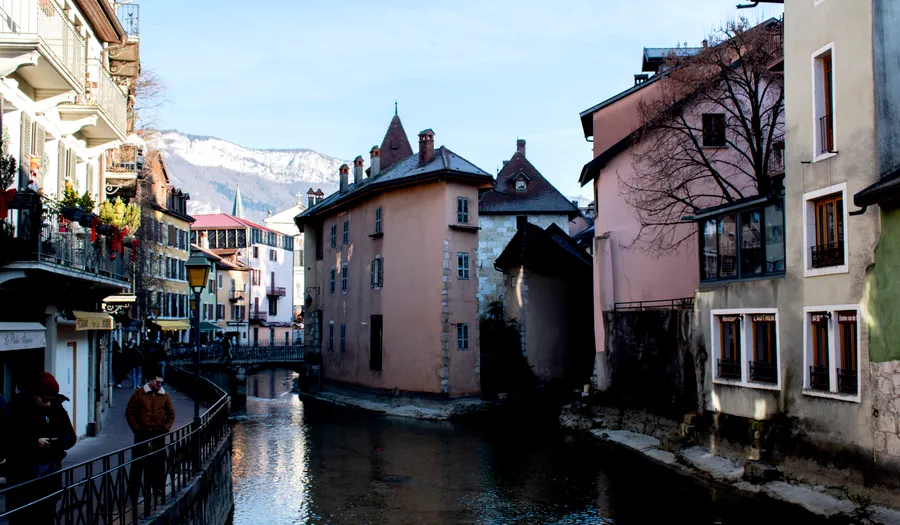
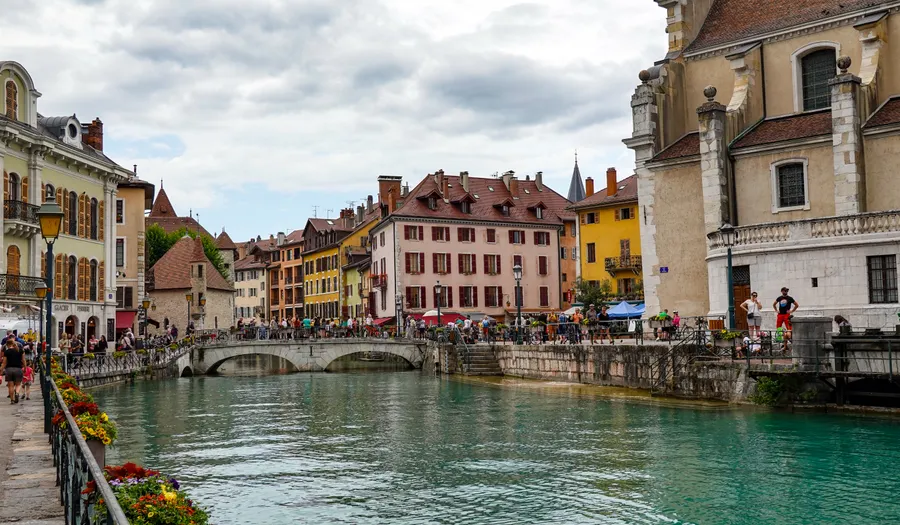
The Thiou, the lake's outflow, runs through the old town for a few hundred metres and creates the whole scene: the arcades of Rue Sainte-Claire and Rue Perrière, pastel façades, low bridges and the Palais de l'Isle planted mid-stream like a ship's prow. This is no reconstruction: the district has kept its medieval layout, covered passages and street-level shops. The market sets up on Tuesday, Friday and Sunday mornings on Rue Sainte-Claire and the quays, and it is the only time the old town still really serves its residents. The arcades shelter you from rain as well as sun, which makes them a decent plan B on a stormy day. Come early: after 10:30 in summer, you move at a crawl.
Beaches and swimming
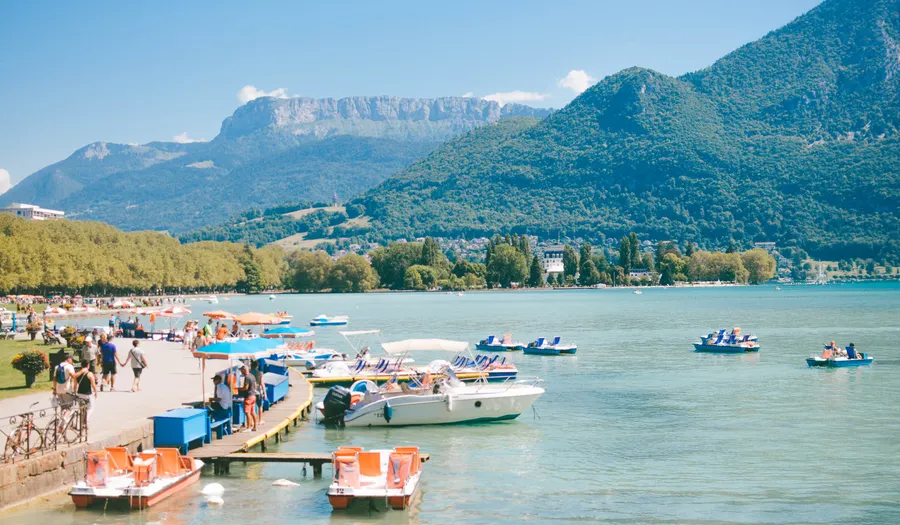
Annecy has three municipal beaches along its shore: Les Marquisats to the south, L'Impérial to the north-east and Albigny in between, all with lifeguards in July and August. L'Impérial is the only one that charges in high season, €4 entry from 4 July to 31 August 2026 between 10:00 and 19:00, with lawns, play areas and toilets; Albigny and Les Marquisats remain free. Les Marquisats is mostly pebbles and pontoons, Albigny grass shaded by tall trees, better suited to families. Around the lake, Saint-Jorioz, Duingt, Menthon and Doussard have less crowded beaches, several of them free. Water quality is excellent, but watch out for swimmer's itch in warm, shallow water in July: drying off quickly when you get out is enough to avoid it.
The greenway and cycling round the lake
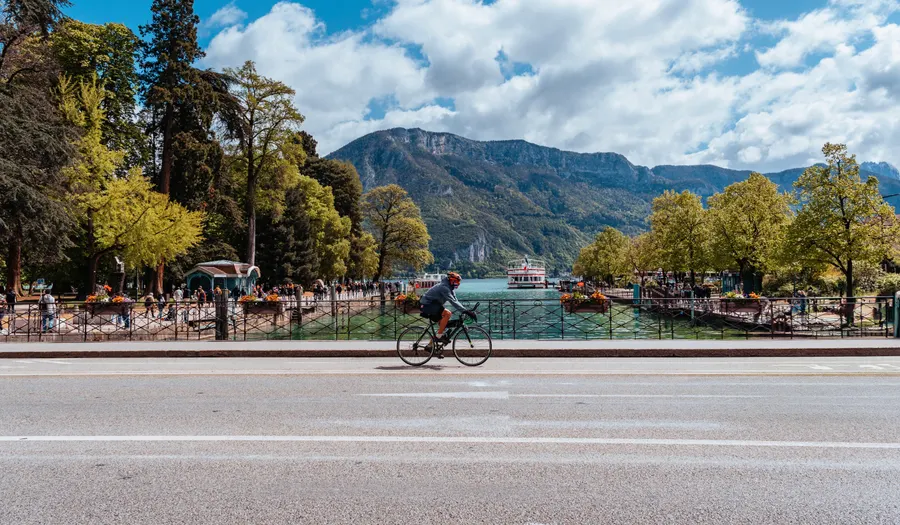
The old Annecy-Albertville railway line has been turned into a paved greenway that follows the west shore for 33 km to Ugine, around thirty of them along the water. The full loop of the lake is 42 km, easy on the west shore and more exposed on the east, where in places you have to share the main road with cars. Allow 2h30 to 4 hours with swimming stops, and longer with children. Hire costs around €22 a day for a standard bike and €42 for an e-bike, with rental shops clustered on Place aux Bois, Rue Camille Dunant and at Les Marquisats. The real problem is congestion on the greenway between Annecy and Sévrier on summer afternoons, when pedestrians, buggies, rollerbladers and cyclists fight over three metres of tarmac.
The château and the Basilica of the Visitation

Annecy's château stands on the rocky spur above the old town: residence of the Counts of Geneva and then the Dukes of Genevois-Nemours, converted into barracks in the 19th century and a museum since 1953. It houses regional art collections and the Regional Observatory of Alpine Lakes, in the Logis Perrière, which explains the lake's limnology in detail. The climb up the Rampe du Château takes five minutes and gives the best bird's-eye view over the rooftops. Higher up the hill, the Basilica of the Visitation, completed in 1930, holds the relics of Francis de Sales and Jane de Chantal; its terrace offers a free panorama over the town, the lake and the Dents de Lanfon. Both municipal museums are closed on Tuesdays all year round.
The Semnoz
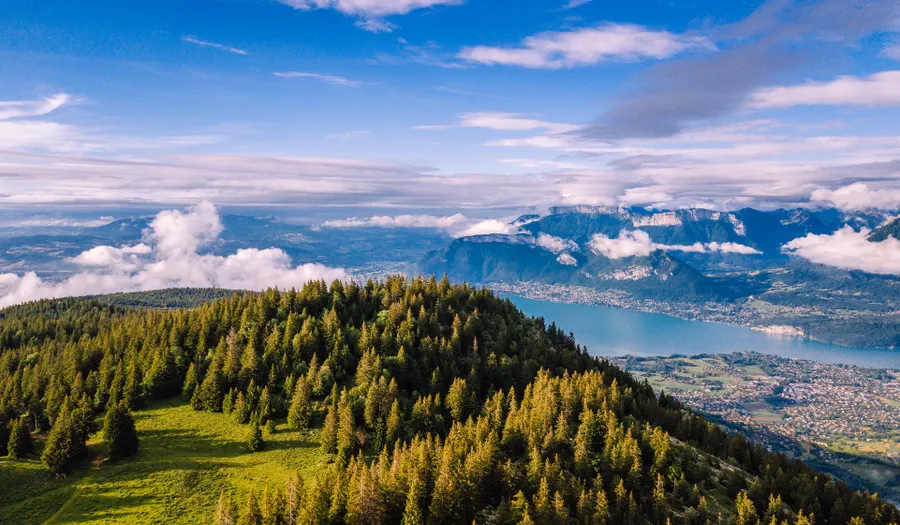
Annecy's own mountain peaks at the Crêt de Châtillon at 1699 m and is reached by eighteen kilometres of road from town, or on foot from Les Marquisats in a three-hour climb. From the summit, the view takes in the lake on one side and the Mont Blanc massif on the other, and it is the only spot around Annecy that gives you both at once. In winter it is a modest family resort with a few drag lifts and a cross-country area, and in summer a gently rolling alpine pasture. The access road is closed by snow from December to March beyond Les Puisots, and it is very popular with cyclists in summer. Bring a light jumper even in August: it is easily ten degrees cooler than on the shore.
The east shore, from Veyrier-du-Lac to Talloires
The east shore of the lake is the steepest, the most expensive and the most photogenic, with villages clinging to the foot of Mont Veyrier and the Dents de Lanfon. Veyrier, Menthon-Saint-Bernard with its neo-Gothic castle, then Talloires and its bay closed off by the Roc de Chère form a string of sheltered anchorages. This is where the region's grand houses and Michelin-starred restaurants are concentrated, but also the Roc de Chère nature reserve, 68 hectares of forest and dry grassland open to walkers free of charge. Above it, the Col de la Forclaz is the launch pad for most of the area's paragliders. The road is narrow, winding and jammed in summer: the shuttle boat or a bike are often faster than a car.
How many days, and which itinerary?
Two full days are enough for the old town, the château, a beach and a stretch of the greenway; four days let you add the bike ride round the lake, the Semnoz, a cruise and a day on the east shore without ever rushing.
🗺️ Day-by-day itinerary · 📓 Free printable Annecy guide (PDF) · 🌍 All of the French Alps
Classic weekend (2 days)
Day 1: the old town and the Palais de l'Isle before 10:00, the château and the Lakes Observatory in late morning, an afternoon on Le Pâquier and a swim at Albigny, dinner in the Sainte-Claire quarter. Day 2: a one-hour cruise from the landing stage, lunch in Duingt or Sévrier, back along the greenway by bike. It is the tightest format on this list, but it works if you schedule visits before 10:30.
Four days around the lake
Add to the weekend a full day cycling round the lake, 42 km with two swimming stops, and a day on the east shore: Menthon, Talloires, the Roc de Chère reserve and the climb to the Col de la Forclaz in late afternoon for the light. Save the Semnoz morning for a clear day, as the view of Mont Blanc does not forgive haze. This pace leaves room for a market and an evening with nothing planned.
Off-season version (3 days)
In May, June or September, everything gets easier: the old town can be visited at any time of day, parking spaces can be found and tables booked the day before. Spend one day on the town and its museums, one hiking on the Semnoz or Mont Veyrier, and one on the lake by boat or bike. The water stays swimmable until mid-September, at around 20 °C, and the colours of late September rival those of summer.
Getting there and getting around
The direct TGV takes 3h40 from Paris Gare de Lyon and drops you 800 m from the old town: by far the best option, with a car only useful for getting out of the basin.
The whole centre, the Albigny and Impérial beaches and the start of the greenway are all under 25 minutes on foot; Sibra buses cover the rest, with a single ticket at around €1.50.
Parking is the real summer trap: the lakeside car parks, Impérial, Sainte-Bernadette and the Marquisats pool, become paying at €1/hour from 1 July to 31 August, 9:00-18:00, seven days a week, and the ten covered car parks in the centre show full by midday.
For the east shore and the lake loop, take a bike or the Compagnie des Bateaux Navibus, which serves the lakeside villages from April to September: the main road is saturated and parking spaces in Talloires or Duingt are rare.
Where to stay in Annecy?
A hotel in the old town or near Le Pâquier: €130 to 250 a night in summer, everything on foot, but rooms are often small and noisy at weekends.
A short-term rental flat or studio in Annecy-le-Vieux or Les Marquisats: €90 to 180, handy for families for the kitchen and parking, 15 minutes' walk from the centre.
A lakeside campsite in Saint-Jorioz, Sévrier or Doussard: €30 to 60 a pitch, with direct access to the water and the greenway, but fully booked from spring for July and August.
A guesthouse or characterful hotel on the east shore, in Menthon, Veyrier or Talloires: €200 to 600, the finest lake views and peace and quiet, at the price of total dependence on a car or boat.
Our places to stay, stop by stop, at three budgets →
What to eat in Annecy?
Lake fish are the only true local speciality: féra, Arctic char and perch, served meunière or as fillets, at €22 to 38 depending on the restaurant and season.
Haute-Savoie cheeses, reblochon, tomme and abondance, go into tartiflettes, fondues and raclettes at €18 to 26, a thoroughly wintry repertoire that is nonetheless served to visitors all year round.
Diots in white wine, crozets and gâteau de Savoie are everyday Savoyard dishes, easier to find in neighbourhood bistros than along the canal.
The Tuesday, Friday and Sunday morning market on Rue Sainte-Claire remains the cheapest way to eat well: charcuterie, cheeses, fruit and bread for a beach picnic at €8 or 10 per person.
Entry requirements
Schengen area: an ID card or passport for EU citizens, 90 days visa-free for UK, US, Canadian and Australian passports.
Rules change: check your own government's travel advice before you go.
Frequently asked questions about Annecy
When is the best time to visit Annecy?
June and September offer the best balance: the water is swimmable, the light is beautiful and the town remains bearable. July and August bring the warmest water, 22 to 24 °C, but also all the crowds and the highest prices; May is superb for hiking and flowers, though the water is still cold.
Should you come by car?
Preferably not. The direct TGV takes 3h40 from Paris and leaves you ten minutes' walk from the lake, whereas in July and August parking becomes a daily headache: the lakeside car parks switch to €1/hour from 9:00 to 18:00 and the covered car parks fill up by midday. If you drive, aim for accommodation with a reserved space and leave the car there during the day.
Do you have to pay for the beaches?
Only one. L'Impérial beach costs €4 entry from 4 July to 31 August 2026, from 10:00 to 19:00, and is free early in the morning and in the evening; Albigny, Les Marquisats and most beaches in the lakeside villages are free. Reduced rates exist for Annecy residents, not for visitors.
Can families cycle round the lake?
Yes, the full 42 km loop is doable with children used to cycling, provided you set off early and allow the whole day with swimming stops. The west shore is a paved greenway entirely separate from traffic; on the east shore you have to ride along the main road in places, the only tricky section. A simple alternative is to cycle out as far as Duingt and come back by boat.
How can you avoid the crowds without leaving town?
By playing with timing rather than places. The old town before 10:00 and after 19:00, the beaches before 11:00, the museums at opening time and the greenway early in the morning are almost calm even in the middle of August. Bear in mind too that both municipal museums close on Tuesdays, when all the visitors pile onto the quays instead.
Similar destinations
 City
City🇮🇪 Galway and Connemara
 Country
🇸🇮 Slovenia
 Region
🇸🇮 Lake Bled
 Region
🇭🇷 Plitvice Lakes
 Region
🇫🇷 The Verdon Gorge
 Country
🇫🇷 France
 Region
🇫🇷 The French Basque Country
 Country
🇭🇷 Croatia
 Country
🇬🇧 United Kingdom
 City
City