When to go to Carcassonne?
→ The detailed month-by-month page, with real weather records
Best time: April to June and September to October
At a glance
Why go to Carcassonne?
The Cité lines up three kilometres of ramparts, 52 towers and two concentric walls on a spur that has been fortified since Roman times. What you see belongs as much to the 13th century as to the 19th: listed for demolition in 1850, the fortress was saved and then rebuilt by Eugène Viollet-le-Duc from 1853, who capped the towers with pepper-pot slate roofs that the south of France had never known. The controversy has run ever since, and it is an interesting one: you are visiting both a Cathar stronghold and an idea of the Middle Ages crafted by French Romanticism. The whole site has been a UNESCO World Heritage Site since 1997.
The practical point that changes everything: getting into the Cité costs nothing. The gates, the streets, the Place Marcou, the Basilica of Saint-Nazaire and the circuit of the lists between the two walls are free to access, 24 hours a day, all year round. Only the Château Comtal and the inner wall walk are paid, and that is the only legal way to walk on the ramparts. Many visitors unknowingly pay for what they could have seen for free, or give up on going in because they think entry is paid: both mistakes can be fixed in thirty seconds.
Then there is the matter of crowds, which is no small thing. With nearly two million visitors a year packed into a handful of lanes, peaks close to 8,000 people a day in summer and a 14 July fireworks display that draws several hundred thousand spectators, the Cité in August is a corridor. The way round it comes down to two moves: arrive before 10:00 or after 18:00, and head down to the Bastide Saint-Louis, the lower town founded by Saint Louis in 1260, which almost every visitor ignores even though it holds the covered market, the street markets and most of local life.
Map of Carcassonne: what is where?
The map shows the 6 places covered in this guide, to picture the distances and plan your route.
- Cité de Carcassonne
- Château Comtal
- Basilica of Saint-Nazaire
- Pont Vieux
- Place Carnot
- Canal du Midi Port
How much does a trip to Carcassonne cost?
Carcassonne is one of the most affordable major heritage destinations in France, provided you sleep in the Bastide rather than inside the walls. The only unavoidable expense is the ticket for the Château Comtal, and the rest of the Cité is free.
| Style | Per day | What it covers |
|---|---|---|
| Backpacker | €45-70/day | Campsite or room in the Bastide, free Cité and lists, Place Carnot market, Lac de la Cavayère |
| Comfort | €90-140/day | Hotel in the Bastide, Château Comtal and ramparts, cassoulet in a restaurant, a trip on the Canal du Midi |
| Premium | €250+/day | Hotel inside the walls with a view of the towers, private guided tour, fine-dining table, tastings in the Corbières |
Everything can be paid by card, including the parking meters at the Cité car parks. Still, keep some change for the Place Carnot market, where several producers only take cash, and buy your castle ticket online: daily capacity is limited and the queue at the ticket office often exceeds an hour in August.
Is Carcassonne safe?
Carcassonne poses no particular safety problem, but two points deserve to be taken seriously. First, the heat: the Cité is entirely stone, without a scrap of shade in the lists or on the wall walks, and the thermometer regularly climbs past 35°C in July and August. People fainting on the ramparts are a common reason for emergency call-outs in summer, so take water, there are hardly any fountains within the walls, and time your visit before 11:00 or after 17:00. Second, the crowds: with nearly two million visitors a year packed into a handful of lanes, pickpockets work the Rue Cros Mayrevieille and the Place Marcou at peak times, no more seriously than elsewhere but with the same methods, and the uneven cobbles trip people up on the slopes down to the Porte d'Aude. In the evening, the Cité empties and becomes perfectly calm again, including for a woman on her own. In the lower town, the bank of the Aude below the Pont Vieux is pleasant by day but poorly lit at night, and a few streets around the station are deserted after 22:00: nothing alarming, just the usual reflexes.
What to see and do in Carcassonne
- Medieval Cité of Carcassonne
- Château Comtal and ramparts
- Basilica of Saint-Nazaire
- The lists of the Cité
- Pont Vieux
- Bastide Saint-Louis
- Canal du Midi Port
- Lac de la Cavayère
The Cité and what you can see for free

You enter by the Porte Narbonnaise to the east, the most monumental with its two almond-shaped towers, or by the Porte d'Aude to the west, steeper but infinitely more beautiful from the Pont Vieux. Inside, the Rue Cros Mayrevieille and the Place Marcou concentrate shops and terraces in an openly touristy register, but the side lanes quickly fall silent. None of this costs anything, at any hour. The Château Comtal and its wall walk are the only ticketed part, and the basilica remains free. Two hours are enough for the free part, including the full circuit of the lists.
The Château Comtal and the ramparts
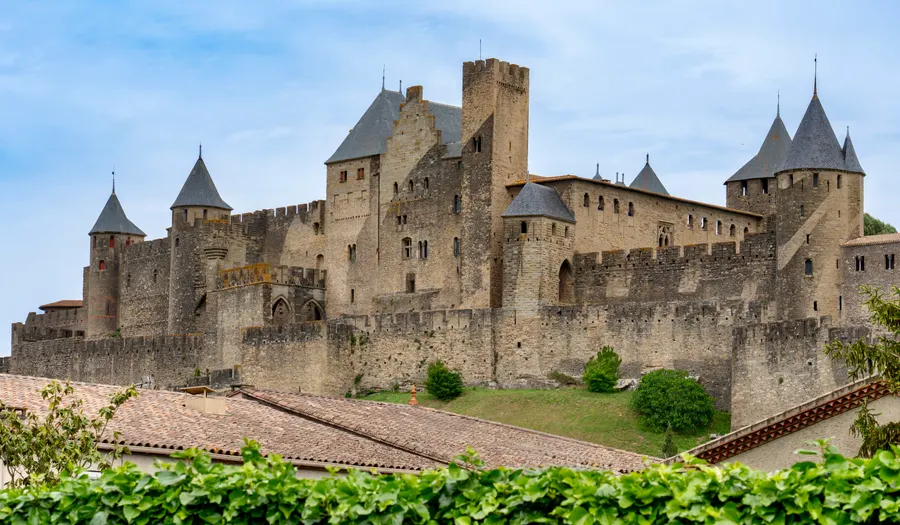
The castle of the Trencavel viscounts occupies the west of the Cité, protected by its own dry moat and a barbican, and was turned into a royal citadel after the crusade against the Albigensians. The ticket gives access to the vaulted halls, a lapidary museum and above all the wall walk along the inner rampart, about 500 metres high above the lists and the Aude plain. Allow an hour and a half to two hours. The price follows the season: €19 from 1 April to 30 September, €13 from 1 October to 31 March, free for under-18s and for European Union nationals aged 18-25. The monument closes on 1 January, 1 May and 25 December, and daily capacity is limited.
The Basilica of Saint-Nazaire
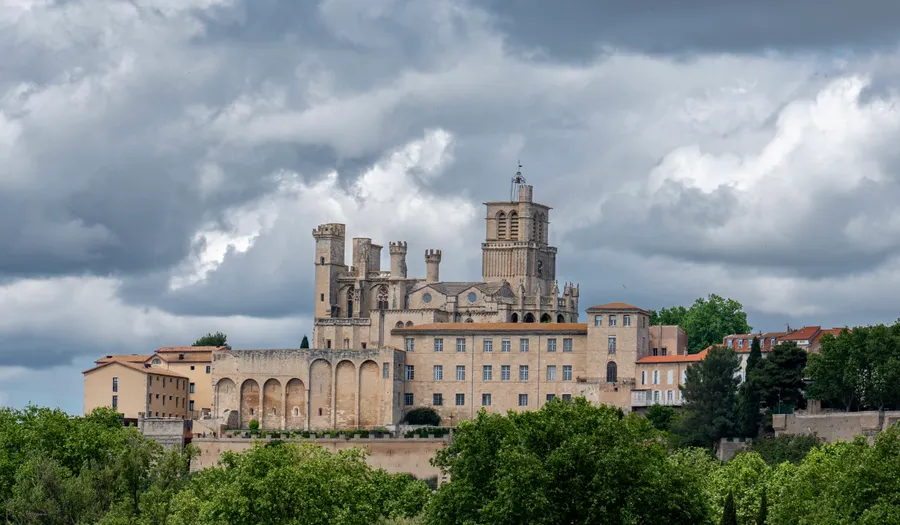
Set against the southern rampart, the former cathedral combines a 12th-century Romanesque nave, massive and dark, with a 14th-century Gothic choir and transept grafted on after the town was annexed to the royal domain. It is the stained glass that justifies the detour: among the oldest in the south of France, it sets the transept ablaze in the late afternoon when the light comes through the south rose window. Entry is free, like the rest of the Cité, with a lunchtime break and closures during services. It is also the coolest spot in the fortress in a heatwave, which makes it a useful break as much as a visit.
The lists
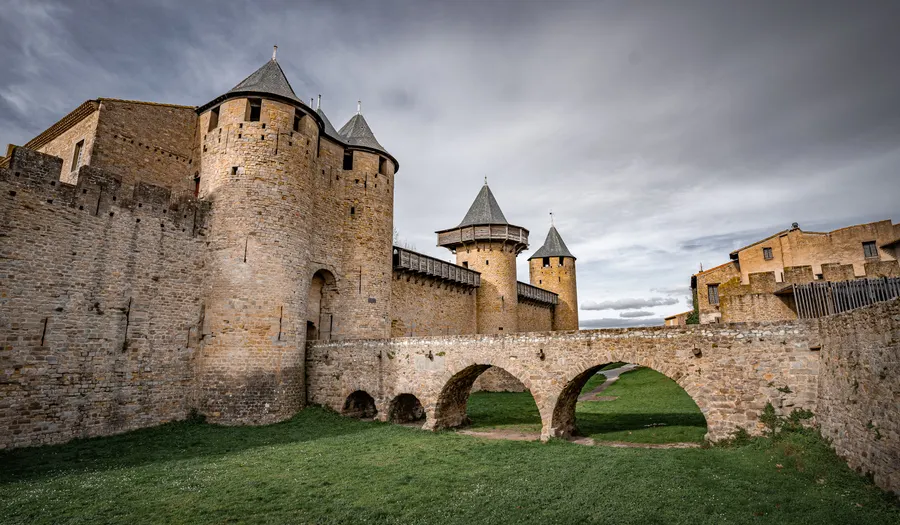
The lists form the grassy corridor that separates the two walls all the way round the fortress, a medieval manoeuvring space that has become the finest walk on the site. The full circuit takes about forty minutes, at the foot of towers where you can clearly make out the Gallo-Roman courses of small stonework, the medieval rebuilds and the 19th-century restorations. It is free, open at all hours, and surprisingly empty while the inner streets overflow. It is the best answer to an August afternoon: enter by the Porte d'Aude and turn into the lists rather than following the flow towards the Place Marcou.
The Bastide Saint-Louis
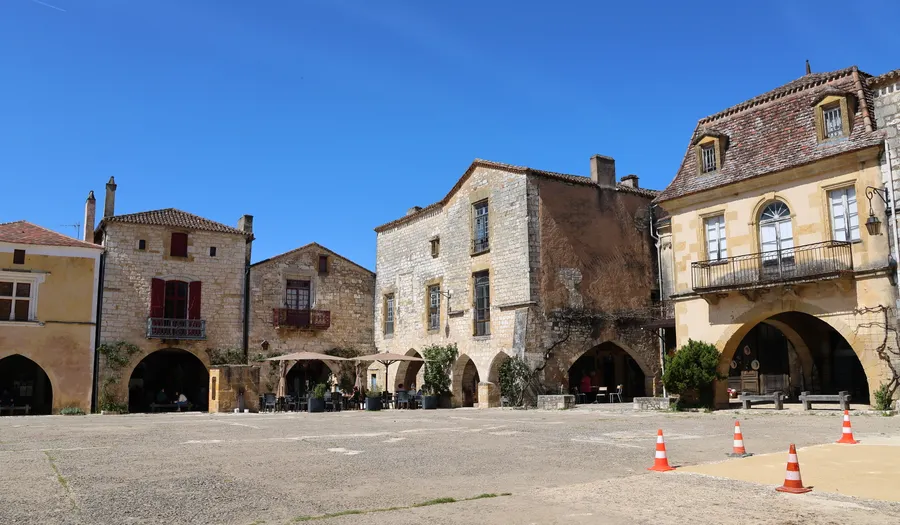
Founded in 1260 on the left bank of the Aude after the outlying suburbs were destroyed, the lower town is a bastide laid out on a grid of straight streets, ringed by tree-lined boulevards. Most visitors leave without setting foot in it, which is a mistake: it holds the Halles Prosper Montagné, the Cathedral of Saint-Michel, the Musée des Beaux-Arts, the mansions of the cloth merchants and most of the town's life. The market fills the Place Carnot on Tuesday, Thursday and Saturday mornings, from 7:00 to 13:00, with a producers' section on Saturdays. The terraces here charge prices that bear no relation to those on the Place Marcou, inside the ramparts.
The Canal du Midi and Lac de la Cavayère
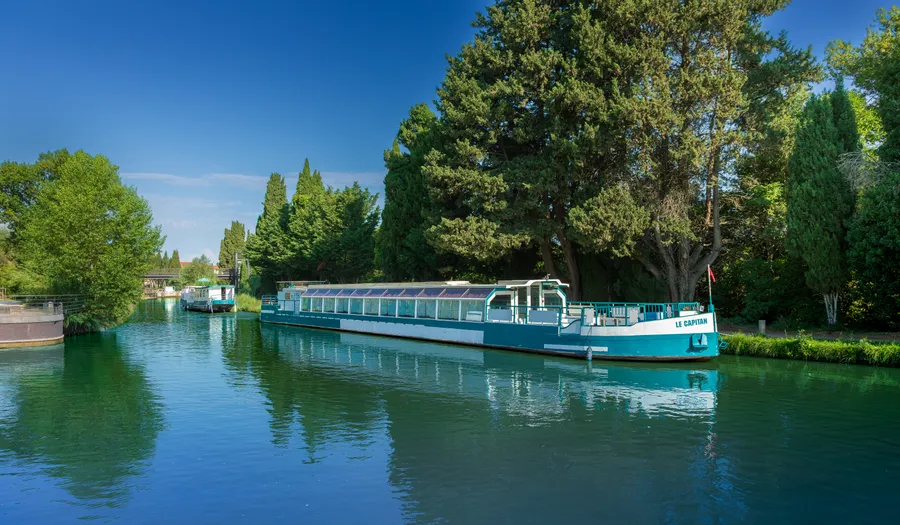
Riquet's canal runs through Carcassonne right in front of the station and widens into a basin lined with plane trees where rental barges are moored, five minutes' walk from the Place Carnot. You can board for an hour-long trip or for a week of licence-free cruising towards Béziers, and the towpath can be walked or cycled for dozens of kilometres. Seven kilometres to the south-east, Lac de la Cavayère offers three sand and grass beaches, a six-kilometre trail and lifeguarded swimming from mid-June to the end of August, generally from 13:00 to 19:00. Access and parking are free: this is where locals go when the Cité is stifling.
How many days, and which itinerary?
One full day is enough for the Cité, castle included, if you arrive early. Two days let you add the Bastide Saint-Louis, the market and the Canal du Midi, which is the format that gives the best idea of the town. Three days open up the hinterland of castles and vineyards.
🗺️ Day-by-day itinerary · 📓 Free printable Carcassonne guide (PDF) · 🌍 All of France
A well-planned day (1 day)
Arrive at the Cité before 9:30 by the Porte d'Aude, do the full circuit of the lists before the shops open, the Château Comtal and the wall walk in the 10:00 slot, then the Basilica of Saint-Nazaire. Lunch in the Bastide rather than on the Place Marcou, then walk back towards the fortress over the Pont Vieux at sunset, when the ramparts light up.
A full weekend (2 days)
Day 1 devoted to the Cité, the lists and the castle, ending the day on the banks of the Canal du Midi. Day 2 in the Bastide Saint-Louis: the Place Carnot market on Saturday morning, the Halles Prosper Montagné, the Cathedral of Saint-Michel and the Musée des Beaux-Arts, then an afternoon swim at Lac de la Cavayère if the season allows.
Three days with the hinterland (3 days)
Two days in Carcassonne as above, and a third by car to the castles of Lastours, about twenty kilometres to the north, or to the abbey and village of Lagrasse in the Corbières. The Minervois, Cabardès and Malepère vineyards all begin less than thirty minutes from town.
Getting there and getting around
TGV from Paris in about 5h30, usually with a change in Toulouse or Montpellier; the station is north of the Bastide, a 10-min walk from the centre and 25 min from the Cité.
The free Citadine shuttle runs from April to October between the Bastide and the Cité, or take a city bus for about €1.10 a journey; lines 2, 3 and 4 all drop you less than 500 m from the gates.
P1 Porte Narbonnaise and P2 Porte d'Aude car parks: about €1 per quarter of an hour for the first two hours, free from 20:00 to 8:00. P1 is full by 10:00 at weekends in July and August.
Carcassonne-Salvaza airport is 4 km from the centre, served by European low-cost flights, with a shuttle to the station and the Bastide.
Where to stay in Carcassonne?
Hôtel de la Cité, the only luxury address inside the ramparts, with views of the towers: from €300 a night in high season.
Guesthouses and small hotels in the Bastide Saint-Louis: €70 to €120 for a double, a ten-minute walk from the Cité over the Pont Vieux and far cheaper than inside the walls.
A furnished flat in the Bastide for three or four nights: €60 to €100 a night, with the covered market and the street market right on your doorstep.
Campsites on the banks of the Aude and at Lac de la Cavayère: €20 to €40 a pitch, the family option in July and August.
Our places to stay, stop by stop, at three budgets →
What to eat in Carcassonne?
Carcassonne cassoulet, made with lingot beans, sausage and confit, served at €18 to €28; the local version differs from those of Toulouse and Castelnaudary by the addition of partridge in season.
The Halles Prosper Montagné, Tuesday to Saturday mornings, closed Sunday and Monday: charcuterie, Pyrenean cheeses and Mediterranean fish from an hour's drive away.
Wines from the four appellations that ring the town, Corbières, Minervois, Cabardès and Malepère, often available by the glass for €3 to €5 in the bars of the Bastide.
Cabardès goat's cheeses and garrigue honey at the Place Carnot market, on Tuesday, Thursday and Saturday mornings from 7:00 to 13:00.
Entry requirements
Schengen area: an ID card or passport for EU citizens, 90 days visa-free for UK, US, Canadian and Australian passports.
Rules change: check your own government's travel advice before you go.
Frequently asked questions about Carcassonne
Do I have to pay to enter the Cité?
No. The gates, the streets, the Place Marcou, the Basilica of Saint-Nazaire and the circuit of the lists between the two ramparts are free and open 24 hours a day. Only the Château Comtal and the inner wall walk are paid, at €19 from April to September and €13 from October to March, free for under-18s and for European Union nationals aged 18-25.
Is one day enough?
For the Cité and the Château Comtal, yes, provided you arrive before 10:00. Two days give a much truer picture of the town, adding the Bastide Saint-Louis, its market and the Canal du Midi. Beyond that, you head off to explore the Corbières and the castles of Lastours.
How do I avoid the crowds in summer?
Three levers. Arrive before 10:00 or come back after 18:00, when the coaches have left and the stone turns orange. Walk in the lists rather than along the Rue Cros Mayrevieille. And avoid mid-July, when the fireworks on the 14th draw several hundred thousand people over two days.
Where can I park without wasting the morning?
P1 Porte Narbonnaise is full by 10:00 on summer weekends. Park in the Bastide instead, where parking is cheaper, and walk up via the Pont Vieux and the ramp to the Porte d'Aude: a fifteen-minute walk and the finest approach to the fortress. The free Citadine shuttle makes the trip from April to October.
Is the lower town really worth the detour?
Yes, and it is the blind spot of the typical stay. The Bastide Saint-Louis holds the Halles Prosper Montagné, the three-times-weekly market on the Place Carnot, the Cathedral of Saint-Michel and the Musée des Beaux-Arts. You eat better there for half the price of inside the ramparts, and you meet locals rather than tour groups.
Similar destinations
 Country
🇵🇹 Portugal
_Abbaye_Saint-Michel_de_Gaillac_exposition_sud_vue_des_berges_du_Tarn.jpg/1280px-(Gaillac)_Abbaye_Saint-Michel_de_Gaillac_exposition_sud_vue_des_berges_du_Tarn.jpg) Region
Region🇫🇷 Gaillac
 Region
🇫🇷 Tarn-et-Garonne
 City
City🇫🇷 Bordeaux and Around
 City
City🇫🇷 Albi and the Tarn Valley
 City
City🇫🇷 Rochefort and the Charente Estuary
 City
City🇫🇷 Mougins
 Region
🇭🇷 Istria
 City
City🇱🇦 Luang Prabang
 City
City