When to go to Mombasa?
→ The detailed month-by-month page, with real weather records
Best time: December to March and July to September
At a glance
Why go to Mombasa?
Mombasa is a Swahili port before it is a Kenyan city. The trading post already existed when the traveller Ibn Battuta called here in 1331, and dhows arrived from Oman, Gujarat and Persia to the rhythm of the monsoons, six months one way, six months the other. That history can be read in the carved teak doors of the old town, in the 16th-century mosques, in the vocabulary of Swahili, which borrows heavily from Arabic, and in the cooking, somewhere between biryani and coconut milk.
Fort Jesus sums up four centuries of rivalry on its own. The Portuguese raised it from 1593 to lock down the route to the Indies, the Omanis besieged it for thirty-three months and took it in 1698, and the British turned it into a prison. It changed flags nine times between 1631 and 1895, which says a great deal about the strategic value of this deep harbour. The site has been a World Heritage Site since 2011 and still commands the entrance to the old harbour.
The rest of the stay plays out on the coast. North of the island, Nyali, Bamburi and Shanzu line up beaches sheltered by a reef a few hundred metres offshore. To the south, beyond the Likoni ferry, Diani unrolls seventeen kilometres of white sand and a turquoise lagoon, with colobus monkeys crossing the road on rope bridges. And thirty kilometres inland, the Shimba Hills reserve shelters Kenya's last sable antelopes.
Map of Mombasa: what is where?
The map shows the 6 places covered in this guide, to picture the distances and plan your route.
- Mombasa
- Fort Jesus
- Nyali Beach
- Haller Park
- Diani Beach
- Shimba Hills
How much does a trip to Mombasa cost?
The Kenyan coast remains affordable once you step outside the resorts: a fish meal costs less than €10 and the beaches are free. It is transfers, organised excursions and half board in a beach hotel that push up the bill for a typical stay.
| Style | Per day | What it covers |
|---|---|---|
| Backpacker | €35-60/day | Small hotel on the island or guesthouse in Diani, matatus and tuk-tuks, fish canteens, public beaches |
| Comfort | €110-170/day | Beach hotel on half board, car with driver for two days, marine park and Shimba Hills |
| Premium | €300+/day | Shanzu resort or staffed villa, private transfers, guided diving and a day in Tsavo |
M-Pesa mobile payment is used everywhere, including by tuk-tuks and small traders, but it requires a Kenyan SIM card. Bank cards work in hotels and supermarkets, rarely elsewhere. Carry cash in shillings for markets, transport and tips, and withdraw from the ATMs in the Nyali shopping centres rather than out on the street.
Is Mombasa safe?
Mombasa calls for the ordinary vigilance of a big port city rather than any special caution. Snatch thefts happen on Moi Avenue and around the markets, so leave documents and large sums at the hotel and do not flash your phone in a crowd. At night, choose a taxi or the local ride-hailing app over a tuk-tuk, especially between the island and the north coast. The Likoni district and the ferry area are best crossed without lingering. On the beaches, beach boys push excursions and souvenirs insistently: a firm, polite no is enough, but always settle transactions in advance and in writing. Malaria is very much present on the coast, with a higher risk than in the highlands: preventive treatment, repellent and a mosquito net are justified. Finally, outgoing lagoon currents are powerful at the gaps in the reef, so swim between the hotels' marked zones.
What to see and do in Mombasa
- Fort Jesus
- Mombasa Old Town
- Moi Avenue elephant tusks
- Nyali Beach
- Mombasa Marine Park
- Haller Park
- Diani Beach
- Shimba Hills Reserve
Fort Jesus

A coral-stone fortress built from 1593 to 1596 by the Portuguese, designed by the Milanese engineer Giovanni Battista Cairati on a plan that suggests a human figure seen from above. Its fifteen-metre walls command the entrance to the old harbour. Nine changes of owner between 1631 and 1895, including the thirty-three-month Omani siege that ended in 1698, have left traces everywhere: graffiti by Portuguese sailors, reworked bastions, British cells. The museum displays Chinese and Persian ceramics from the excavations.
The old town and the dhow harbour

Below the fort, a maze of alleys where Swahili, Omani and Indian architecture overlap. Carved teak doors studded with brass, ornate balconies and lime-washed facades tell the story of the monsoon trade. The Mandhry Mosque, founded around 1570, is still the oldest working mosque in the city. The old harbour still loads dhows bound for the Somali coast. The streets are lively, noisy and largely Muslim, and best explored in the morning before the heat sets in.
Nyali, Bamburi and Shanzu beaches

The north coast begins ten minutes from the centre over the Nyali Bridge and strings together three white-sand beaches over some fifteen kilometres. A reef a few hundred metres offshore breaks the swell and creates a calm lagoon, where low tide uncovers the reef flat for hundreds of metres. This is where the resorts, dive clubs and seafront restaurants are concentrated. Bamburi is also home to Haller Park, a former cement quarry turned into a nature reserve since 1971.
Mombasa Marine Park

Created in 1986, it protects around ten square kilometres of lagoon and reef off Nyali, supplemented by a 200 km² reserve. The bleaching events of 1998 and 2016 damaged the coral, but marine life is still abundant: parrotfish, triggerfish, moray eels, stingrays and green turtles. Glass-bottom boats leave straight from the north coast hotels and drop swimmers on the reef flat. Visibility is best from December to March, when the sea calms down.
Diani and the south coast
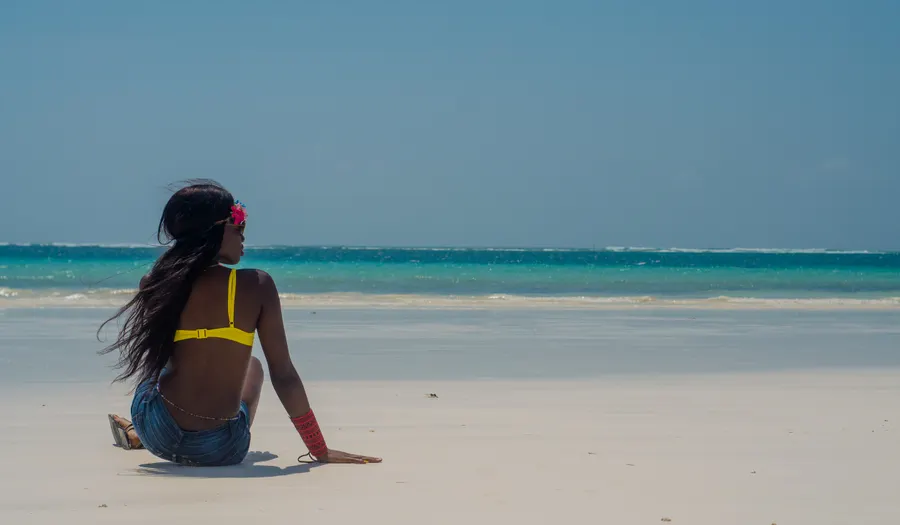
Seventeen kilometres of white sand some thirty kilometres to the south, reached by the Likoni ferry or by the faster Dongo Kundu bypass. The reef-enclosed lagoon stays turquoise and shallow, and steady winds have made Diani a kitesurfing spot known far beyond Kenya. Black-and-white colobus monkeys cross the road on rope bridges. The 15th-century Kongo Mosque stands at the mouth of the Tiwi River, at the northern end of the beach.
Shimba Hills Reserve

Three hundred square kilometres of wooded hills 30 km to the south-west, the only coastal forest of this size in Kenya. It is home to the country's last population of sable antelope, around two hundred animals, as well as elephants numerous enough to have prompted the creation of a corridor to Tsavo. The Sheldrick Falls, about twenty metres high, are reached on a guided three-quarter-hour walk that ends with a swim. A full day and a 4x4 are needed.
How many days, and which itinerary?
Three days are enough for Fort Jesus, the old town and two days on the beach on the north coast. A week lets you add Diani in the south, a marine park outing, the Shimba Hills reserve and a day trip to Tsavo East, two and a half hours' drive inland.
🗺️ Day-by-day itinerary · 📓 Free printable Mombasa guide (PDF) · 🌍 All of Kenya
Coastal stopover (3 days)
Day 1: the old town early in the morning, Fort Jesus with a guide, then a fish lunch at the old harbour and the Moi Avenue tusks in the late afternoon. Day 2: Nyali beach in the morning, Haller Park for the giraffe feeding late in the day. Day 3: a glass-bottom boat trip in the marine park at high tide, then back to the airport. This format follows on neatly from a safari in the southern parks.
Mombasa and both coasts (1 week)
Two nights on the island for the historic side, two nights on the north coast between Bamburi and Shanzu for the marine park and Haller Park, then three nights in Diani to the south, with kitesurfing, colobus monkeys and the Kongo Mosque. Add the Shimba Hills reserve as a full day out from Diani, with the walk to the Sheldrick Falls. The Dongo Kundu bypass avoids the wait for the Likoni ferry in both directions.
Safari and beach (12 days)
The Kenyan classic: arrive in Nairobi, then four nights in the Masai Mara for the migration and two nights in Amboseli facing Kilimanjaro, before heading to the coast on the high-speed train from Nairobi, six hours to Mombasa. Five nights between the island and Diani to finish in peace. The Madaraka Express is booked online a few days ahead and costs a fraction of a domestic flight.
Getting there and getting around
The Madaraka Express train links Nairobi to Mombasa in about six hours, with several departures a day, for 1,000-4,500 shillings depending on class. Tickets are bought online a few days ahead, and Mombasa station is 10 km from the centre.
Domestic flights from Nairobi take an hour and land at Moi airport, 10 km from the island. Several airlines serve the route every day, and fares stay close to those of first class on the train.
Locally, matatus and tuk-tuks cover the whole urban area for a few dozen shillings. The Likoni ferry, free for foot passengers, links the island to the south coast but gets saturated at rush hour: the Dongo Kundu bypass saves an hour.
For Diani, Shimba Hills and Tsavo, a car with driver remains the simplest choice, at around €60-100 a day. Self-drive hire is possible, but driving is on the left, with heavy traffic and frequent potholes.
Where to stay in Mombasa?
Hostels and small hotels on the island, around Haile Selassie Road and the old town: €20-45 a night, with a fan or basic air conditioning. Handy for the historic side, but noisy and far from any swimmable beach.
Beach hotels in Nyali and Bamburi: €70-130, with pool, garden and direct access to the lagoon. Half board is common and often better value than going out for dinner, as the restaurants are scattered along the coast road.
Apartments and villas on the north coast and in Diani: €60-140, with a kitchen and sometimes household staff. The format suits families and stays of more than a week, and is very common between Shanzu and Kikambala.
Resorts in Shanzu, Bamburi and Diani: €180-320, with spa, several restaurants and kids' clubs. Rates rise sharply from mid-December to early January and during the Kenyan school holidays in August.
Our places to stay, stop by stop, at three budgets →
What to eat in Mombasa?
Fish and shellfish dominate: capitaine, tuna, mangrove crab and spiny lobster, grilled or simmered in coconut milk. A full plate costs 800-1,500 shillings, or €5-10, in the seafront canteens away from the resorts.
Biryani and pilau, a legacy of the monsoon trade, are made with cardamom, cloves and cinnamon. On Fridays, old-town families serve beef pilau, and the canteens of Mackinnon Market get through whole pots of it.
Mishkaki, beef or goat skewers marinated then grilled over charcoal, are sold in the evening at street stalls for 50-100 shillings each. They come with mkate wa sinia, a fermented rice bread baked in a tray.
Madafu, fresh coconut opened with a machete, is drunk all along the beaches for around a hundred shillings. Hand-pressed sugar cane juice, with lime and ginger added, is Mombasa's other street drink.
Entry requirements
An electronic travel authorisation (eTA) is required for EU, UK, US, Canadian and Australian citizens, applied for online before departure; allow at least two weeks. Your passport must be valid six months after arrival with two blank pages.
Rules change: check your own government's travel advice before you go.
Frequently asked questions about Mombasa
Can Mombasa be combined with a safari?
Yes, it is in fact the dominant logic of trips to Kenya. Tsavo East is two and a half hours away by road, Tsavo West a little further, and Shimba Hills an hour to the south. For the Masai Mara or Amboseli, you need a domestic flight or the train to Nairobi, six hours. Allow a week at least to combine parks and coast without spending your days in transfers.
Which beach should I choose, north or south?
The north coast, from Nyali to Shanzu, is ten to twenty minutes from the centre and suits short stays or trips combined with the city. Diani, to the south, offers wider sand, a clearer lagoon and a calmer feel, but means an hour's drive and crossing by ferry or the bypass. For a full week on the beach, Diani wins.
When should I go to the Kenyan coast?
From December to March, with clear skies, a calm sea and good underwater visibility, and from July to September, slightly cooler and windier. Avoid April, May and June, the long rains, when many establishments close. November brings short showers, often bearable.
Do I need antimalarials?
Yes, the Kenyan coast is classed as an area of active transmission all year round, with a higher risk than Nairobi or the highlands. Preventive treatment should be discussed with a doctor before departure, backed up by skin repellent, long clothing in the evening and a mosquito net. No yellow fever vaccination is required for travellers arriving directly from Europe.
How do I get to Mombasa from Nairobi?
The Madaraka Express train takes about six hours for 1,000-4,500 shillings depending on class, with several daily departures and online booking a few days ahead. The plane takes an hour, for a fare close to first class on the train. The road, 480 km, takes seven to eight hours and is only worthwhile if you stop at Tsavo on the way.
Similar destinations
 City
City🇫🇷 Bordeaux and Around
 City
City🇫🇷 Rochefort and the Charente Estuary
 Region
🇭🇷 Istria
 City
City🇸🇳 Saly
 Country
🇫🇷 France
 Region
🇫🇷 Normandy
 Country
🇵🇹 Portugal
 City
City🇮🇪 West Cork
 City
City🇮🇪 Galway and Connemara
 Region