When to go to Toulouse?
→ The detailed month-by-month page, with real weather records
Best time: April to June and September
At a glance
Why go to Toulouse?
Toulouse suffers from the opposite reputation problem to the big-name destinations: people rarely come for the city itself, more often for a trade fair or a connection, and only once there discover one of the most important groups of Romanesque buildings in Europe. Saint-Sernin is the largest surviving Romanesque church on the continent, a major stop on the Camino de Santiago, and the Couvent des Jacobins holds the tomb of Thomas Aquinas beneath a palm-tree vault of twenty-two ribs. All of this fits into a centre where you can walk from the Capitole to the Garonne in ten minutes.
Above all, the city lives off the sky. The Aéropostale took off from Montaudran, Airbus assembles the A350 and the A321 here, the French space agency CNES controls France's satellites from Toulouse and the Cité de l'Espace has been drawing families since 1997. You can tour a working assembly line in the morning, climb aboard a Concorde and an A380 in the afternoon, then walk along the old Aéropostale runway: no other European city offers that continuity.
Finally, it is a city that eats and goes out. Upstairs, the Victor-Hugo market hides a handful of restaurants that cook produce from the stalls below, at lunchtime only. Cassoulet, Toulouse sausage, duck and the wines of Fronton and Gaillac make up a rich, straightforward cuisine, and the city's 130,000 students fill the banks of the Garonne and Place Saint-Pierre as soon as the first fine days arrive.
Map of Toulouse: what is where?
The map shows the 6 places covered in this guide, to picture the distances and plan your route.
- Place du Capitole
- Saint-Sernin Basilica
- Couvent des Jacobins
- Pont-Neuf
- Cité de l'Espace
- Halle de La Machine
How much does a trip to Toulouse cost?
Toulouse is one of the most affordable big cities in France: municipal museums cost a few euros, the centre is walkable and market restaurants serve full set menus for under €20. The big-ticket items are the Cité de l'Espace and the factory tours, both of which need booking.
| Style | Per day | What it covers |
|---|---|---|
| Backpacker | €45-75/day | Hostel or shared apartment, markets and lunch menus, municipal museums for a few euros, walks along the riverbanks |
| Comfort | €95-150/day | Hotel in the centre, Cité de l'Espace, Airbus tour, cassoulet at a good restaurant and a Fronton wine |
| Premium | €220+/day | Mansion hotel in Les Carmes, fine dining, a light-aircraft flight over the Garonne and a private guide |
Cards are accepted everywhere, even for a coffee. Still bring some cash for certain stalls at the Victor-Hugo market, where several producers only take cash, and for the Sunday flea market at Saint-Sernin.
Is Toulouse safe?
Toulouse is a safe city by French standards, but pickpocketing is concentrated in the centre at busy times, notably on metro line A between Jean-Jaurès and Capitole, and in the shopping streets on Saturday afternoons. In the evening, the area around Matabiau station, Place Arnaud-Bernard and some parts of the Bayard district attract groups of drinkers and are worth skirting after midnight, though the risk goes no further than unpleasantness. The banks of the Garonne and Place Saint-Pierre overflow with students on match nights and at the end of exams: a festive but noisy atmosphere, and a few people fall into the water every year, as the banks have no continuous railing. One last point: the metropolitan area enforces a low-emission zone, so if you arrive in an older vehicle, check your Crit'Air sticker before entering the centre; a fine is more likely than a theft.
What to see and do in Toulouse
- Place du Capitole
- Saint-Sernin Basilica
- Couvent des Jacobins
- Cité de l'Espace
- Musée des Augustins
- The banks of the Garonne and the Pont-Neuf
- Halle de La Machine
- Aeroscopia and Airbus tours
The Capitole and the pink centre
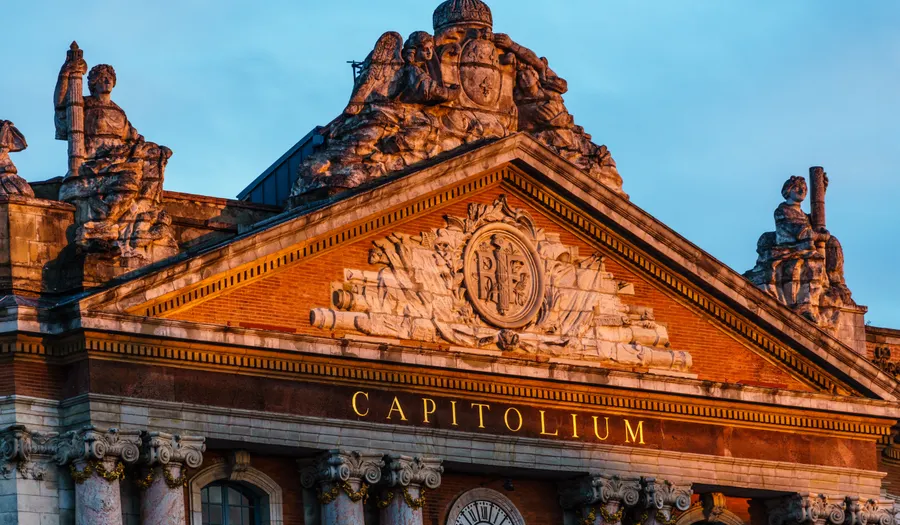
Place du Capitole, twelve thousand square metres and fully pedestrianised, has served as the city's outdoor living room since it was redesigned in the 1990s. The 128-metre brick and stone façade, completed in 1760, conceals the town hall, the Théâtre du Capitole and the Salle des Illustres, a painted gallery from the late 19th century that is free to visit. Behind it run Rue Saint-Rome and Rue des Changes, a shopping street inherited from the Roman cardo, then Place de la Trinité and its cafés. The Occitan cross designed by Raymond Moretti and set into the paving is every Toulousain's default meeting point. Allow an hour there, two if you go into the municipal rooms.
Saint-Sernin and Arnaud-Bernard

The Basilica of Saint-Sernin, built between 1080 and 1120 to receive pilgrims bound for Santiago de Compostela, stretches 115 metres of nave beneath a five-tier octagonal bell tower that became the model for all of Toulouse's Gothic. Its crypt holds an exceptional collection of shrines and reliquaries, open to visitors for a few euros. The surrounding district, between Place Arnaud-Bernard and Les Carmélites, is the most working-class and multicultural part of the centre, with Portuguese, North African and Asian grocers. The Sunday-morning flea market on the basilica's forecourt is still one of the city's fixtures. In the evening the area is lively but less orderly than the rest of the centre.
Les Carmes and Saint-Étienne

South-east of the Capitole, the Carmes district is the most upmarket and the quietest part of the centre, with Renaissance mansions built by the woad merchants. Saint-Étienne cathedral, a building project interrupted several times over, has a nave and a choir that are out of alignment and never meet, an architectural oddity unique in France. The Hôtel d'Assézat, the finest woad merchant's palace in the city, houses the Fondation Bemberg and its painting collection, reopened after three years of works. The Carmes market, smaller than Victor-Hugo, plays the same role for the people of the neighbourhood. This is where you will find the city's best wine merchants and cheesemongers.
Saint-Cyprien and the banks of the Garonne

On the left bank, Saint-Cyprien was long the district of floods and hospitals; today it is one of the liveliest in the city. The Hôtel-Dieu Saint-Jacques and the domed Hôpital de La Grave make up the most reproduced view of Toulouse, seen from the right bank. Les Abattoirs, a modern and contemporary art museum in the former municipal slaughterhouses, holds among other things a stage curtain painted by Picasso. The Prairie des Filtres, a vast riverside lawn, fills up as soon as the sun comes out and serves as a giant picnic ground. The Pont-Neuf, completed in 1632 despite its name, is the oldest bridge in the city.
Montaudran and the Piste des Géants

Four kilometres from the centre, Montaudran is the birthplace of the Aéropostale: it was from here that Mermoz, Guillaumet and Saint-Exupéry took off for Barcelona, Casablanca and Dakar. Nearly two kilometres of the old runway have been preserved and turned into an urban promenade, lined by the L'Envol des Pionniers museum. Next door, the Halle de La Machine houses the creations of the La Machine company, including the fourteen-metre Minotaur that regularly comes out for a stroll along the runway. Metro line B followed by the tram serves the area easily. It is a half-day that appeals to children and adults alike.
The Canal du Midi and the Port de l'Embouchure
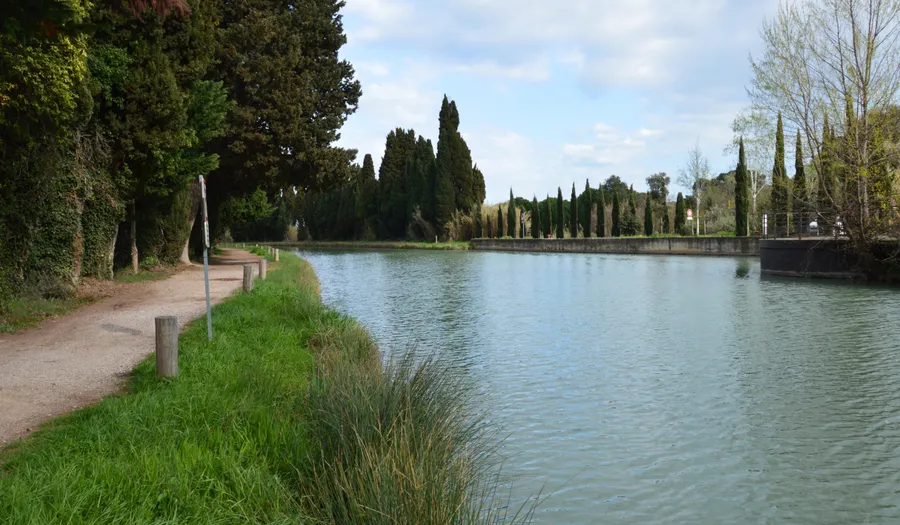
A UNESCO World Heritage Site, the Canal du Midi crosses Toulouse for about ten kilometres, between plane trees and lived-in barges. The Port de l'Embouchure marks the junction with the Canal de Brienne and the Garonne Lateral Canal, beneath an 18th-century stone arch bearing bas-reliefs on the theme of navigation. The towpaths can be cycled along the entire route and reach Castelnaudary in a long day in the saddle. Port Saint-Sauveur is home to rental boats and, in summer, a few open-air guinguettes. Canker stain disease has doomed a large share of the historic plane trees, which have been gradually replaced since the 2010s.
How many days, and which itinerary?
Two days cover the historic centre, the Jacobins and an evening on the riverbanks. Three to four days let you add the Cité de l'Espace, an Airbus factory tour and a train trip out to Albi or Carcassonne.
🗺️ Day-by-day itinerary · 📓 Free printable Toulouse guide (PDF) · 🌍 All of France
City weekend (2 days)
Day 1: the Capitole and the Salle des Illustres, Saint-Sernin, lunch upstairs at the Victor-Hugo market, the Jacobins in the afternoon, an aperitif on Place Saint-Pierre. Day 2: Les Carmes, Saint-Étienne cathedral and the Fondation Bemberg in the morning, across the Pont-Neuf, Les Abattoirs and the Prairie des Filtres in the afternoon. No journey is longer than twenty minutes on foot.
Aerospace Toulouse (3 days)
A day in the historic centre, a day at the Cité de l'Espace, a morning at the Airbus factory in Blagnac followed by Aeroscopia, then Montaudran and the Halle de La Machine. Book the Airbus tour at least three weeks ahead: slots go quickly and ID is checked at the entrance.
Toulouse and Occitania (5 days)
Two days in Toulouse, a day in Albi and its brick cathedral an hour away by train, a day in Carcassonne fifty minutes away, and a last one cycling the Canal du Midi from Port Saint-Sauveur. Everything can be done without a car from Matabiau station.
Getting there and getting around
Tisséo ticket at €1.90 since 1 July, 10 journeys for €16, 24-hour pass at €7.20 and 3-day pass at €14.30: two metro lines, two tram lines and a cable car.
The Téléo urban cable car crosses the Garonne in about ten minutes between the Oncopole and Paul-Sabatier University, for the price of an ordinary ticket, with the best view of the city.
Blagnac airport is about twenty minutes away by tram T2 to Arènes and then metro line A, or by the express shuttle bus to Matabiau.
Bike-share and the canal's cycle paths make cycling faster than the metro for short trips in the centre.
Where to stay in Toulouse?
Boutique hotel in a mansion in Les Carmes or near the Capitole: €120 to 200 a night, right in the pedestrian heart.
Chain or independent hotel around Jean-Jaurès and Matabiau: €70 to 110, handy for trains and day trips.
Rental apartment in Saint-Cyprien or Les Chalets: €60 to 110, lively neighbourhoods and gentler prices than on the right bank.
Youth hostel or student residence in summer: €30 to 55 per person, with supply swelling from June to August when the students leave.
Our places to stay, stop by stop, at three budgets →
What to eat in Toulouse?
Toulouse cassoulet, with sausage and duck confit, is a lunchtime dish and rarely eaten in summer: expect €18 to 25 at a good restaurant.
Upstairs at the Victor-Hugo market, restaurants cook the produce sold on the ground floor, at lunchtime only and never on Mondays.
Toulouse sausage, unsmoked and coarsely minced, is sold by the metre at the charcutiers of the Carmes market.
Candied violets, Toulouse pastis flavoured with orange blossom and the wines of Fronton and Gaillac round out the local menu.
Entry requirements
Schengen area: an ID card or passport for EU citizens, 90 days visa-free for UK, US, Canadian and Australian passports.
Rules change: check your own government's travel advice before you go.
Frequently asked questions about Toulouse
Has the Musée des Augustins reopened?
Yes, on 19 December 2025, after more than six years of works, but the reopening is gradual. The church and the Gothic rooms open during 2026 and the restoration of the cloister will not be finished until spring 2027: check which areas are actually open before you go. Admission costs about €4 and the first Sunday of the month is free.
How can you tour an Airbus factory?
Only through the approved operator that runs tours of the A350 and A321 assembly lines, for around €16 to 18. Booking is compulsory and fills up weeks in advance; valid ID is checked at the entrance, driving licences are not accepted and a passport is required for visitors from outside the European Union, children included. Arrive 30 minutes early and leave cameras and large bags at your hotel.
When should you eat cassoulet?
At lunchtime and not in a heatwave. It is a very filling dish, simmered for hours, that good restaurants serve mainly from October to April and that will wreck your afternoon if you have a busy schedule. Plan a long walk along the riverbanks straight afterwards.
Do you need a car?
Not for the city, possibly for the surrounding countryside. The centre is pedestrianised or one-way, the metropolitan area enforces a low-emission zone and car parks in the centre are expensive. Albi, Carcassonne and Montauban are all less than an hour by train from Matabiau.
What is there to see with children?
The Cité de l'Espace fills a whole day with its rockets, planetarium and simulators, at €29 for adults and €22.50 for ages 5 to 18. The Halle de La Machine and its fourteen-metre Minotaur, in Montaudran, take half a day and regularly bring their machines out onto the old runway. The Muséum and the Jardin des Plantes round off a rainy day nicely.
Similar destinations
 Country
🇪🇸 Spain
 City
City🇪🇸 Barcelona
 City
City🇪🇸 Madrid
 City
City🇮🇹 Naples
 City
City🇮🇪 Cork
 City
City🇬🇧 Belfast
 Country
🇩🇪 Germany
 City
City🇧🇪 Brussels
 City
City🇮🇹 Milan
 City
City