When to go to Nantes?
→ The detailed month-by-month page, with real weather records
Best time: May to September
At a glance
Why go to Nantes?
Nantes is a city that decided to reinvent itself through art because it had lost its trade. The shipyards closed in 1987, leaving the Île de Nantes derelict, and the city filled it with workshops, a school of architecture and a company of machine builders. Today a 48-tonne elephant of wood and steel carries passengers across the old slipways, and nobody finds that absurd.
Its historical bedrock, however, is far older and heavier. The Château des Ducs de Bretagne, where Anne of Brittany was born and where Henri IV signed the Edict of Nantes in 1598, now houses a history museum that devotes several rooms to the city's role in the Atlantic slave trade: Nantes was France's leading slave-trading port, with more than 1,700 voyages. The Memorial to the Abolition of Slavery, dug beneath the Quai de la Fosse in 2012, continues this unflinching work. Few French cities have gone so far in examining the source of their own wealth.
Then there is the Loire, which the city had almost erased. The river's channels were filled in during the 1930s to create boulevards, and only in the last twenty years has Nantes been turning back towards the water: river shuttles, quayside walks, Buren's rings lined up facing the river, and the fishing village of Trentemoult eight minutes away by boat. It is this return to the river, more than the machines, that sets the city's current rhythm.
Map of Nantes: what is where?
The map shows the 6 places covered in this guide, to picture the distances and plan your route.
- Les Machines de l'Île
- Château des Ducs de Bretagne
- Passage Pommeraye
- Jardin des Plantes
- Quai des Antilles
- Trentemoult
How much does a trip to Nantes cost?
Nantes sits towards the upper end of French provincial cities, with accommodation more expensive than in Lille or Rennes in summer. The local quirk is that the Machines are paid for per activity: a family of four wanting the elephant, the carousel and the gallery can easily spend more than €100 in half a day.
| Style | Per day | What it covers |
|---|---|---|
| Backpacker | €70-100/day | Dorm or two-star hotel near Malakoff, free château ramparts and green line, Talensac market, everything by tram |
| Comfort | €140-200/day | Central hotel, Pass Nantes, two activities at the Machines, Musée d'Arts, dinner in Graslin |
| Premium | €320+/day | Boutique hotel in the centre, fine dining, elephant ride in a booked slot, private day in the vineyards |
Everything can be paid by card, including river shuttles and Machines tickets, ideally bought online. Keep cash only for Talensac market and the small producers in the vineyards.
Is Nantes safe?
Nantes is a quiet city on the whole, but it has a reputation within France linked to crime stories and real tensions in certain outlying districts, Bellevue, Le Breil and Malakoff, where a visitor has no reason to be in the evening anyway. Within the tourist area, the real issues lie elsewhere. On Friday and Saturday nights the Bouffay quarter concentrates a lot of alcohol into very few square metres, with scuffles when the bars close around 2am: avoid hanging around Place du Bouffay at that time. The very lively Hangar à Bananes area is poorly served late at night once the trams stop, and walking back along the dark quays is not a good idea: book a ride-hailing car. Pickpocketing occurs on tram lines 1 and 2 at rush hour and at Talensac market on Saturdays. Finally, the Loire quays do not have railings along the river everywhere, and accidental drownings after a night of drinking are a known problem in the city, regularly highlighted by the town hall.
What to see and do in Nantes
- Les Machines de l'Île
- Château des Ducs de Bretagne
- Passage Pommeraye
- Musée d'Arts de Nantes
- Jardin des Plantes
- The Lieu Unique and the LU tower
- Buren's Rings, Quai des Antilles
- Trentemoult
The Île de Nantes and the Machines

On the former shipyard, François Delarozière's company has built a mechanical bestiary inspired by Jules Verne, who was born in Nantes, and by Leonardo da Vinci. The Grand Éléphant, twelve metres tall, takes some fifty passengers on a 35-minute walk while spraying onlookers with water. The Carrousel des Mondes Marins stacks three storeys of deep-sea creatures that you pilot yourself, and the Galerie des Machines shows prototypes under construction, including the Arbre aux Hérons. All around, the Nefs, the Parc des Chantiers and the preserved yellow cranes form an industrial landscape that is still easy to read. It is the city's most visited site and the only one where booking really changes your day.
The Château des Ducs de Bretagne and the Bouffay
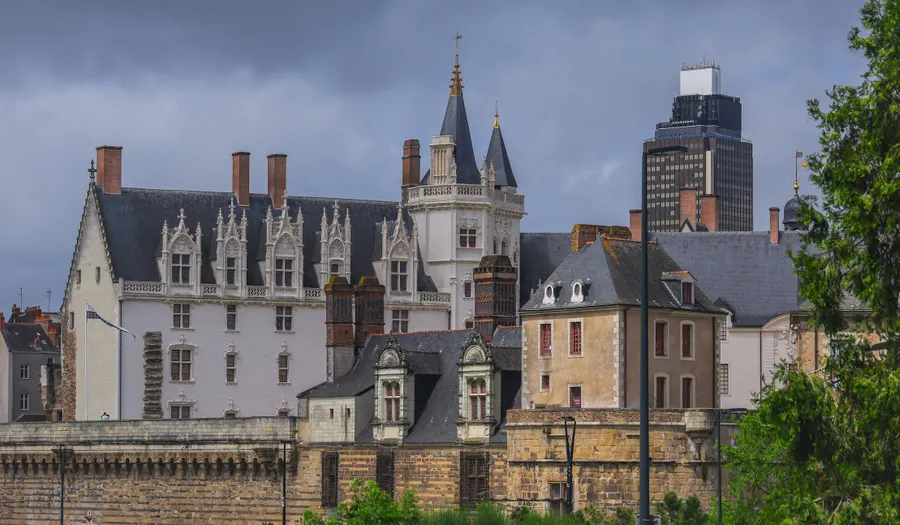
The white tufa fortress planted in the city centre is the last great Loire château before the ocean, with seven towers linked by 500 metres of wall walk. The ramparts, the moats and the inner courtyard are open free of charge all year round, something many visitors are unaware of as they queue at the ticket desk. The Nantes History Museum inside unfolds across 32 rooms and more than a thousand objects, including a frank section on the slave trade. Right next door, the Bouffay quarter packs in the medieval lanes, the half-timbered houses and most of the centre's café terraces. The Cathedral of Saint-Pierre-et-Saint-Paul, restored after the 2020 fire, closes the view.
Graslin, Place Royale and the Passage Pommeraye

The 18th-century Nantes of the shipowners can be read in the Graslin district: the colonnaded theatre, the brasserie La Cigale with its 1895 ceramic décor, and Cours Cambronne lined with buildings adorned with carved masks. Place Royale and its fountain link the ensemble to the shopping centre. Between the two, the Passage Pommeraye, opened in 1843, connects three street levels via a monumental staircase beneath a glass roof, lined with allegorical statues: it is one of the few covered arcades in France to play with the slope in this way, and Jacques Demy shot scenes of Lola here. The whole area can be explored for free in an hour. The shops are expensive, but the architecture costs nothing.
The Voyage à Nantes green line
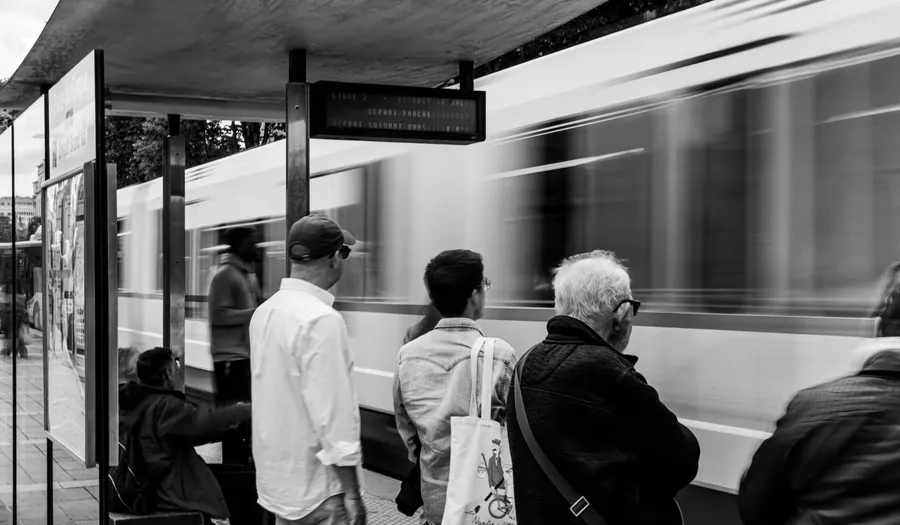
A green line painted on the pavement links some sixty artworks and sites over about 12 kilometres, from the château to the quays by way of the Jardin des Plantes and the island. It is the city's smartest idea: no map to unfold, you just follow the line on the ground and stumble upon an installation. The route is permanent, but every summer, between early July and late August, it is expanded with new pieces commissioned from artists. Some works are permanent, such as Buren's Rings or Le Nid at the top of the Tour Bretagne, while others disappear in September. Allow a full day for the whole thing, or half a day for the city-centre section.
The Jardin des Plantes and the Lieu Unique
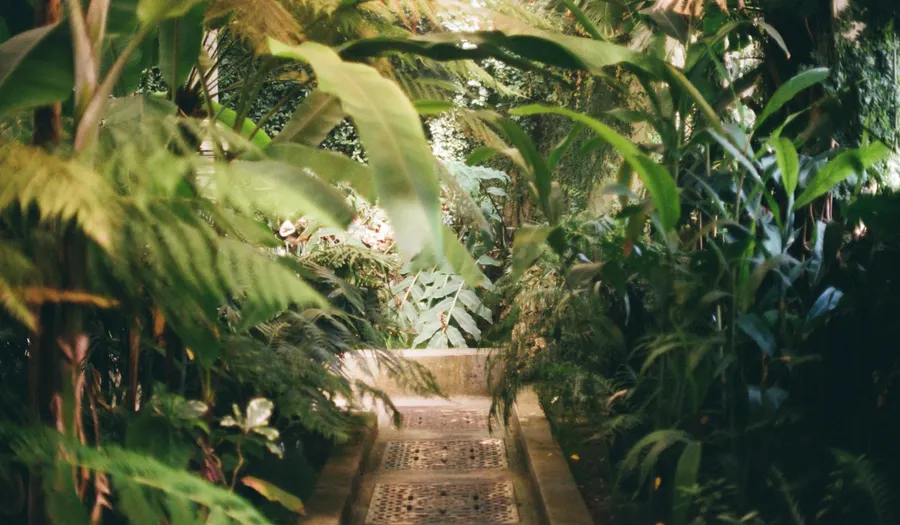
The Jardin des Plantes, seven hectares opposite the station, is one of France's four national botanical gardens, with two-hundred-year-old magnolias, a camellia valley among the richest in Europe and tropical glasshouses. Since 2013, Claude Ponti's sculptures have added a giant chick, a sulking bench and perched houses, stormed by children. Ten minutes' walk away, the former LU biscuit factory, saved from demolition, has housed a national performing arts venue since 2000, set in an industrial interior deliberately left raw. Its tower with a golden dome serves as a landmark from the quays. The Lieu Unique bar stays open late and draws as many locals as audience members.
The Loire quays and Trentemoult
.jpg/960px-Trentemoult_(Rez%C3%A9).jpg)
Since 2007, the Quai des Antilles, where ships from the Caribbean once docked, has carried eighteen 3.50-metre steel rings lined up over 400 metres, by Daniel Buren and Patrick Bouchain, which light up red, green and blue at night. The neighbouring Hangar à Bananes, a former refrigerated warehouse, is packed with bars and restaurants and gets very lively at weekends. Opposite, on the south bank, Trentemoult has kept its narrow lanes and its houses painted yellow, pink and blue, a custom inherited from leftover paint brought back from the ships. Eight minutes on the river shuttle is all it takes to pass from one world to the other. A few riverside terraces make up most of what is on offer, and that is precisely the appeal of the place.
How many days, and which itinerary?
3 days
🗺️ Day-by-day itinerary · 📓 Free printable Nantes guide (PDF) · 🌍 All of France
The essentials (2 days)
Day 1: the Château des Ducs and its free ramparts, the Bouffay, the Passage Pommeraye and Graslin, an evening at the Lieu Unique. Day 2: the Machines de l'Île with a booked slot in the morning, the Quai des Antilles and Buren's rings at dusk. Doable on a TGV return trip, as long as you have secured your elephant slot before setting off.
Nantes in full (3 days)
The same core, plus the Musée d'Arts and the Jardin des Plantes, and a late afternoon in Trentemoult by river shuttle. Add the Memorial to the Abolition of Slavery, beneath the Quai de la Fosse, and the trip up to Le Nid at the top of the Tour Bretagne. This is the length of stay at which the city starts to be understood rather than consumed.
Nantes and the estuary (5 days)
Three days in the city, then the Estuaire trail, some thirty monumental artworks set along the 60 kilometres between Nantes and Saint-Nazaire, including the Maison dans la Loire at Couëron. Finish with a day in the Muscadet vineyards or a trip to Clisson and its Italianate architecture. Train and boat are enough for most of the stages.
Getting there and getting around
Paris-Montparnasse to Nantes in 2h05 by TGV, between €30 and 100 depending on how far ahead you book; the station is ten minutes' walk from the château and opens straight onto the Jardin des Plantes.
Three tram lines, a busway and river shuttles run by TAN: 1-hour ticket at €1.80, 10 journeys for €16.30, 24-hour pass at €5.70. The tram serves the station, the centre and the Île de Nantes.
The Navibus Loire links the Gare Maritime to Trentemoult in eight minutes, roughly every twelve minutes on weekdays, for the price of a bus ticket and free at weekends.
The Pass Nantes costs €30 for 24 hours and €40 for 48 hours, including public transport and entry to the Galerie des Machines or the Carrousel: it pays for itself with two museums and one Machines activity on the same day.
Where to stay in Nantes?
City centre, around the Bouffay and Graslin: the most practical, everything on foot, expect €90 to 160 a night in high season, with terrace noise until 1am at weekends around the Bouffay.
Station area and Malakoff: chain-hotel prices between €65 and 100, a direct tram to the centre in five minutes, a functional area with nothing much going on in the evening.
Île de Nantes: recent hotels and apartments facing the Machines, between €80 and 140, ideal with children but very quiet and somewhat lifeless in the evening.
Trentemoult and the south bank: a few B&Bs and rentals at around €70, a unique setting facing the Loire, as long as you accept that the last evening shuttle leaves early out of season.
Our places to stay, stop by stop, at three budgets →
What to eat in Nantes?
Nantes beurre blanc, an emulsion of butter, shallots and Muscadet, traditionally accompanies Loire pike or zander: it is the city's signature dish, at around €22 to 30.
The historic brasserie on Place Graslin, listed for its 1895 ceramic décor, serves seafood platters and needs booking several days ahead for dinner.
On the sweet side, gâteau nantais, a moist almond cake glazed with rum inherited from the colonial trade, and the LU petit-beurre biscuit sum up the city's industrial history between them.
Talensac market, open Tuesday to Sunday mornings, is the best place for oysters from the Bourgneuf basin and produce from the vineyards; the Muscadet bars of the Bouffay complete the picture at around €4 a glass.
Entry requirements
Schengen area: an ID card or passport for EU citizens, 90 days visa-free for UK, US, Canadian and Australian passports.
Rules change: check your own government's travel advice before you go.
Frequently asked questions about Nantes
Do you need to book the Machines de l'Île?
For the Grand Éléphant, yes, no question: rides run on named time slots that sell out several days ahead at weekends and during French school holidays. Book through the site's online ticket office; for the Galerie des Machines and the Carrousel, buying on site on the day is often still possible but not guaranteed in July and August.
Are the Machines closed on Mondays?
Outside the high season, yes: the site operates from Tuesday to Sunday and closes on Mondays. In July and August it is open every day. It also closes completely from 2 November to the end of February for maintenance, and elephant rides are cancelled in strong winds or above 36°C, without the day being automatically refunded.
How many days should you spend in Nantes?
Two days cover the château, the old centre and the Machines. Three days let you add the Musée d'Arts, the Jardin des Plantes and Trentemoult without rushing. Beyond that, you head out of the city towards the estuary, the vineyards or Clisson.
Do you have to pay to visit the château?
Only in part. The courtyard, the moats and the 500 metres of wall walk are free and open every day, often into the evening; only the history museum inside charges admission, around €9 and free for under-18s. It closes on Mondays except in July and August.
When does Le Voyage à Nantes take place?
The summer edition runs every year from early July to late August and adds temporary works to the green line route. Outside that period, the green line stays painted on the ground and a good number of the installations, including Buren's Rings and Le Nid, remain in place all year round.
Similar destinations
 Region
🇫🇷 The Loire Valley
 City
City🇫🇷 Bordeaux and Around
 Country
🇪🇸 Spain
 City
City🇪🇸 Barcelona
 Region
🇮🇹 The Amalfi Coast
 City
City🇮🇪 Cork
 City
City🇬🇧 Belfast
 City
City🇧🇪 Brussels
 Region
🇮🇹 Puglia
 Region