
Best time to travel in Seceda?
→ The detailed month-by-month page, with 2015-2024 averages
Best time: June to October
Best avoided if possible: December to April (less pleasant weather or big crowds).
Temperatures and rainfall modelled for Seceda · averages over recent years, Open-Meteo data (ERA5 reanalysis).
High alpine: crystal-clear mornings, clouds building almost every day after 1pm in summer, and the first frosts from mid-September. The best time to visit Seceda is June, July, August, September and October, with temperatures reaching 13-19°C (summer at 2,500 m). Conversely, January, February, March, April, May, November and December are generally less favourable (less pleasant weather or heavy crowds, depending on the destination), although a trip is still possible with some planning. In high season, book early: prices and crowds climb fast.
Go against the flow. To avoid the crowds without sacrificing too much on the weather, aim for May and November: the crowds thin out, prices drop too, and the climate stays pleasant.
Do these months appeal to you? See what's best elsewhere too: where to go in June · where to go in July · where to go in August · where to go in September · where to go in October.
At a glance
Why go to Seceda?
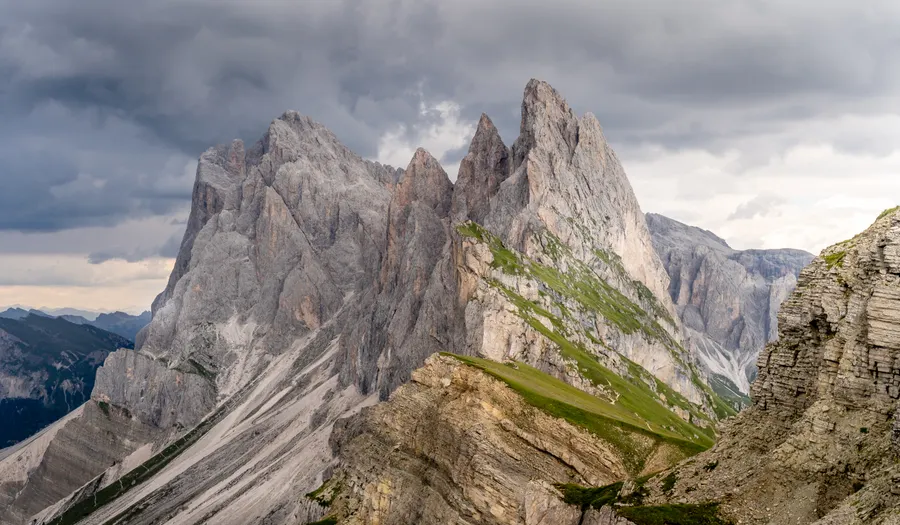
The shape is unique. Seceda's south side rises in a gentle slope, carpeted with short grass and bilberry bushes, like a vast tilted plane you stroll up at leisure. Then it stops. On the other side, the rock drops vertically for several hundred metres towards Val di Funes, and the ridge traces a jagged blade that extends the Odle group. This abrupt asymmetry, between one side you can walk in trainers and another where nobody sets foot, is what makes the place so photogenic.
The way in says a lot about the place: there is no road. No vehicle goes up to Seceda. You take a gondola from Ortisei to Furnes, then a cable car from Furnes to the top station at 2,493 m, and step out straight onto the ridge, five minutes from the panorama. It is expensive, it is quick, and it draws a very mixed crowd: well-equipped hikers, families out for a stroll and plenty of people who have come for a photo and a coffee.
The plateau stretching out behind the ridge is the real surprise. Between 2,000 and 2,400 m, the Puez-Odle Nature Park unrolls rolling pastures dotted with small, friendly huts: Baita Sofie, Fermeda, Troier, Mastlé, Firenze. Twenty minutes' walk in any direction is enough to leave the cable car queue behind and find yourself alone with cows, a wooden bench and the Odle as a backdrop. Most visitors ignore it and leave after an hour.
Tourist map of Seceda: what's where?
The map below pinpoints the 6 places covered in this guide: a handy way to picture the distances between each stop and plan your route in Seceda.
- Seceda
- Ortisei
- Furnes
- Baita Sofie
- Pieralongia
- Col Raiser
How much does a trip to Seceda cost in 2026? Budget calculator
Estimate your budget for Seceda based on your travel style: accommodation, meals, activities and local transport included (flights excluded). Adjust the length and the number of travellers, and the totals update.
Totals for all travellers over the chosen length; the daily amount is per person. Flights extra, indicative amounts to adjust depending on the season.
Cards are accepted at the lift ticket offices and in most huts, but Fermeda and the small baite on the plateau are sometimes cash only.
Safety in Seceda: should you be worried?
Nothing technical here, but two classic traps. The first is the summit cornice: the turf runs out over the drop with no visible transition, and several serious accidents have happened because of photos taken too close to the edge. Stay on the marked path. The second is the weather: clouds build almost every day after 1 pm in summer and can wipe out the view in ten minutes, with dry storms and violent wind on the ridge. Pack a windproof jacket whatever the temperature in the valley, and keep an eye on the time of the last cable car, often 6 pm, or you will face 1,250 metres of descent on foot.
Things to see and do in Seceda
Our first-hand favourites, and the great classics:
- Seceda's tilted ridge
- Ortisei-Furnes-Seceda cable car
- Baita Sofie
- Rifugio Fermeda
- The Pieralongia rocks
- Rifugio Firenze and the Puez-Odle park
- Descent to Col Raiser
- Walking up via Furnes
What to book before you go to Seceda →
🧭 Discover the Seceda itinerary, day by dayMap, timings, budget and where to stay: free to access, to fit your dates. Create my tailor-made itinerary →The summit ridge
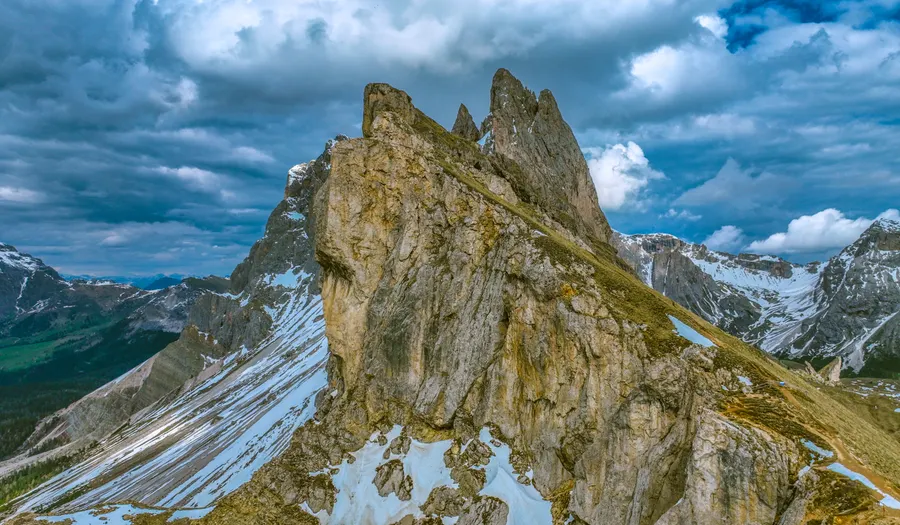
Five minutes is all it takes to get from the station at 2,493 m to the viewpoint, which explains the crowds. The ridge runs north-west, grassy on one side and sheer on the other, with the Fermeda pinnacles and the Odle group standing out one after another. You can follow it for about a kilometre on the ridge path, gaining a slightly different frame with every step. Keep away from the edge: the cornice is grassy and the drop hides beneath a lip of turf. In the late afternoon, the long shadows sculpt the crests far better than at midday.
The two lifts from Ortisei
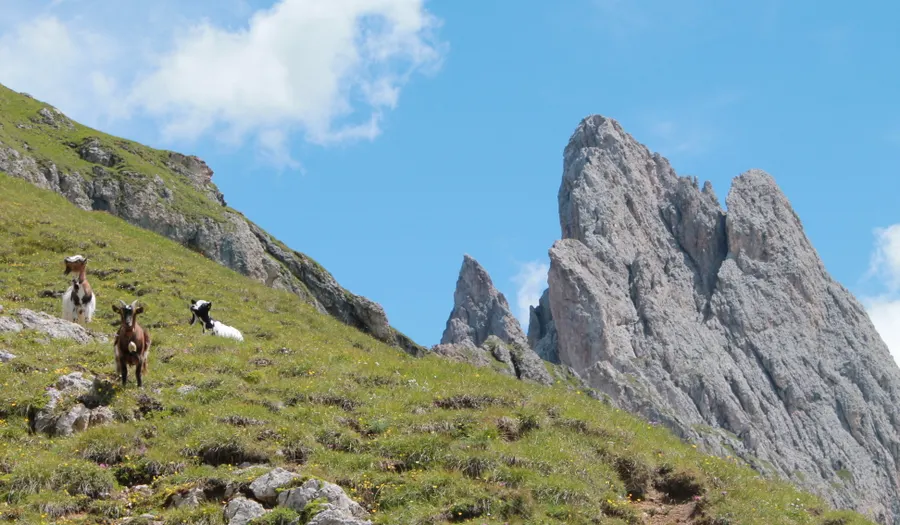
Access comes in two stages: a gondola from Ortisei, at 1,236 m, up to Furnes at 1,730 m, then a cable car from Furnes to Seceda. In 2026 an adult return costs €74, a single €49, the junior fare for ages 8 to 15 is €37, and children under 8 travel free. The summer season runs from 22 May to 2 November 2026, with services from 8.30 am to 6 pm. An important change: since summer 2026 online booking is required, in 30-minute slots with limited numbers, and the ticket offices in the valley only sell unsold places. Book the day before for an early slot.
Baita Sofie
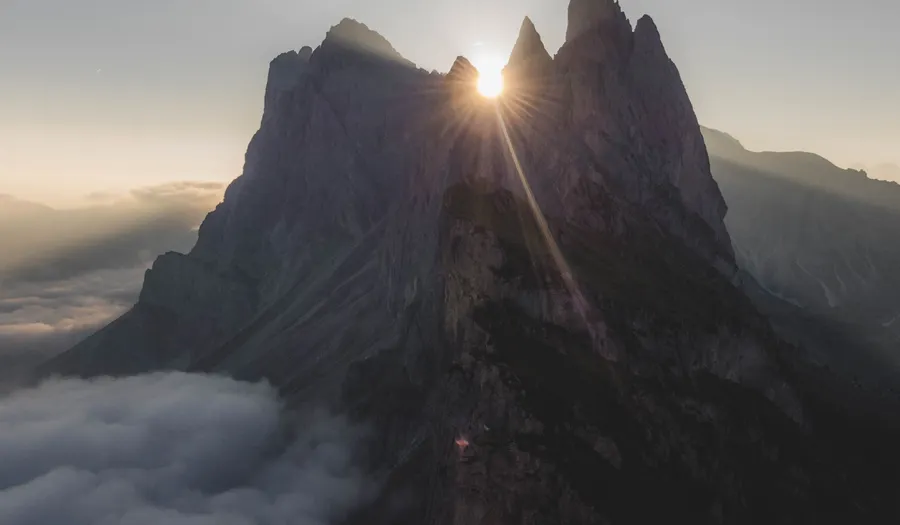
The hut closest to the summit, at 2,412 m, barely ten minutes below the station. Its wooden terrace faces due south towards the Sassolungo and the Sella group, making it an excellent spot to let the 11 am wave of visitors pass. The menu revolves around Ladin classics: canederli, pearl barley, spinach spätzle, and a bilberry tart worth the detour in August. You can stay the night in a very small number of rooms, which gives you the ridge at sunrise without relying on the first cable car.
The Pieralongia rocks
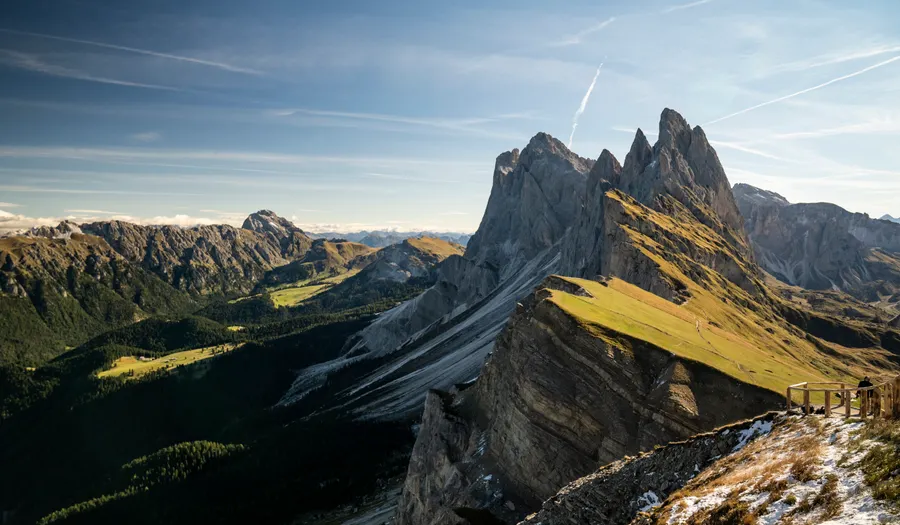
An hour's easy walk from the station, these two isolated rock towers rise from the middle of the pasture at 2,285 m, as if simply set down there. After the ridge itself, this is the plateau's most distinctive scene, and it is far less crowded. The path leading there is wide, gently sloping and fine with children. From the rocks, the view plunges over Val Gardena on one side and climbs towards the Puez walls on the other. Carry on for twenty minutes and you reach Baita Troier and its Mastlé pasture.
Rifugio Firenze

Also known as the Regensburger Hütte, this hut at 2,040 m marks the gateway to the heart of the Puez-Odle Nature Park. It is lower, more rustic and much less touristy than what lies near the ridge, with around thirty beds and unpretentious mountain cooking. It is the starting point for the big routes towards the Sass Rigais and the Fermeda pass, and a possible stage on the Alta Via 2. It takes an hour and a half to walk down from Seceda, and forty minutes to climb back up to Col Raiser and ride the gondola down.
The descent to Col Raiser
The smartest route if you want to avoid retracing your steps. From the ridge, cross the plateau eastwards via Pieralongia and Mastlé, then join the Col Raiser gondola at 2,106 m, which runs down to Santa Cristina. Allow 5 to 6 km and two hours of walking, almost all downhill and with no difficulty. You then need a single ticket for the ride up and a separate ticket at Col Raiser, or a Val Gardena pass if you are staying several days. From Santa Cristina, the local bus or the cycle path takes you back to Ortisei in fifteen minutes.
How many days, and which itinerary in Seceda?
Half a day is enough for the ridge and a hut, a full day allows the traverse to Col Raiser, and two days with a night up high add the sunrise.
🗺️ Day-by-day Seceda itinerary · 📓 Printable Seceda travel guide (PDF) · 🌍 Discover all of the Dolomites
The half day (one morning)
First cable car at 8.30 am, an hour on the ridge while the light is still low, an early lunch at Baita Sofie and back down around 12.30 pm before the main rush. The afternoon is free for Ortisei or Val Gardena.
The Seceda-Col Raiser traverse (1 day)
Ride up on a single ticket, take in the ridge, then cross the plateau via Pieralongia, Mastlé and Baita Troier, with a detour down to Rifugio Firenze. A gentle climb back to Col Raiser and the gondola down to Santa Cristina. Five to six hours of walking, mostly downhill.
A night up high (2 days)
Go up in the late afternoon, spend the night at Baita Sofie or Rifugio Firenze, watch the sunrise on a deserted ridge, then enjoy a long day's hiking in the Puez-Odle park before heading down. The only format that gives you Seceda in peace.
How to get to Seceda and get around?
No road goes up to Seceda: motor access ends at Ortisei, at 1,236 m, and from there you must continue by lift or on foot.
Ortisei-Furnes gondola then Furnes-Seceda cable car: €74 adult return in 2026, €49 single, €37 junior fare, running from 22 May to 2 November, 8.30 am to 6 pm.
Online booking compulsory since summer 2026, in 30-minute slots: the Ortisei ticket offices only sell the remaining places.
Paid car parks at the foot of the lifts in Ortisei, around €12-18 a day. From Innsbruck allow 1h45 by road, from Venice 3 hours.
Where to stay in Seceda?
Baita Sofie, at 2,412 m and ten minutes from the ridge: only a few rooms, around €90-120 half board, the only address that gives you sunrise without a lift.
Rifugio Firenze (Regensburger), 2,040 m in the heart of the Puez-Odle park: €55-70 half board, with the feel of a true hikers' hut.
Hotels and garni in Ortisei, at the foot of the lifts: €110-190 a night in summer, with the mobility card included at many places.
Santa Cristina and Selva, quieter and often 20% cheaper than Ortisei: €90-150, useful if you plan the descent via Col Raiser.
Our picks stop by stop, in three price ranges →
What to eat in Seceda?
Spinach spätzle with melted butter, served in every hut on the plateau for around €12-14, the safe bet after two hours' walking.
Turtres, Ladin fritters filled with spinach or sauerkraut, a Val Gardena speciality rarely found elsewhere, €5-7.
Wild bilberry tart in August and September, made with berries picked on the plateau's slopes, around €6 a slice.
Bring water: the huts charge €3 to €4 for a small bottle and the plateau has no marked drinking water point.
Which kind of traveller is it for?
Seceda lends itself to a nature-focused, romantic and active trip. Whether you go as a couple, with friends or even with family, everyone can find their own pace there. As for accommodation, it is mostly classic hotels, boutique hotels and lodges.
Entry requirements & practical info
Schengen area: an ID card or passport for EU citizens, 90 days visa-free for UK, US, Canadian and Australian passports.
Rules change: before you leave, check your country's official travel advice.
Frequently asked questions about Seceda
Can you drive up to Seceda?
No, no road leads there. You have to take the gondola from Ortisei to Furnes and then the cable car to Seceda, or walk up from Ortisei, allowing about 1,250 metres of ascent and four hours.
How much does the cable car cost in 2026?
€74 for an adult return, €49 single, €37 for ages 8-15 and free under 8. Since summer 2026, online booking in 30-minute slots has been compulsory.
What is the best time of day for the ridge?
The first departure at 8.30 am, or after 4 pm. Clouds build almost daily after 1 pm in summer and the crowds peak between 11 am and 3 pm.
What is there to do up there, apart from the photo?
Cross the plateau to the Pieralongia rocks and Baita Troier, walk down to Rifugio Firenze, or carry on to Col Raiser to descend via Santa Cristina. Twenty minutes' walk is enough to find peace and quiet.
Until when do the lifts run?
From 22 May to 2 November 2026 for the summer season, from 8.30 am to 6 pm. Outside these dates, only access on foot remains possible, and snow makes the ridge impassable without equipment.
Similar destinations
 Region
🇫🇷 The French Alps
 Countries
🇸🇮 Slovenia
 City
🇮🇹 Tre Cime di Lavaredo
 City
🇫🇷 Annecy
 Region
🇸🇮 Lake Bled
 Region
🇭🇷 Plitvice Lakes
 Region
🇫🇷 The Verdon Gorge
 Region
🇫🇷 Savoie and Mont Blanc
 Countries
🇫🇷 France
 Region