When to go to the Dolomites?
→ The detailed month-by-month page, with real weather records
Best time: June to September (hiking) and December to March (skiing)
At a glance
Why go to the Dolomites?
The Dolomites look like no other mountains. Their pale dolomite walls shoot straight up above lush green pastures and blaze pink at sunset, a phenomenon the locals call enrosadira. UNESCO listed the whole range in 2009, and one sunrise over the Tre Cime is enough to understand why.
It is a hiking paradise for every level. The lifts run all summer, hoisting walkers up to balcony trails, high-altitude lakes and a network of mountain huts where the food is remarkably good. The Tre Cime loop, the circuit of the Sassolungo, the ridges of the Seceda: the legendary routes follow one another without ever feeling alike.
The region also has a way of life all its own, straddling Italy and the Tyrol. In Val Gardena or Val Badia, people speak Ladin, you sleep in spotless chalets and dine on spätzle, strudel and South Tyrolean wines. In winter, the Dolomiti Superski area and its 1,200 km of pistes take over, with Cortina as its Olympic showcase.
Map of the Dolomites: what is where?
The map shows the 6 places covered in this guide, to picture the distances and plan your route.
- Tre Cime di Lavaredo
- Lake Braies
- Ortisei (Val Gardena)
- Alpe di Siusi
- Cortina d'Ampezzo
- Passo Giau
How much does a trip to the Dolomites cost?
The Italian mountains cost a little more than the national average, especially in August and during the ski holidays. Lifts and half board weigh on the budget, but the mountain huts are excellent value.
| Style | Per day | What it covers |
|---|---|---|
| Backpacker | €70-100/day | Campsite or mountain hut, picnics, hikes without lifts, valley buses |
| Comfort | €130-190/day | B&B or three-star hotel, hire car, daily lifts, restaurant dinners |
| Premium | €280+/day | Spa hotel on half board, hiking guide, guided via ferrata, Michelin-starred tables in Alta Badia |
Cards are accepted everywhere, including most mountain huts, but keep €50 in cash for alpine pastures and small car parks.
Is the Dolomites safe?
The Dolomites are a very safe destination; the only real risk is in the mountains. Check the forecast every morning, set off early to avoid the afternoon storms that are frequent in summer, and match the route to your level: the trails are excellent but the terrain is still alpine. Good shoes, water and a warm layer are enough for the classic hikes; vie ferrate require specific gear and, for beginners, a guide. The European emergency number 112 works everywhere.
What to see and do in the Dolomites
- Tre Cime di Lavaredo
- Lake Braies
- Alpe di Siusi
- Seceda
- Cortina d'Ampezzo
- Val Gardena
- Lake Sorapis
- Passo Giau
Tre Cime di Lavaredo 2 549 m

The three limestone towers are the ultimate emblem of the Dolomites. The classic loop from the Auronzo hut covers about 10 km with 400 m of ascent, within reach of any regular walker. The view from the Locatelli hut, facing the north faces, is one of the most famous in the Alps. The toll road restricts access in high season, so go up early. Allow 4 hours of walking including the many photo stops.
Lake Braies
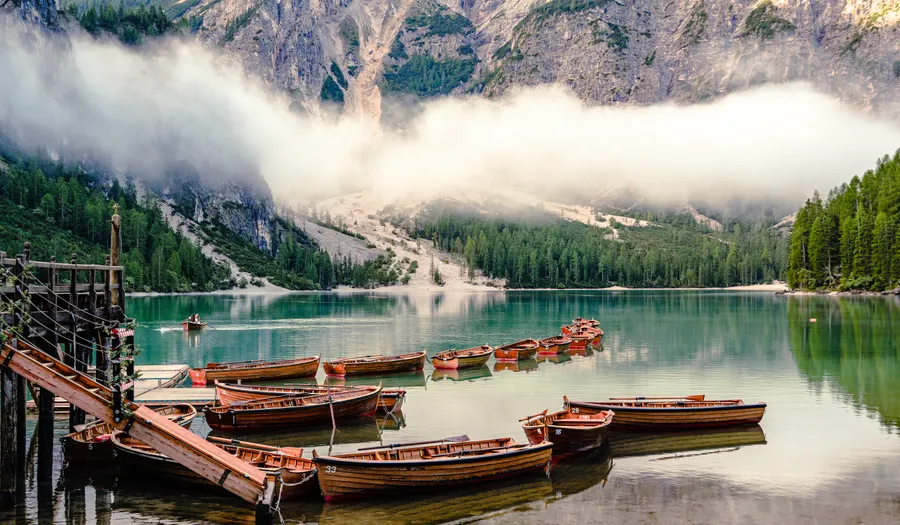
Lago di Braies lines up emerald water, wooden rowing boats and the walls of the Croda del Becco in a picture-postcard setting. The walk around the lake takes an hour and a half on an easy path. The site is a victim of its own success: in summer, car access is regulated and you must book a time slot. Come at sunrise to find the calm and the perfect reflections. Hiring a rowing boat is a very photogenic classic.
Alpe di Siusi

Europe's largest high-altitude alpine meadow rolls out its undulating pastures facing the Sassolungo and the Sciliar. You reach it by cable car from Ortisei or Siusi, as the road is closed to cars during the day. Easy paths wind between chalets and wooden barns, perfect for families. In winter, the plateau becomes a gentle ski area with toboggan runs. Its sunsets are among the finest in the Dolomites.
Seceda

The cable car from Ortisei drops visitors at 2,500 m, on the edge of the most spectacular tilted ridges in the range. The needles of the Odle tear at the horizon in a panorama that has become iconic on social media. From there, trails lead down to the pastures of Val di Funes and the church of San Giovanni in Ranui. It is the quintessential panoramic hike, for moderate effort. Go up early, as clouds often cap the ridges by early afternoon.
Cortina d'Ampezzo

The queen of the Dolomites, host of the 2026 Winter Olympics, blends elegant boutiques with direct access to the finest sights in the east of the range. It is the ideal base for the Tre Cime, Lake Sorapis, the Cinque Torri and the Passo Giau. The pedestrian Corso Italia is packed with cafés and terraces facing the mountains. The Tofane and Faloria lifts run in summer and winter alike. The atmosphere is more fashionable and prices higher than elsewhere.
Val Gardena

This Ladin valley lines up three perfect villages, Ortisei, Santa Cristina and Selva, at the foot of the Sassolungo and the Sella. It is the best base for exploring: Seceda and Alpe di Siusi on one side, the Sella Ronda passes on the other. The valley has lived from woodcarving for centuries. Its choice of spa hotels is exceptional, from family-run three-stars to designer five-stars. In winter, it sits at the heart of the Sella Ronda ski circuit.
How many days, and which itinerary?
Allow 5 to 7 days for a first trip between Val Gardena and Cortina, a full week if you want to hike to your heart's content.
🗺️ Day-by-day itinerary · 📓 Free printable Dolomites guide (PDF) · 🌍 All of Italy
Best of from two bases (5 days)
Two bases: Val Gardena (Seceda, Alpe di Siusi, Passo Gardena) then Cortina (Tre Cime, Lake Braies, Sorapis). The most efficient itinerary for a first visit, with 2 to 4 hours of walking a day.
Grand traverse (8 days)
Val di Funes, Val Gardena, Passo Pordoi and Lake Fedaia beneath the Marmolada, Val Badia, Braies and a finale in Cortina. The full circuit of the range by car, with a headline hike every day and a night in a mountain hut.
Alta Via 1 hut-to-hut trek (6-10 days)
The legendary trek links Lake Braies to Belluno from hut to hut, via the Cinque Torri and the Lagazuoi. Stages of 4 to 6 hours; booking the huts from January for the summer is essential.
Getting there and getting around
Fly into Venice (2h15 by road from Cortina) or Verona, then hire a car: it is the most flexible option, allow €40-60/day.
Once there, the car is king for linking passes and valleys, but some sites (Braies, Tre Cime, Alpe di Siusi) are regulated in summer: book parking or a shuttle.
SAD buses and Cortina Express serve the valleys well in season, with handy multi-journey passes from Bolzano or Cortina.
Summer lifts are a genuine means of transport: day tickets or multi-valley passes save money beyond two rides.
Where to stay in the Dolomites?
High-altitude huts on half board: €60-90/person, unforgettable atmosphere, booking from January essential for July-August.
Garni hotels and valley B&Bs in Ortisei or San Cassiano: €90-150 a room with hearty breakfasts.
Four-star spa hotels in Val Gardena or Alta Badia: €200-400 on half board, often excellent value for what you get.
Well-equipped campsites around Cortina and Dobbiaco: €30-45 a pitch, the budget option in the range.
Our places to stay, stop by stop, at three budgets →
What to eat in the Dolomites?
Canederli (bread dumplings with speck) and spinach spätzle, Tyrolean classics served in every mountain hut.
Speck Alto Adige PGI and alpine cheeses, perfect for a hiking snack bought from a producer.
Apple strudel and kaiserschmarrn, the desserts that reward a day's walking.
South Tyrolean white wines (Gewürztraminer, Sylvaner) and local beers, to taste in the cellars of Bolzano or in the hütten.
Entry requirements
Schengen area: an ID card or passport for EU citizens, 90 days visa-free for UK, US, Canadian and Australian passports.
Rules change: check your own government's travel advice before you go.
Cities and regions to discover
 City
City🇮🇹 Tre Cime di Lavaredo
 City
City🇮🇹 Seceda
 City
City🇮🇹 Lago di Braies
 City
City🇮🇹 Alpe di Siusi (Seiser Alm)
Frequently asked questions about the Dolomites
When is the best time to visit the Dolomites?
From mid-June to late September for hiking, with peak crowds in August. September offers superb light and quiet trails. For skiing, December to March in the Dolomiti Superski area.
What daily budget should I plan?
Around €70-100 camping and staying in huts, €130-190 in a comfortable hotel with a car and lifts, and over €280 for spa hotels and guided activities.
How do you get around?
A hire car from Venice or Verona is the most practical solution. In summer, several sites require a parking or shuttle booking (Braies, Tre Cime, Alpe di Siusi), so sort it out the day before.
How many days should I allow?
Five days for the main sights from two bases, seven to eight days to circle the range or string together the great hikes without rushing.
Are the Dolomites good for families?
Yes, they are one of the best places in Europe for it: lifts, flat high-altitude trails such as Alpe di Siusi or the Braies lake loop, and mountain huts that welcome children.
Similar destinations
 Region
🇫🇷 The French Alps
 City
City🇫🇷 Annecy
 Region
🇸🇮 Lake Bled
 Region
🇭🇷 Plitvice Lakes
 Region
🇫🇷 The Verdon Gorge
 Region
🇫🇷 Savoie and Mont Blanc
 Region
🇫🇷 Corsica
 Region
🇫🇷 The French Basque Country
 Region
🇪🇸 The Canary Islands
 City
City