When to go to Lyon?
→ The detailed month-by-month page, with real weather records
Best time: April to June, September to October and December
At a glance
Why go to Lyon?
Lyon is first and foremost a city of layered history, UNESCO-listed over 500 hectares. You move from the Roman theatres of Fourvière, where Lugdunum was capital of the Gauls, to the Renaissance courtyards of Vieux Lyon, the largest ensemble in that style outside Italy, then to the silk workers' buildings on the Croix-Rousse. The traboules, secret passageways that cut through the buildings, turn every walk into a treasure hunt.
It is also the world capital of gastronomy, a title the city defends at every meal. The bouchons serve pike quenelles, tablier de sapeur and cervelle de canut in an inimitable counter-side atmosphere, while Les Halles Paul Bocuse line up the best artisans: the city has one of the highest densities of restaurants in France. People come to Lyon to eat too, if not above all.
Lastly, Lyon lives intensely without the crushing scale of a megacity. You can cross the Presqu'île on foot in 30 minutes, the redeveloped banks of the Rhône invite cycling and barge bars, and the Parc de la Tête d'Or offers 105 hectares of breathing space. In early December, the Fête des Lumières turns façades into monumental shows over four nights, one of the finest urban events in Europe.
Map of Lyon: what is where?
The map shows the 6 places covered in this guide, to picture the distances and plan your route.
- Saint-Jean Cathedral, Vieux Lyon
- Fourvière Basilica
- Cour des Voraces, Croix-Rousse
- Les Halles de Lyon Paul Bocuse
- Place Bellecour
- Musée des Confluences
How much does a trip to Lyon cost?
Lyon offers some of the best value for money among France's big cities: you sleep and eat remarkably well for less than in Paris.
| Style | Per day | What it covers |
|---|---|---|
| Backpacker | €65-90/day | hostel or simple hotel, tarte à la praline and lunch menus, TCL and walking |
| Comfort | €110-180/day | 3-star hotel on the Presqu'île, a bouchon a day, museums and the funicular |
| Premium | €280+/day | 5-star hotel or a suite with a view, Michelin-starred tables (the region has dozens), private tours |
Cards are accepted everywhere; the Lyon City Card (from €29/day) includes museums, TCL transport and a cruise, and quickly pays for itself.
Is Lyon safe?
Lyon is a safe city where the tourist districts can be explored with ease by day and by night. As anywhere, watch your belongings on the metro, on Rue de la République and during the Fête des Lumières, when the crowds are very dense. The Perrache area and some streets in La Guillotière are less pleasant late at night without being genuinely problematic. The cobbled slopes and staircases of the Croix-Rousse call for good shoes, especially in the rain.
What to see and do in Lyon
- Vieux Lyon
- Fourvière Basilica
- Croix-Rousse traboules
- Les Halles Paul Bocuse
- Presqu'île
- Parc de la Tête d'Or
- Musée des Confluences
- Mur des Canuts
Vieux Lyon

At the foot of Fourvière, the Saint-Jean, Saint-Paul and Saint-Georges districts form the largest Renaissance ensemble in France. The ochre and pink façades hide galleried inner courtyards, towers and dozens of traboules, including the famous long traboule linking Rue du Bœuf to Rue Saint-Jean. Saint-Jean cathedral and its 14th-century astronomical clock anchor the district. Early in the morning, before the shops open, the light on the cobbles is superb.
Fourvière Basilica

Perched on the hill that prays, the white 19th-century basilica watches over Lyon with its four towers and an interior covered in gilded mosaics. From the esplanade, the view stretches from the Presqu'île to the Alps, with Mont Blanc on very clear days. You go up by funicular, known as la ficelle, or on foot through the Jardin du Rosaire. Close by, the Roman theatres still host the Nuits de Fourvière festival in summer.
Croix-Rousse traboules

The hill that works keeps alive the memory of the canuts, the 19th-century silk workers. Their high-ceilinged buildings are pierced by traboules that tumble down the slope, including the spectacular Cour des Voraces and its monumental six-storey staircase. The descent from the Croix-Rousse to the Terreaux, from passage to passage, is the finest urban walk in Lyon. The Maison des Canuts tells the story of the silk trade, with loom demonstrations.
Les Halles de Lyon Paul Bocuse
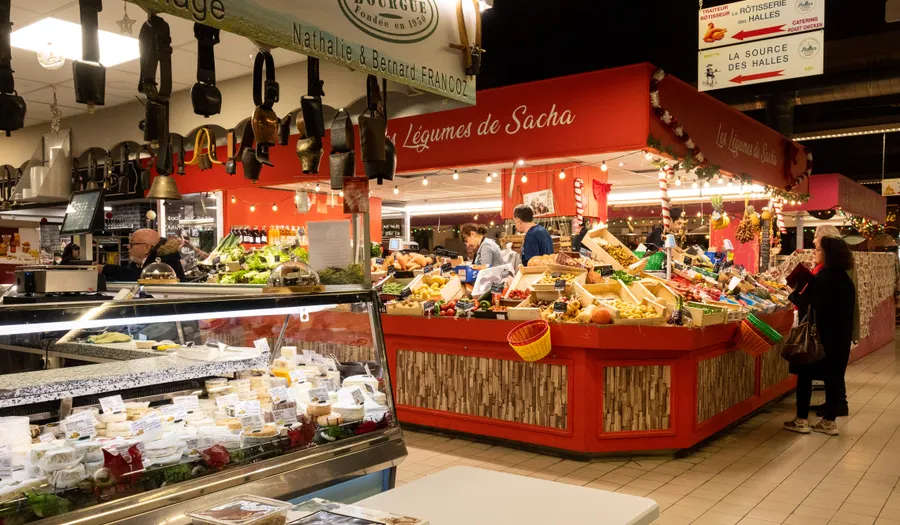
The city's temple of food gathers some fifty exceptional artisans: cheeses from La Mère Richard, quenelles from Giraudet, Sève chocolates, oysters and charcuterie. You lunch at the counter among the stalls, in a party atmosphere that never lets up at weekends. The region's chefs come to stock up at dawn. Allow €25 to 40 for a memorable lunch, and book on Saturdays.
Presqu'île

Between the Rhône and the Saône, this is the beating heart of Lyon: Place Bellecour and its equestrian statue of Louis XIV, Place des Terreaux with the town hall and the Bartholdi fountain, and the Musée des Beaux-Arts in a former abbey. Rue de la République is the shopping street, while the nearby slopes have the bars and designers. In the evening, the banks and barges of the Rhône take over until late.
Musée des Confluences

At the southern tip of the Presqu'île, where the Rhône meets the Saône, this deconstructed vessel of glass and steel houses a fascinating museum of science and civilisations. Dinosaur skeletons, ethnographic collections and ambitious temporary exhibitions unfold in a spectacular setting. The roof offers a unique view of the confluence. Tram T1 runs straight there from Perrache.
How many days, and which itinerary?
Allow 3 days to grasp the essentials of Lyon, 4 if you want to add Confluences and wander without watching the clock.
🗺️ Day-by-day itinerary · 📓 Free printable Lyon guide (PDF) · 🌍 All of France
Essential Lyon (2 days)
Day 1: Vieux Lyon and its traboules in the morning, the funicular up to Fourvière and the Roman theatres in the afternoon, dinner in a bouchon. Day 2: Les Halles Paul Bocuse, the Presqu'île from Bellecour to the Terreaux, then up to the Croix-Rousse via the slopes.
Gourmet and cultural Lyon (4 days)
To the two essential days, add a museum day between Confluences and the Beaux-Arts, then a morning at the Parc de la Tête d'Or followed by the Croix-Rousse market and a cooking class or a tasting at Les Halles.
Lyon and its surroundings (6 days)
Round it off with a trip to the Beaujolais and its golden-stone villages, a day in Pérouges, a medieval town 35 minutes away, and an escape to the Condrieu or Côte-Rôtie vineyards to the south.
Getting there and getting around
TGV from Paris Gare de Lyon: 2h direct to Part-Dieu or Perrache, €25 to 80 depending on how early you book.
TCL metro, funiculars and trams: a dense network, €2 a ticket, and the Fourvière funicular is included in the day pass (€6.20).
Vélo'v: 4,000 shared bikes, perfect for the banks of the Rhône, around €4 a day.
On foot: the Presqu'île, Vieux Lyon and the slopes can all be explored on foot; bring good shoes for the climbs.
Where to stay in Lyon?
Presqu'île between Bellecour and Terreaux: the ideal location, hotels from €110 to 220 a night.
Vieux Lyon: Renaissance charm and cobbled lanes, boutique hotels from €130 to 250.
Croix-Rousse slopes: village feel and designers, apartments and hotels from €90 to 150.
Good value: the Guillotière district, central and lively, doubles under €100.
Our places to stay, stop by stop, at three budgets →
What to eat in Lyon?
Lyon bouchons: quenelle in Nantua sauce, tablier de sapeur and a pot of Côtes-du-Rhône, menus from €25 to 35 (look for the Bouchons Lyonnais label).
Les Halles Paul Bocuse: a platter of oysters, La Mère Richard cheese and praline, lunch at the counter from €25 to 40.
Tarte à la praline: the pink icon of Lyon's bakeries, around €3 to 4 a slice.
Barges and banks of the Rhône: waterside aperitifs, sharing boards and glasses of Viognier from €5 to 8.
Entry requirements
Schengen area: an ID card or passport for EU citizens, 90 days visa-free for UK, US, Canadian and Australian passports.
Rules change: check your own government's travel advice before you go.
Frequently asked questions about Lyon
When is the best time to visit Lyon?
April to June and September to October for mild weather, or early December for the Fête des Lumières, four nights of monumental shows (book accommodation very early).
What daily budget should I plan for in Lyon?
Allow €65 to 90 a day on a budget and €110 to 180 for a comfortable stay with a hotel on the Presqu'île and a bouchon meal every day.
How do I get around Lyon?
Almost everything can be done on foot, supplemented by the metro, the two funiculars up to Fourvière and Vélo'v bikes along the riverbanks. The €6.20 TCL day pass covers it all.
How many days do you need to visit Lyon?
Three days let you cover Vieux Lyon, Fourvière, the Croix-Rousse and the Presqu'île while leaving time for two proper Lyonnais meals a day.
How do you visit the traboules?
The main ones are open to the public during the day: push the doors marked with a plaque, keep quiet in the private courtyards and close the door behind you. A guided tour (around €15) reveals the most hidden ones.
Similar destinations
 Region
🇫🇷 Normandy
 Region
🇫🇷 Alsace
 Region
🇫🇷 The Loire Valley
 City
City🇫🇷 Paris
 City
City🇪🇸 Seville
 Country
🇮🇹 Italy
 City
City🇮🇹 Rome
 Region
🇮🇹 Florence and Tuscany
 Region
🇮🇹 The Amalfi Coast
 Region