When to go to Nara?
→ The detailed month-by-month page, with real weather records
Best time: Late March to April and October to November
At a glance
Why go to Nara?
Nara was the capital of Japan from 710 to 784, before Kyoto, and it was here that state Buddhism took on its monumental form. The Great Buddha of Todai-ji, 15 metres of bronze cast in the 8th century, sits in what remains one of the largest timber structures in the world, even rebuilt in 1709 at two-thirds of its original size. Eight sites in the city form a UNESCO-listed ensemble, and Horyu-ji, ten kilometres away, holds the oldest standing wooden buildings on the planet.
Nara's second singularity is its deer. Around a thousand sika deer roam free in the park and into the adjoining streets, protected since the 8th century as messengers of the Kasuga deities. They bow to beg for the crackers sold by street vendors, which amuses everyone for about three minutes. They are wild animals: they bite, headbutt and kick, and reported injuries run into the hundreds every year.
Finally, Nara is explored on foot. Todai-ji, Kasuga-taisha, Kofuku-ji, the gardens and the Naramachi district all fit within a two-kilometre radius of the park, with no serious slopes. From Kyoto or Osaka it is 35 to 45 minutes by train, which explains why almost all visitors come for the day. Yet staying the night has a real benefit: the park at dawn, empty, with the deer and the mist, is nothing like the park at 14:00.
Map of Nara: what is where?
The map shows the 6 places covered in this guide, to picture the distances and plan your route.
- Todai-ji
- Nara Park
- Kasuga-taisha
- Kofuku-ji
- Naramachi
- Horyu-ji
How much does a trip to Nara cost?
Nara is one of the cheapest cities in Kansai: temple entry fees hover around €3 to €5 and the park is free. Most visitors spend only the train fare and two tickets, which makes it a very good-value day trip.
| Style | Per day | What it covers |
|---|---|---|
| Backpacker | €40-70/day | Day trip from Kyoto, free park and Nigatsu-do, Todai-ji, kakinoha-zushi lunch |
| Comfort | €100-150/day | Hotel night in Nara, Todai-ji, Kasuga-taisha, Isuien garden, dinner in a Naramachi izakaya |
| Premium | €250+/day | Ryokan with kaiseki dinner, private guide at Horyu-ji, tea ceremony in a historic garden |
Cards are accepted in hotels, the main temples and big chains, but the deer-cracker sellers, small temples and Naramachi stalls still deal in cash. The cash machines in 7-Eleven convenience stores accept foreign cards.
Is Nara safe?
Nara is an extremely safe city, including at night and for solo travellers. The only real danger comes from the deer, and it should not be taken lightly: the city records several hundred injuries every year, bites, headbutts and shoves, especially among children who hold on to the crackers for too long. The males are particularly aggressive from September to November during the rut, which is also when their antlers are cut at a public ceremony. Finally, summer is gruelling: the Nara basin is enclosed and muggy, with peaks of 35°C and humidity that makes long walks in the park a struggle between 12:00 and 16:00.
What to see and do in Nara
- Todai-ji and the Great Buddha
- Nara Park and its deer
- Kasuga-taisha and its lanterns
- Naramachi district
- Kofuku-ji and the Ashura statue
- Isuien Garden
- Nigatsu-do
- Horyu-ji
Todai-ji
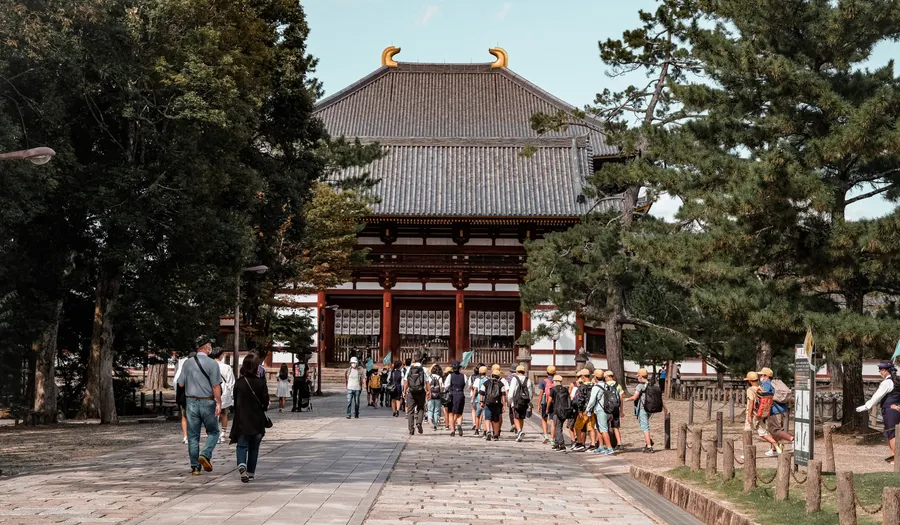
The Great Eastern Temple houses a bronze Daibutsu 15 metres tall and weighing 250 tonnes, completed in 752 at the cost of a large share of the country's copper reserves. The Daibutsuden that shelters it has burned down twice, and its current version, from 1709, is only two-thirds of the original width. You enter through the Nandaimon gate and its two 8-metre Nio guardians, carved in 1203. Entry costs around €5 and you should allow an hour. The complex extends well beyond, up to Nigatsu-do on the hillside.
Nara Park
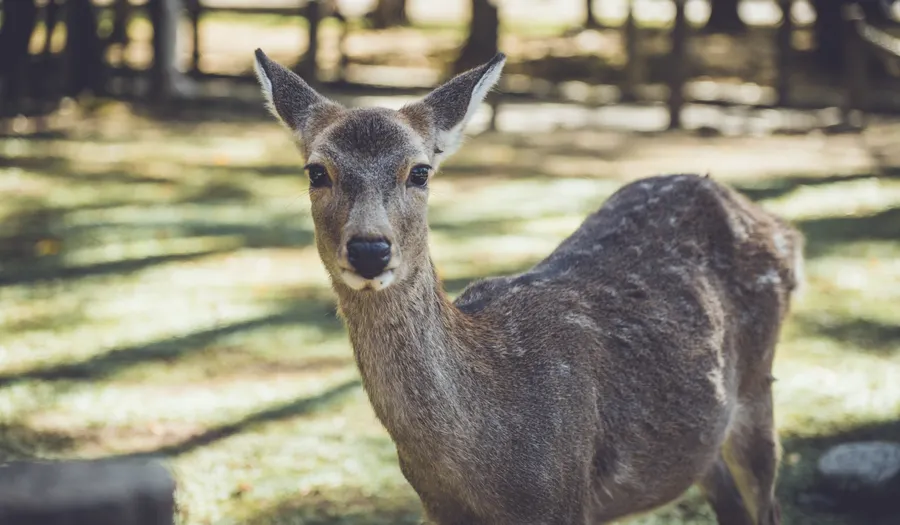
Five hundred hectares of lawns, ponds and groves link the great shrines, with around a thousand sika deer roaming free. Senbei crackers, sold at ¥200 a packet, are the only food allowed. The park is open at all times with no ticket, so you can enter at dawn while it is still deserted. Sarusawa Pond, to the south, reflects the silhouette of Kofuku-ji. It is the natural thread running through all the city's sights.
Kasuga-taisha
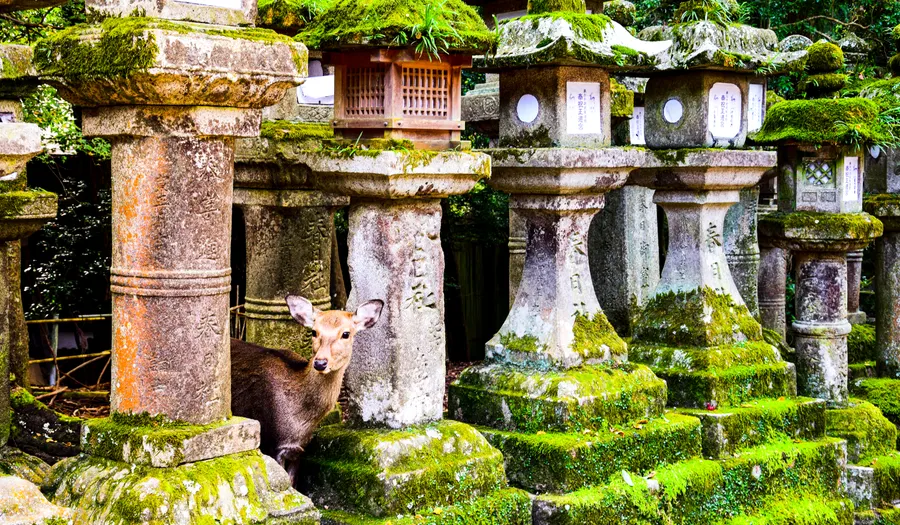
The tutelary shrine of the Fujiwara clan, founded in 768, hides at the end of a forest path lined with two thousand mossy stone lanterns. Its vermilion buildings are rebuilt identically every twenty years in keeping with Shinto tradition. A thousand more bronze lanterns hang from the inner galleries. The surrounding Kasugayama forest has not been cut since 841 and is part of the UNESCO listing. The inner precinct costs about €3.50; the outer paths are free.
Naramachi

South of the park, the old merchant quarter has kept its machiya, narrow, deep townhouses of dark wood. Here you will find cafés, craft workshops, small sake breweries and Koshi no Ie, a restored machiya you can visit for free to understand the interior layout. The red fabric balls hanging from the façades are migawari-zaru, scapegoat monkeys meant to take on misfortune in place of the residents. It is the calm counterpoint to the great temples, ideal in the late afternoon.
Kofuku-ji
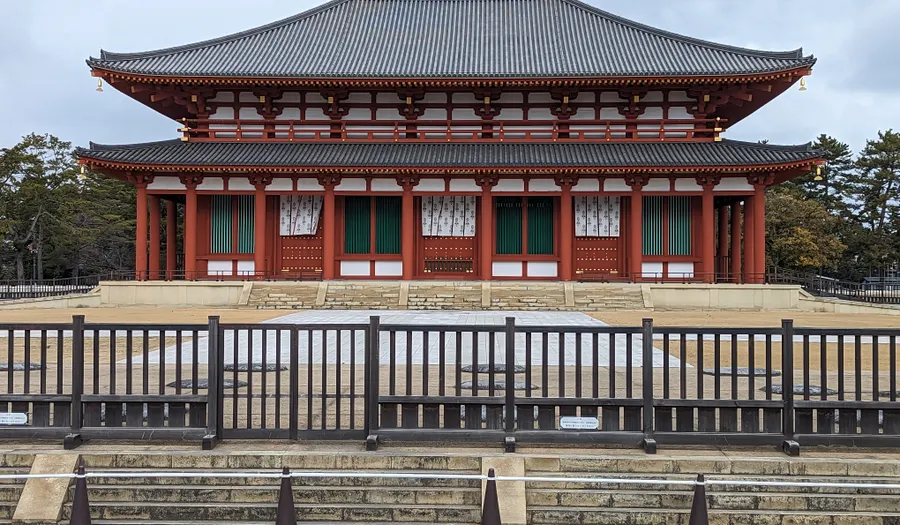
The Fujiwara temple, moved here in 710, stands on a rise between Kintetsu station and the park. Its 50-metre five-storey pagoda, the second tallest in Japan, is under major restoration and wrapped in sheeting until the early 2030s. The interest has therefore shifted to the National Treasure Museum, which holds the three-faced, six-armed Ashura, an 8th-century dry-lacquer statue and one of the most famous in the country. The gilded Central Golden Hall, rebuilt in 2018, can also be visited. Allow an hour.
Horyu-ji

Ten kilometres west of Nara, this monastery founded in 607 by Prince Shotoku preserves the oldest wooden buildings still standing in the world, dating from the early 8th century. Its pagoda, golden hall and cloister form an ensemble of striking sobriety, worlds away from the exuberance of Kyoto. The site was the first Japanese property inscribed by UNESCO, in 1993. Entry costs about €10 and the round trip from Nara takes half a day. Visitor numbers here are infinitely lower than in the city.
How many days, and which itinerary?
A full day from Kyoto or Osaka covers the park, Todai-ji, Kasuga-taisha and Naramachi. Two days with a night in town add Horyu-ji, the gardens and above all the park at dawn.
🗺️ Day-by-day itinerary · 📓 Free printable Nara guide (PDF) · 🌍 All of Japan
The classic day (1 day)
Train from Kyoto or Osaka, arriving around 9am. Kofuku-ji, across the park to Todai-ji, up to Nigatsu-do for the view, the lantern path to Kasuga-taisha, and back through Naramachi in the late afternoon. About 8 km of walking, entirely flat.
Nara in two days
The same core, but spread out, with a night in the city. The first day is devoted to the park and Todai-ji, dawn on the second day in the deserted park, then a trip to Horyu-ji in the morning and the Isuien and Yoshikien gardens in the afternoon. The format that finally gives the city its due.
Historic Kansai (4-5 days)
Based in Kyoto or Osaka, with Nara as the pivot: one night in Nara, a day at Horyu-ji and Asuka, and an extension to Mount Koya by train from Osaka. For those who want the Japan of its origins rather than its postcards.
Getting there and getting around
From Kyoto: Kintetsu limited express to Kintetsu Nara in 35 min (about €8), or the JR Miyakoji rapid train to JR Nara in 45 min, covered by the Japan Rail Pass.
From Osaka: Kintetsu from Namba in 40 min, or the JR Yamatoji line from Osaka station in 50 min. Allow €5 to €8.
Kintetsu Nara station is a 10-min walk from the park entrance, the JR station 20 min: choose Kintetsu if you do not have a JR pass.
In town, everything is done on foot within a 2 km radius; only Horyu-ji and Nishinokyo require a train or bus, 15 to 25 min.
Where to stay in Nara?
Chain hotel near Kintetsu or JR station: €70 to €110 for a double, decent and well placed for walking to the park.
Traditional ryokan in Naramachi, with baths and a Japanese breakfast: €150 to €280 for two, the most immersive option.
Renovated machiya rented whole in the lanes to the south: €100 to €180, practical for families or groups of friends.
Youth hostel or guesthouse: €25 to €45 per person, Nara remaining noticeably cheaper than Kyoto for equal comfort.
Our places to stay, stop by stop, at three budgets →
What to eat in Nara?
Kakinoha-zushi, mackerel or salmon sushi wrapped in a persimmon leaf, a local speciality born of preservation before refrigeration, €1.50 a piece.
Narazuke, vegetables steeped for months in sake lees, with a very pronounced flavour: taste before you buy.
Mochi pounded with a mallet at Nakatanidou, near Kintetsu station, where the pounding demonstration happens at the speed of a magic trick, about €1.50.
Miwa somen, very fine wheat noodles served cold in summer, made 20 km away for more than a thousand years.
Entry requirements
Visa-free for 90 days for EU, UK, US, Canadian and Australian passports.
Rules change: check your own government's travel advice before you go.
Frequently asked questions about Nara
Can Nara be visited in a day?
Yes, and that is what almost every traveller does. Allow 35 to 45 minutes by train from Kyoto and 40 to 50 from Osaka, with all the major sites on foot within a 2 km radius. A night in town mainly adds the park at dawn and Horyu-ji.
Are Nara's deer dangerous?
They are wild animals, not pets. Several hundred injuries are reported each year: bites, headbutts, kicks. Do not hold the crackers in your hand, do not tease them, and be especially wary of males in rut, from September to November.
Should you go from Kyoto or Osaka?
Both work. Kyoto is slightly quicker via the Kintetsu limited express (35 min). From Osaka Namba, allow 40 min. If you have a Japan Rail Pass, the JR lines remain free but drop you at the JR station, further from the park.
When is the best time to go?
Late March and April for the cherry blossom in the park, October and November for the maples and superb light. Avoid mid-July to early September: the Nara basin is stifling, with peaks of 35°C and high humidity.
Is Horyu-ji worth the detour?
If you are staying two days, yes. These are the oldest wooden buildings in the world, in total calm 10 km from the city. Allow half a day including the journey. With a single day in Nara, it is better to skip it.
Similar destinations
 City
City🇮🇩 Bali
 City
City🇯🇵 Kyoto
 City
City🇨🇳 Guilin and Yangshuo
 Country
🇫🇷 France
 City
City🇮🇪 Galway and Connemara
 City
City🇹🇭 Chiang Mai
 Country
🇨🇳 China
 City
City🇯🇵 Miyajima
 City
City🇫🇷 Annecy
 Region